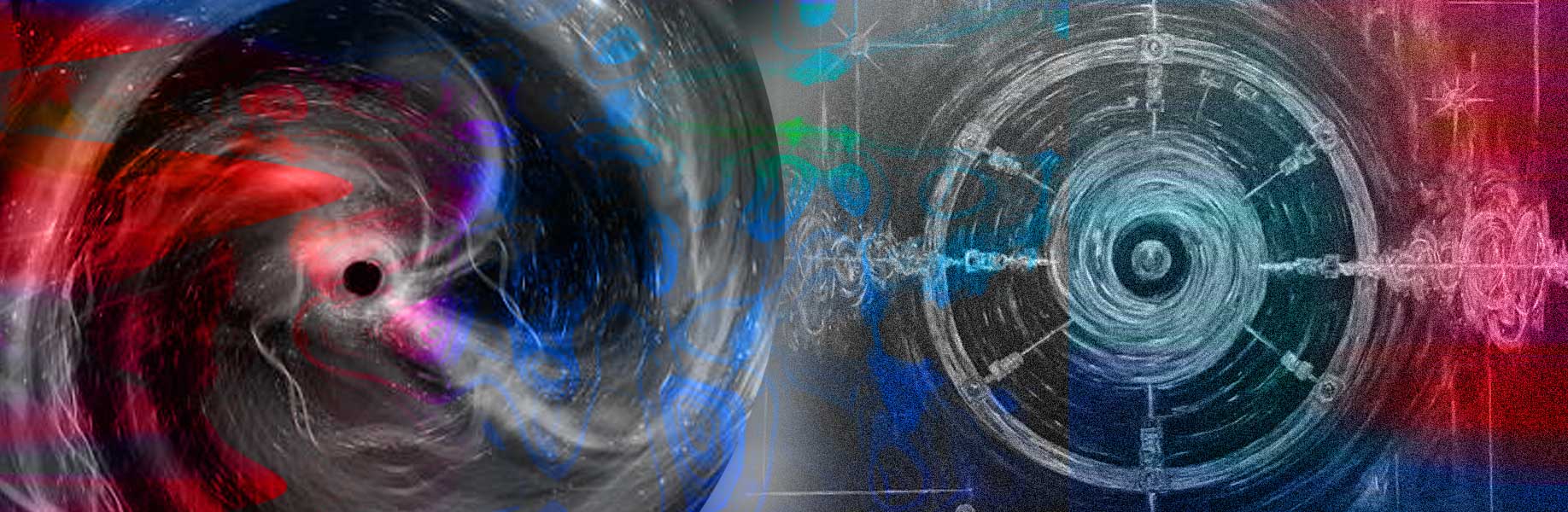

More than half a century after Sir Roger Penrose theorized that energy could be extracted from a spinning black hole, physicists have finally brought that idea to life inside a laboratory. In a landmark study published in Nature on July 08, 2026, researchers at the Advanced Science Research Center of the CUNY Graduate Center demonstrated wave amplification using a stationary radio frequency device that simulates rotation so extreme it would be mechanically impossible to achieve. Rather than spinning a physical object, the team engineered a system whose properties are modulated rapidly across both space and time, generating what they call synthetic ultrafast rotation. This carefully constructed illusion reaches effective rotational speeds far beyond what any conventional apparatus could endure, recreating the conditions of the ergosphere, the region near a black hole where spacetime itself is dragged along by the object's immense spin.
The experiment validates not only Penrose's 1969 proposal but also the related SZ effect from the 1970s, which predicted that waves interacting with a sufficiently fast-rotating body could gain energy and emerge amplified. The significance of the CUNY demonstration lies not merely in confirming decades-old theoretical physics, but in showing that the underlying mechanics can be replicated without any physical motion at all. By replacing mechanical rotation with time-varying material properties, the researchers bypassed the engineering barriers that have long prevented experimental tests of these extreme rotational phenomena.
According to the CUNY team, the breakthrough opens tangible pathways for new research in optics, wireless communications, and quantum information science. The ability to amplify electromagnetic waves through synthetic rotation could lead to entirely new classes of sensors and communication devices that exploit the same energy-extraction principles Penrose identified at the cosmic scale. What was once a thought experiment confined to the boundaries of general relativity has now become a reproducible benchtop phenomenon, a bridge between the cosmological and the practical that could reshape how engineers approach signal amplification and energy transfer at the smallest scales. The work also offers a new experimental platform for studying fundamental physics, including quantum gravity effects, in a controlled laboratory setting rather than relying solely on astronomical observation.