
Physicists have succeeded in describing how very small black holes can form using an exact mathematical formula. A black hole is a region in space where gravity is so strong that nothing can escape from it, not even light. While most known black holes are very large, theory allows for microscopic versions as well.
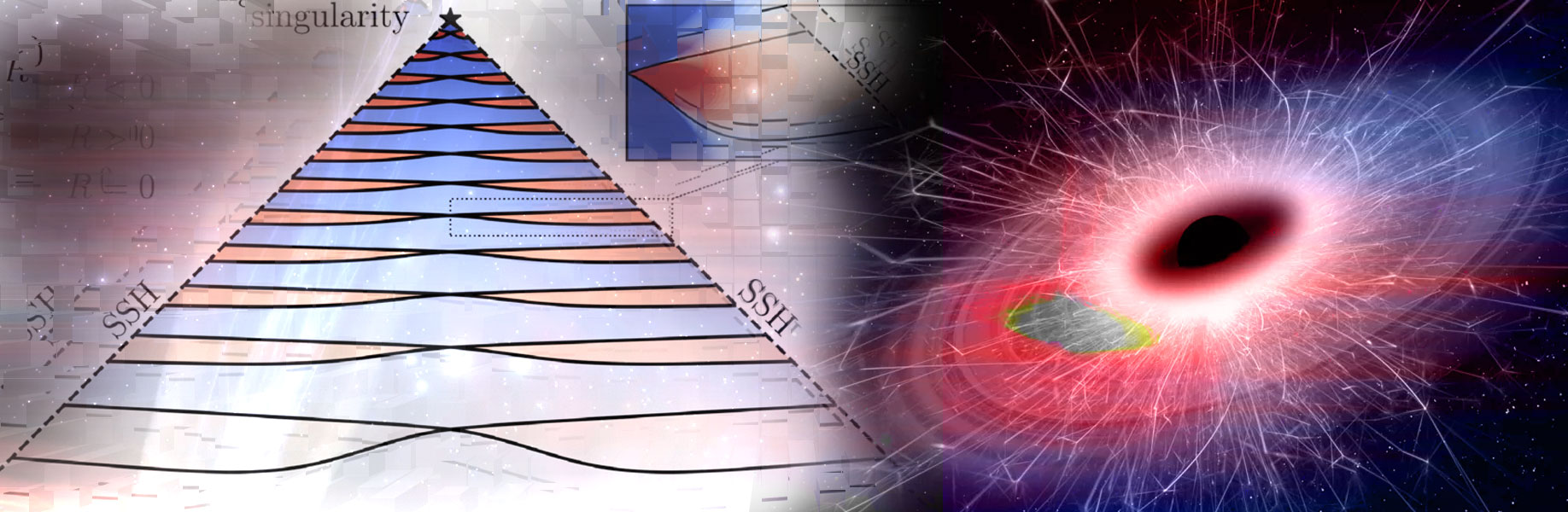
These tiny black holes can emerge from special critical states. In these states, spacetime organizes itself into a regular, repeating pattern. The process is called critical collapse.
The idea is similar to what happens when water freezes. At zero degrees Celsius, a small change can cause water molecules to arrange into an ice crystal. In the same way, spacetime curvature can organize into a kind of spacetime crystal under certain conditions. This crystal is an unstable intermediate state. With a tiny addition of energy, it can turn into a black hole instead of returning to normal spacetime.
A mathematical breakthrough after decades
Computer simulations had suggested since 1993 that black holes could form this way. However, finding an exact mathematical description proved very difficult. Researchers from Goethe University Frankfurt and TU Wien have now solved this by using an unusual approach. They wrote the equations as if the universe had many more dimensions, even infinitely many. In this limit, complex problems become much simpler. They then translated the solution back to our four-dimensional universe through careful approximations.
This method allows them to study black-hole formation analytically, meaning with mathematical formulas on paper rather than only through computer simulations. The new approach can be refined for higher accuracy as needed. It also provides a new way to investigate other black-hole-related phenomena that were previously hard to analyze exactly. Such microscopic black holes may have formed shortly after the Big Bang from the chaotic early universe, and are known as primordial black holes.
The researchers have described the methods and results of this study in a paper published in Physical Review Letters.