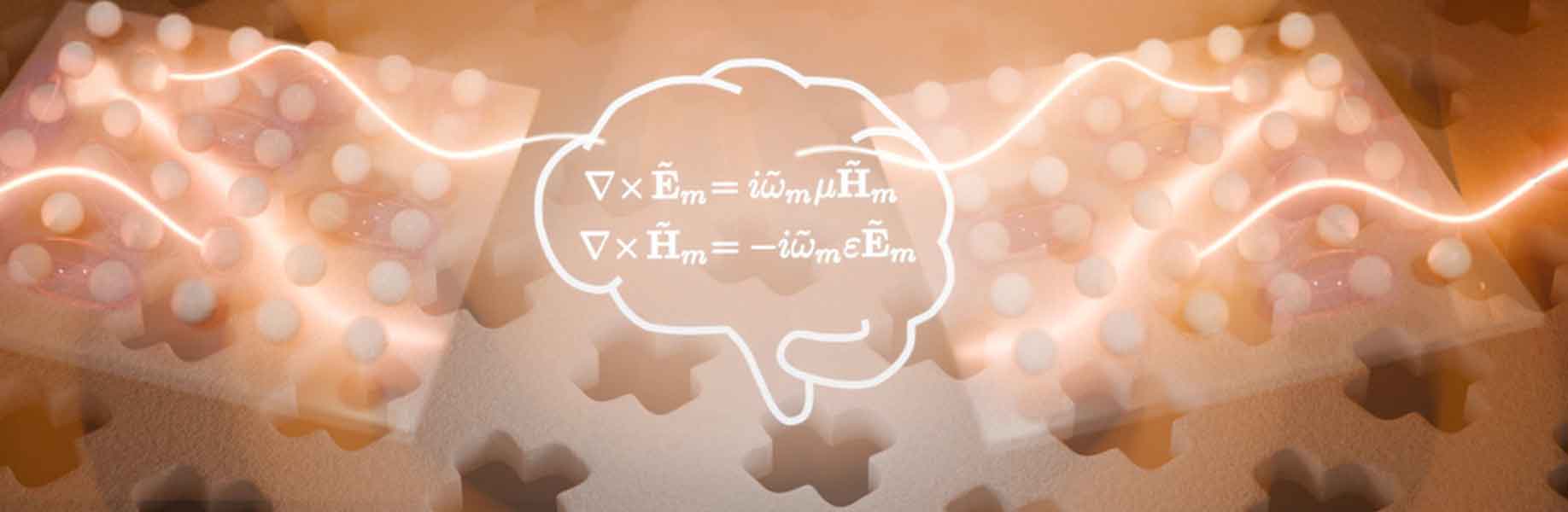

Researchers at Chalmers University of Technology have shown that incorporating knowledge of fundamental physics into machine learning can speed up the design of artificial materials for controlling light. These materials are studied in the field of nanophotonics, where light is manipulated at scales smaller than its wavelength. At these tiny sizes, light can be directed in ways not possible with ordinary materials. The researchers use computer simulations to create such artificial materials, which could lead to lighter and thinner lenses for cameras or eyeglasses. The same approach may also help develop components for quantum computers, where light could carry information between systems using photonic crystals that reflect light with very high efficiency.
The simulations depend on neural networks. Creating enough training data for these networks is time-consuming. Each data point can require between ten minutes and one hour of calculation, and tens of thousands of such points may be needed. In the past, preparing the data could take an entire month, and adding new requirements might demand another month of work.
Teaching physics to artificial intelligence
The researchers solved this by teaching the neural network the basic laws of physics and electromagnetism at the start. In earlier work, the network had to learn these laws by analyzing the data itself. Now it uses this built-in knowledge instead of figuring everything out from scratch. As a result, the network requires much less data to train well and produces more accurate results with fewer obvious mistakes. What previously took thirty days now takes only three days. Once trained, the network can determine the light-controlling properties of a material structure in about a millisecond.
This method was outlined in an article published in Laser & Photonics Reviews. The main benefit is faster development of designs for optical components. Although the current work is limited to simulations on supercomputers, it helps advance practical applications in light-based technologies. The researchers note that the physics involved is complex, and the network can draw conclusions that are hard for humans to see directly from the data alone.