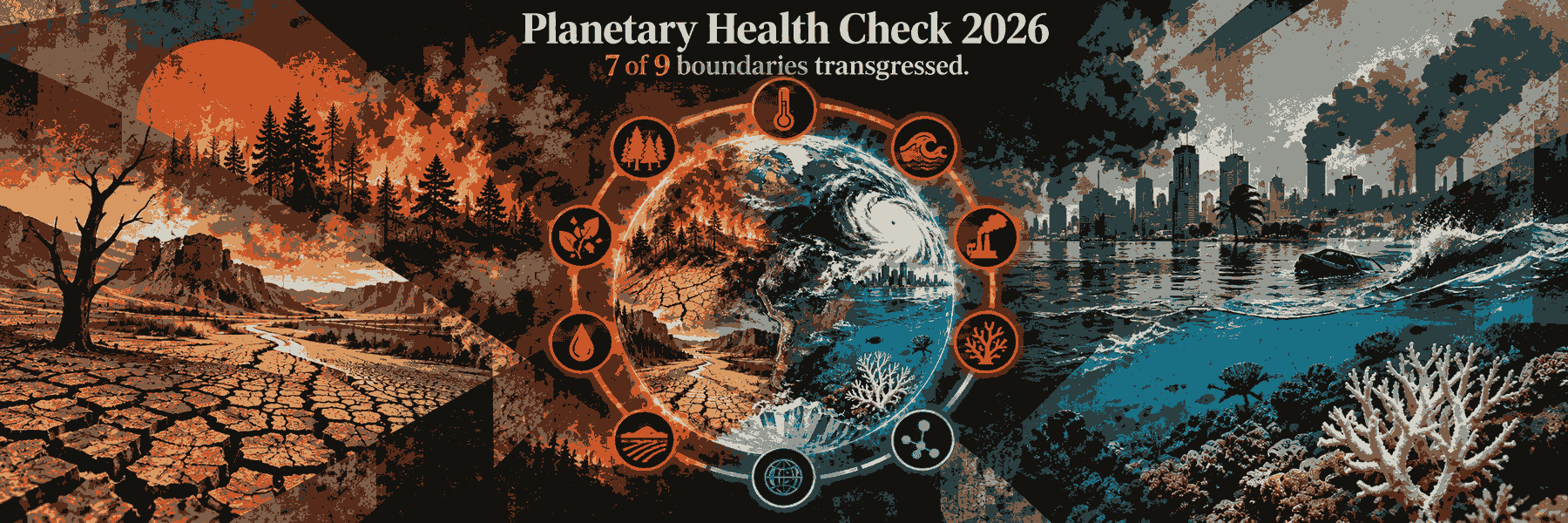

Earth’s environmental pressures are worsening across all seven already breached planetary boundaries, according to the Planetary Health Check 2026, released on September 21 by the Potsdam Institute for Climate Impact Research.
The assessment, produced by more than 60 scientists, does not announce a new seventh breach. Ocean acidification crossed its boundary in 2025; the update finds deeper transgression across all seven.
The framework examines interconnected ecological systems, rather than treating climate, water and biodiversity as separate problems. That distinction changes the question: an improvement in one indicator cannot stand in for the condition of the whole planet.
It also places recent disasters in the context of warming-driven extreme weather. Repeated heat, drought and fire can weaken vegetation and soils’ ability to absorb carbon, sometimes turning sinks into sources. Researchers question whether models overstate those sinks’ resilience.
Ozone depletion and atmospheric aerosol loading remain the two boundaries inside the global safe operating space. However, global aerosol improvement can conceal unsafe regional conditions.
Crossing a boundary signals rising risk, not a precise timetable for irreversible change. The report assesses the latest available observations, some collected before 2026.