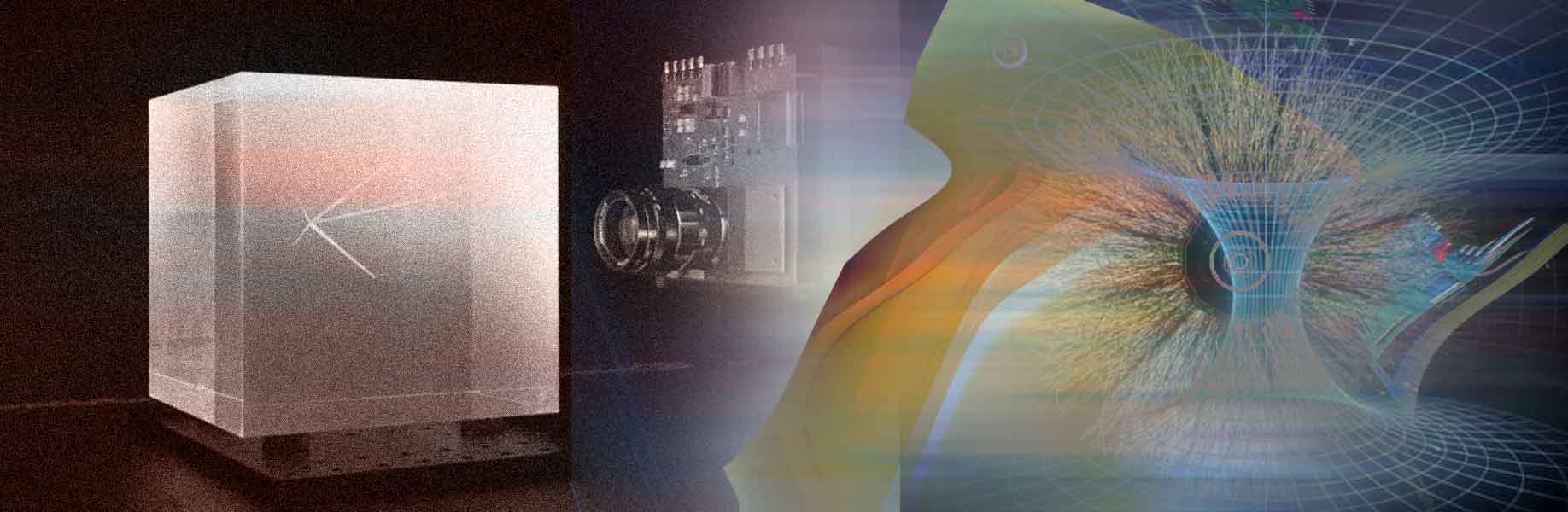

Particle physics has a hardware problem. For decades, the field's most sensitive detectors the kind that can track neutrino interactions or reconstruct the debris of proton collisions have relied on millions of individually wired components: tiny scintillator tiles, photomultiplier tubes, silicon pixels, and kilometers of cabling. Each component is a potential point of failure. Each requires calibration, alignment, and signal routing. Scaling these systems up for the next generation of experiments, from the Deep Underground Neutrino Experiment (DUNE) in the United States to future neutrino factories, has become an engineering challenge that threatens to outpace the physics. A collaboration between ETH Zurich and EPFL has now proposed a radical alternative: PLATON, a particle detector that replaces that vast complexity with a single block of light-producing material observed by an ultrafast plenoptic camera. [1]
The concept, detailed in a paper published in Nature Communications, works by coupling a micro-lens array (MLA) with a single-photon avalanche diode (SPAD) sensor array. When a charged particle passes through the detector's active medium—a monolithic scintillating block—it produces light at the point of interaction. The MLA captures that light from multiple angular perspectives simultaneously, and the SPAD array, which can resolve individual photons with picosecond timing precision, reconstructs the particle's three-dimensional trajectory in a single exposure. No wires. No discrete pixels. No multi-stage readout. [2]
The team has already built and characterized a laboratory demonstrator, testing its spatial resolution with controlled particle sources. The PLATON design is described as applicable well beyond accelerator-based neutrino studies. The authors note it could be adapted for medical imaging, nuclear non-proliferation monitoring, and dark matter detection where sub-millimeter 3D tracking in compact form factors is required.
What makes PLATON potentially transformative is not merely the simplification of hardware, but the implication for cost. Current tonne-scale detectors can cost hundreds of millions of dollars to build, with a significant fraction consumed by sensor fabrication and signal routing. If a plenoptic-SPAD system can deliver comparable spatial resolution from a single optical readout, the economics of large-scale experimental physics could shift fundamentally opening the door to detectors that are larger, cheaper, and far easier to maintain than anything currently deployed.