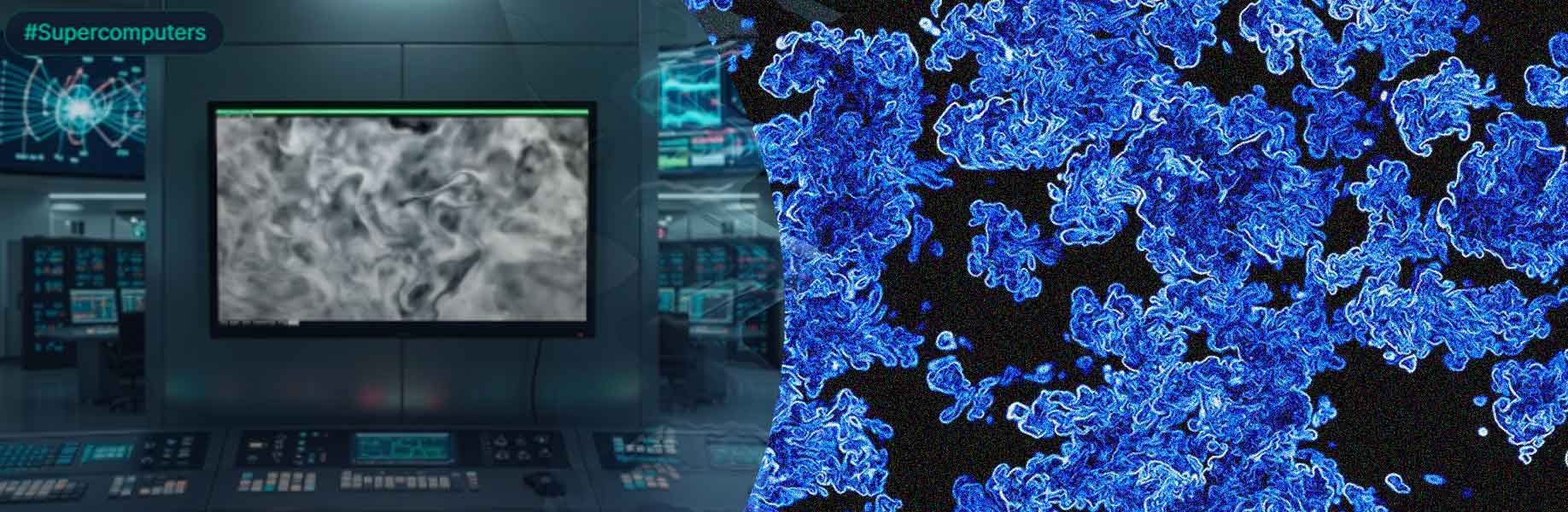

Scientists used the Frontier supercomputer, which can perform over a billion billion calculations per second, to create the largest ever direct numerical simulation of turbulence. Turbulence is to the chaotic and unpredictable movements in fluids like air or water. This simulation reached a record of 35 trillion grid points. The work focused on three-dimensional turbulence, providing fresh details about how these messy flows work in nature and machines, such as ocean currents, airplane wings, or engine combustion areas. Better knowledge of turbulence could help make more accurate weather predictions and build vehicles that use less fuel.
The simulation tackled a long-standing challenge in fluid dynamics, the study of how liquids and gases move. Turbulent flows involve wild changes over different sizes and times, and they vary with shapes, like rough rivers versus smooth pipes. Yet, turbulence often follows universal patterns, especially when the flow is very intense. The researchers achieved this by running the model at a high Reynolds number of 2,500 (a high Reynolds number means more chaos.
Achieving new levels of detail
With Frontier's power, the simulation matched real lab experiments in scale, making results reliable for testing old ideas about turbulence. It revealed how rare extreme bursts, which can cause big problems like severe storms or engine failures, fit into overall patterns. The study looked at the probability distributions for energy dissipation - how bulk motion turns into tiny swirls and heat - and enstrophy, a measure of twisting strength in the flow. It confirmed key rules, like the dissipative anomaly, where average energy loss stays steady despite less stickiness in intense flows, but also showed needed tweaks for spotty small-scale effects.
To handle the huge task, the scientists used a method called multiresolution independent simulation, mixing short high-detail runs with longer basic ones. This saved time while capturing fine points. The data is now shared online for others to use, promising advances in modeling across fields where fluids matter.
This research is published in the Journal of Fluid Dynamics