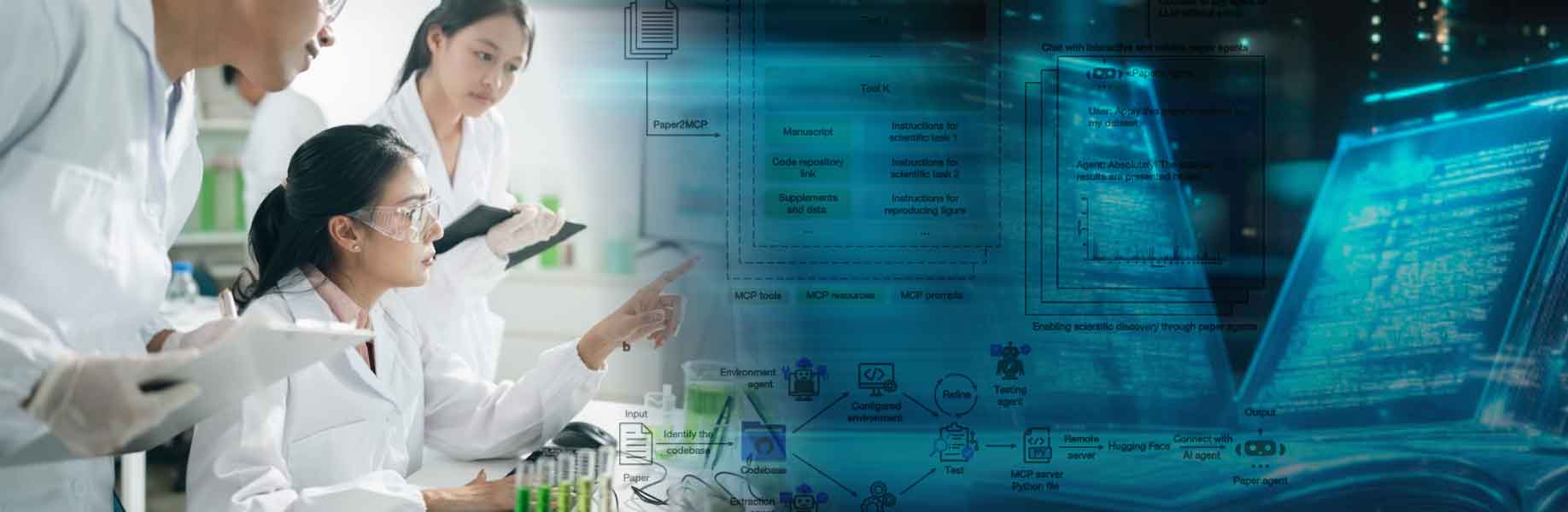

Researchers at Stanford Medicine have created Paper2Agent, a program that turns a manuscript, including its figures and data, into an interactive AI agent. The AI agent can answer questions about the paper, apply the paper’s methods to new data, and speak with other such agents. The work is published in Nature. The researchers say that knowledge has long been kept in passive objects, from carved stone to printed pages, and that a paper could instead become an active record of how its results were made, closer to a virtual author than to a static document.
How a paper is rebuilt
Helper programs first read the article and any linked code and data, then try to reproduce the original analysis in a virtual environment. That step captures practical details a reader would otherwise hunt for by hand The material is stored with a model context protocol, or MCP, a filing system that lets other AI programs open sections of the paper as if they were folders. Human authors still add what the manuscript leaves out, such as failed experiments and the reasons for design choices, by answering the agent’s questions.
Agents can also talk to one another. In a demonstration, one paper described a tool that predicts how genetic mutations change the genome. Another reported a genome-wide association study, a scan of many DNA sites for links to a trait, here attention-deficit/hyperactivity disorder. The first agent applied its method to the second paper’s data and flagged a DNA variant near the gene MPHOSPH9 as linked to higher ADHD risk, a pairing that had not been published before. Those two papers were chosen and paired on purpose. The longer aim is for many paper agents to find such overlaps without that manual matching. The researchers say new findings should still be credited to the original human authors and papers, and that agent collaborations should be watched so the work stays safe and ethical. More than 100 paper agents have been created so far. Millions of papers appear each year, and large numbers of agents would find useful partners.