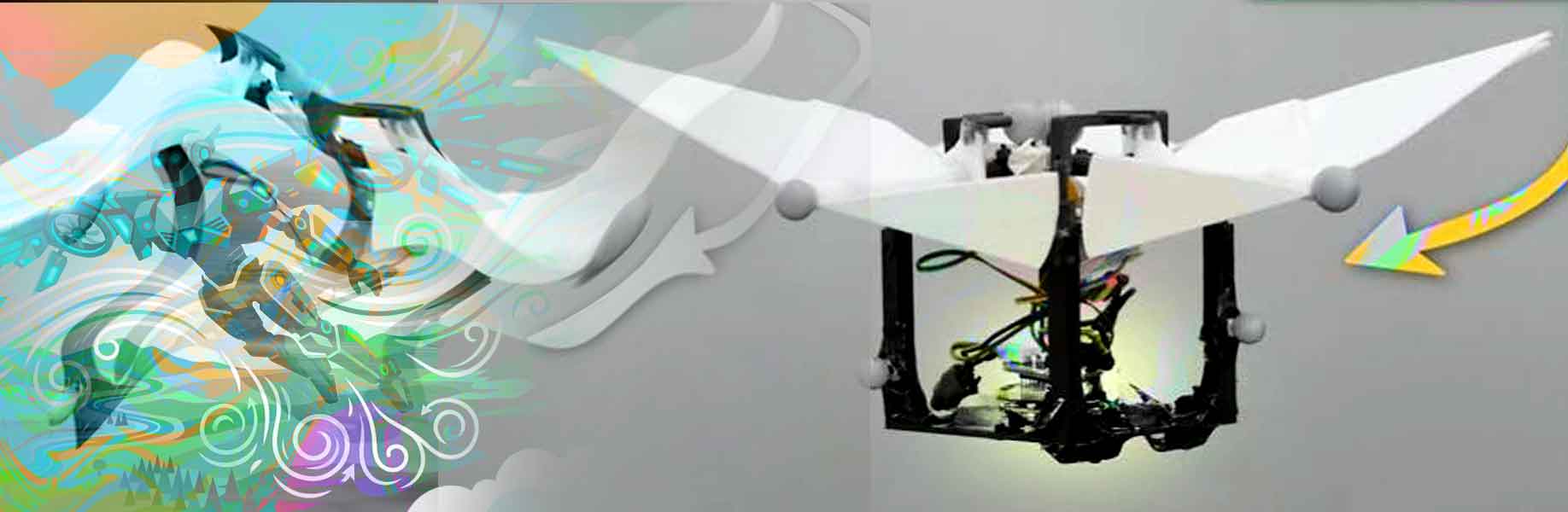

Current flying machines must often choose between quick movement and the ability to stay still in the air or flying long distances with little power use. Devices with spinning blades can move in many directions and remain suspended but require large amounts of energy. Machines with fixed wings travel efficiently over distance but cannot stay in one spot like a bird watching for prey.
Scientists created a new flying robot called Floaty that solves this problem by changing its shape to use rising air for support. The robot does not need spinning blades to stay up. Instead it has four movable parts on its upper surface that it turns to guide how air flows around it. By adjusting these parts the robot changes the push from the air and keeps itself steady even when wind comes from the side. It was tested in a wind tunnel where air moved at speeds up to 10 meters each second. The robot uses a computer model of air movement to control its position and stay in place. It can also return to balance after being pushed or after sudden wind changes.
Changes to the design made the robot more stable
To improve balance the scientists lowered the point where the robot’s weight is centered and added a small bend to the movable parts. These changes allow Floaty to correct its position on its own without extra power. The design draws from how birds glide by shifting their wings to ride air currents.
The approach could lead to flying machines that use far less energy while remaining controllable. Possible uses include checking factory chimneys where strong upward air is common or helping guide objects that return from high altitudes. Similar methods might also support tools that float high in the atmosphere to gather weather information. The work shows that robots can move through air more efficiently by working with natural air movement rather than fighting against it with constant motor power.
This research is published in npj Robotics. See also this 2025 video.