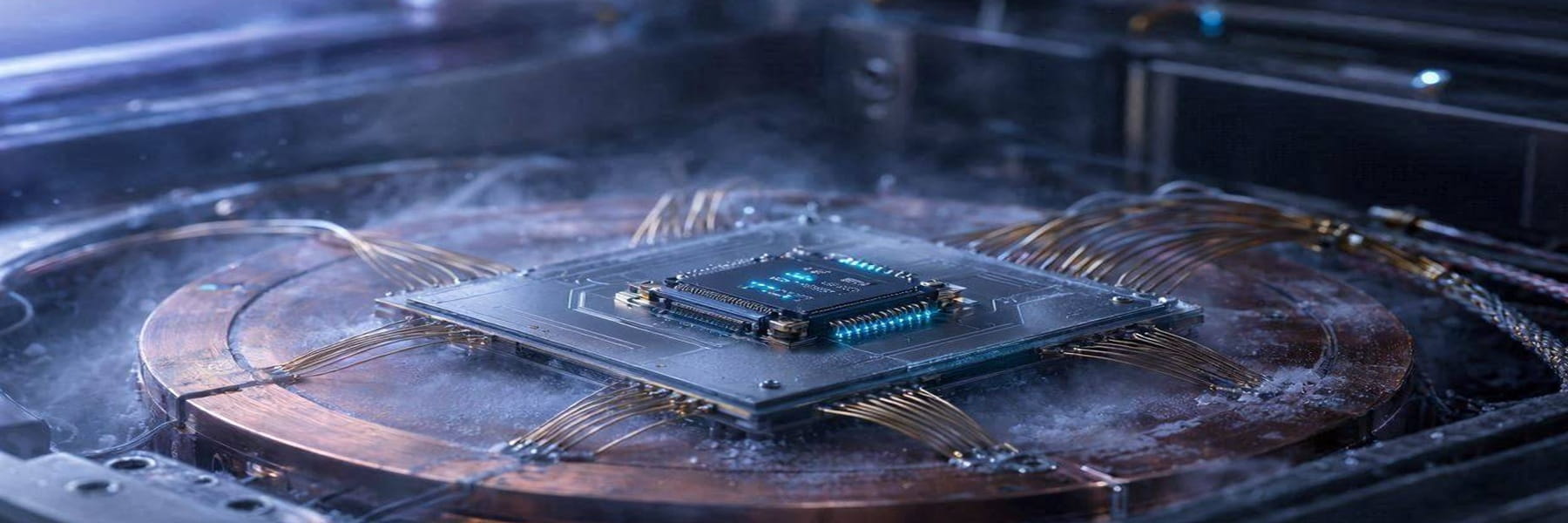

Two landmark studies published in Nature reveal that scientists have successfully re-engineered conventional silicon-chip technology to build scalable quantum processors, bringing the dream of practical quantum computing dramatically closer to reality.
A team led by Undseth et al. demonstrated a silicon quantum processor with reconfigurable long-range connectivity using a "spin-shuttling" architecture which is essentially a nanoscale conveyor belt that physically relocates individual electrons across the chip while preserving their fragile quantum states. This dynamic connectivity is critical for implementing quantum error correction, the single biggest engineering barrier to useful quantum computers.
Simultaneously, researchers at HRL Laboratories unveiled a digitally controlled silicon quantum processing unit that integrates its own custom cryogenic CMOS controller directly inside the ultra-cold cryostat at temperatures near absolute zero. The chip essentially runs itself — autonomously executing quantum error-correction routines without relying on external room-temperature electronics. Their controller was fabricated using a standard 130-nanometer radio-frequency CMOS process, the same commercial manufacturing technology found in everyday smartphones.
"We're talking about repurposing the same semiconductor know-how that gave us billions of transistors per chip," said Nature commentator Natalia Ares of the University of Oxford. "A silicon-based quantum computer could theoretically solve in hours problems that would take today's best supercomputers longer than the age of the Universe."