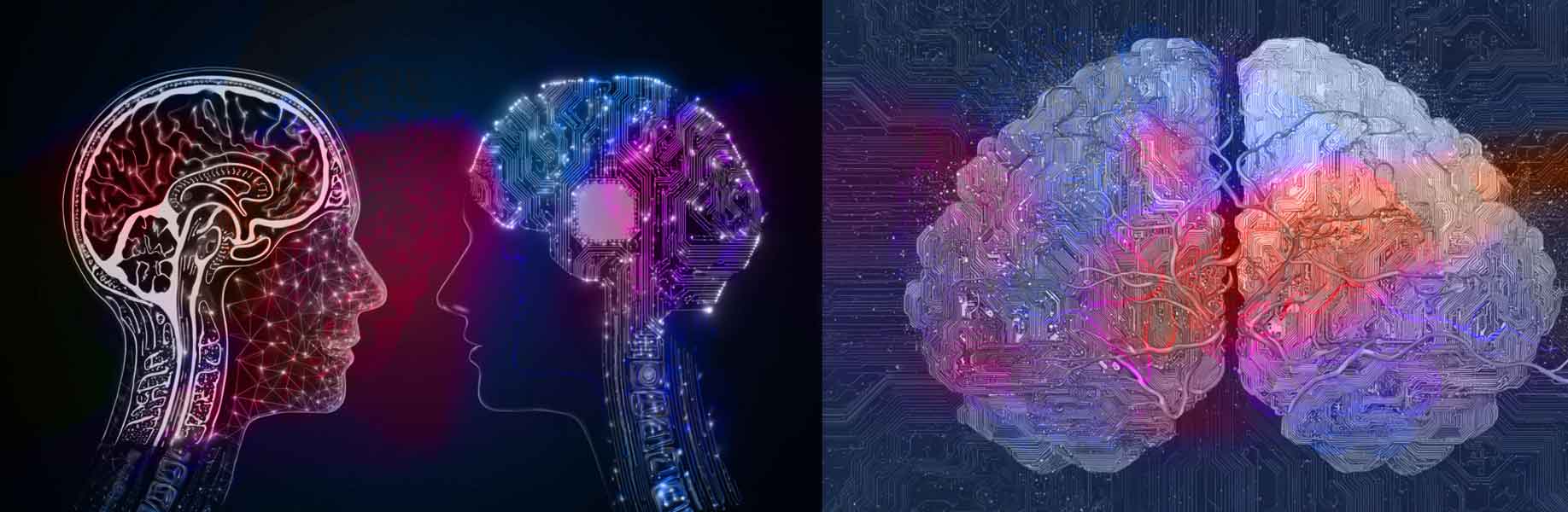

Both artificial intelligence (AI) and the human brain can represent the world abstractly, meaning they simplify complex ideas into patterns. They also generalize from small amounts of data, meaning they learn broad rules from a few examples, and process information in layers, like breaking tasks into steps. A new study from researchers at Technical University of Denmark (DTU), published in Nature Communications, highlights another similarity called convexity, a property that helps both humans and machines organize knowledge.
When humans learn about something, like a cat, they don’t just memorize one image. Instead, they form a flexible idea that includes all kinds of cats, whether big, small, or different colors. This idea of convexity comes from mathematics, where it describes shapes with no dents, like a circle. In thinking, convexity means related ideas, like different cats, group together in the brain’s mental space. Imagine stretching a rubber band around these ideas. Any point between two cats inside this band is still a cat. This helps humans learn quickly, share ideas, and understand each other.
AI models, especially deep learning models, work similarly. These models turn raw data, like pictures or words, into internal maps called latent spaces. These spaces organize the AI’s understanding of the world, much like the brain’s mental spaces.
Measuring AI’s internal structure
The DTU study explored whether AI’s latent spaces form convex regions, like human brains do. The researchers tested these ideas across AI models handling images, text, audio, and even medical data. They found that convexity is common in AI, suggesting it’s a natural part of how machines learn.
The study also showed that convexity appears in both general AI models, trained on huge datasets, and specialized models, trained for tasks like identifying animals. When models are refined for specific tasks, their convex regions become clearer, improving their accuracy. Interestingly, the level of convexity in a general model can predict how well it will perform after being specialized. This could help design better AI that learns efficiently, especially with limited data. By understanding convexity, researchers see how AI generalizes, much like humans, which could lead to machines that think in ways humans can trust and understand.