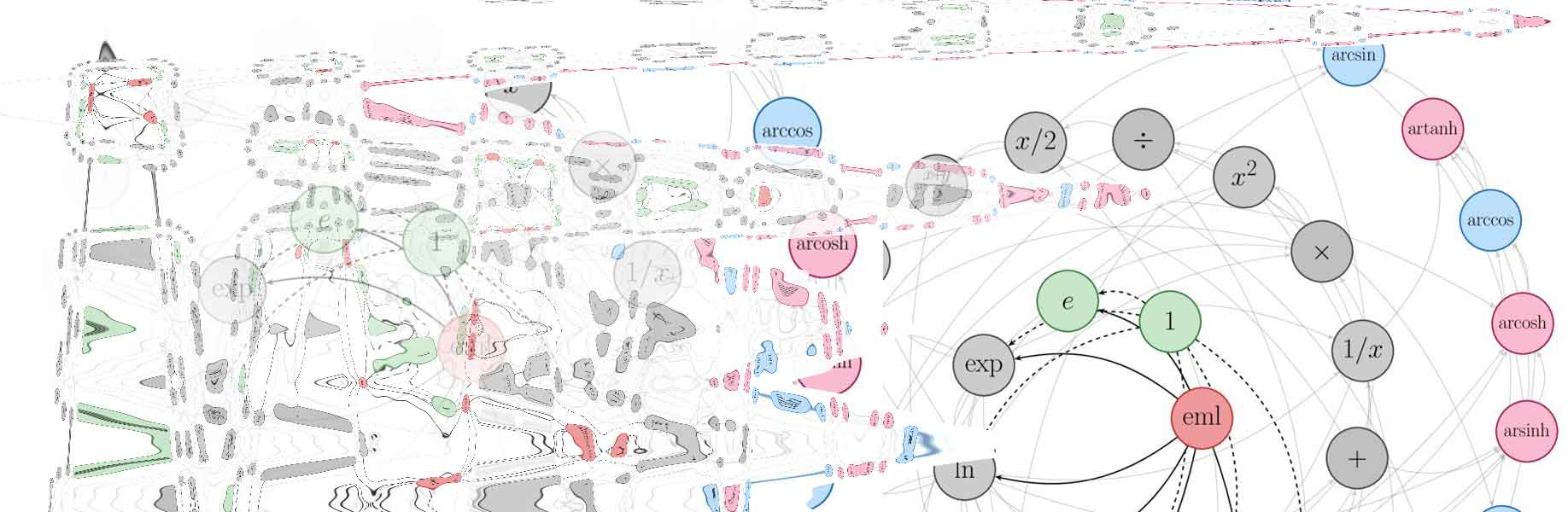

A recent preprint on arXiv shows that a single binary mathematical operator, together with the constant 1, can generate all standard elementary functions used in science and engineering.
Elementary functions include basic arithmetic operations such as addition, subtraction, multiplication, division, and exponentiation, as well as transcendental functions like sine, cosine, logarithm, exponential, square root, and constants such as e (the base of natural logarithms), π (pi), and i (the imaginary unit).
The operator, called eml(x, y), is defined as exp(x) − ln(y), where exp is the exponential function and ln is the natural logarithm. It works in the complex number domain but produces correct real results for real inputs when used carefully.
The author demonstrates that repeated applications of eml, always using the constant 1 as one input when needed, can build every common scientific-calculator function. For example: exp(x) is simply eml(x, 1); ln(x) requires a short chain: eml(1, eml(eml(1, x), 1)).
All expressions take the form of binary trees with identical eml nodes and leaves of 1. This creates a very simple grammar: any valid expression is either the constant 1 or eml applied to two previously built expressions.
A NAND gate for math
The discovery came from systematic computer search that tested many combinations of operations until the minimal set was found.
The uniform tree structure also supports a new approach to symbolic regression. In this technique, a computer tries to discover a mathematical formula that fits given numerical data. Here, the eml trees serve as trainable circuits.
The work draws an analogy to digital logic, where a single gate called NAND can build all Boolean operations. No such single primitive was previously known for continuous mathematics.
Potential applications include simpler hardware designs (digital or analog), more structured symbolic regression tools in machine learning, and a new minimal foundation for computer algebra systems. Limitations include the need for the constant 1, occasional deep expressions, and internal use of complex arithmetic even for real-valued results.
The paper is titled "All elementary functions from a single binary operator" and written by Andrzej Odrzywołek (Jagiellonian University).