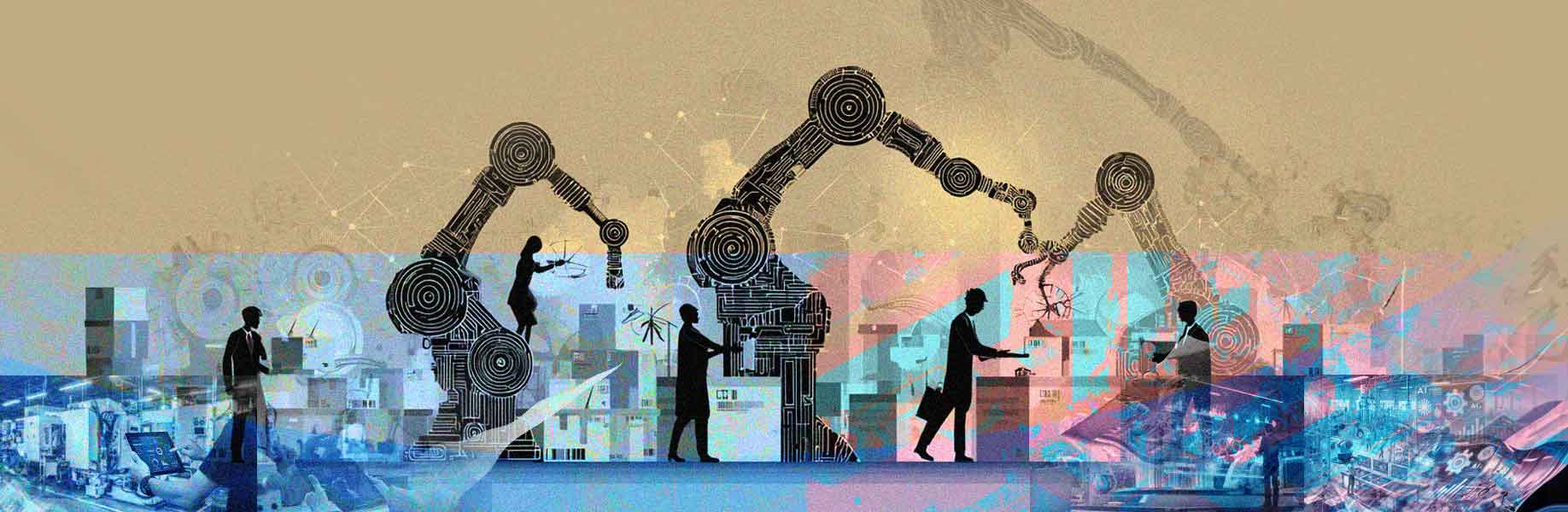

Industrialization once required smokestacks, railroads, and generations of labor migration. Today, it may require servers, sensors, and software instead.
For two centuries, economic development followed a predictable arc: agriculture to factories, factories to services. AI micro-automation challenges that sequence, suggesting smaller nations could bypass mass industrialization entirely—building prosperity through distributed intelligence rather than centralized industry.
The global economic order is quietly entering a structural transition. Artificial intelligence systems are no longer confined to research labs or cloud platforms; they are becoming embedded in logistics, agriculture, manufacturing, and governance. At the same time, many developing nations face shrinking opportunities to replicate the export-led industrialization models once used by East Asian economies.
Automation in wealthy countries has reduced demand for offshore labor. Robotics and AI now allow manufacturing to reshore closer to consumer markets, weakening the traditional advantage of low wages. For smaller nations, the ladder of industrialization appears partially withdrawn just as they begin climbing it.
Yet emerging technologies may offer an alternative path. Advances in edge AI, low-cost robotics, and modular production systems enable “micro-automation”: small, highly automated units capable of performing specialized economic tasks. The tension lies in whether this shift empowers smaller economies—or deepens technological dependency on global platforms and infrastructure providers.
The End of Scale as Destiny
Industrialization historically rewarded scale. Steel mills, automobile plants, and textile factories required massive capital investments and concentrated labor pools. Productivity emerged from aggregation: more machines, more workers, more output.
AI changes the economics of scale by embedding decision-making directly into machines. A micro-factory equipped with computer vision and adaptive control software can produce customized goods with minimal human supervision. Productivity becomes a function of intelligence rather than size.
This shift mirrors the transformation of computing itself. Mainframes once dominated because computation required physical concentration. Distributed computing later decentralized processing power. Manufacturing may now follow the same trajectory.
Why this matters:
If scale is no longer the primary driver of competitiveness, small nations can participate in advanced production without building mega-industrial infrastructure.
Micro-Automation as Infrastructure
Micro-automation refers to compact automated systems performing narrowly defined tasks—precision farming units, autonomous fabrication workshops, AI-managed cold chains, or robotic recycling stations.
These systems rely on inexpensive sensors, machine learning models trained in the cloud, and local edge processors capable of operating offline. Instead of building one national factory, a country deploys thousands of semi-autonomous productive nodes.
In agriculture, AI-driven irrigation systems optimize water usage field by field. In manufacturing, modular CNC and robotic arms produce spare parts locally. In logistics, algorithmic routing reduces inefficiencies that traditionally required massive infrastructure investments.
Economic capacity becomes distributed infrastructure rather than centralized industry.
Why this matters:
Development shifts from capital-heavy megaprojects to incremental deployment, allowing nations with limited financing to grow productivity step by step.
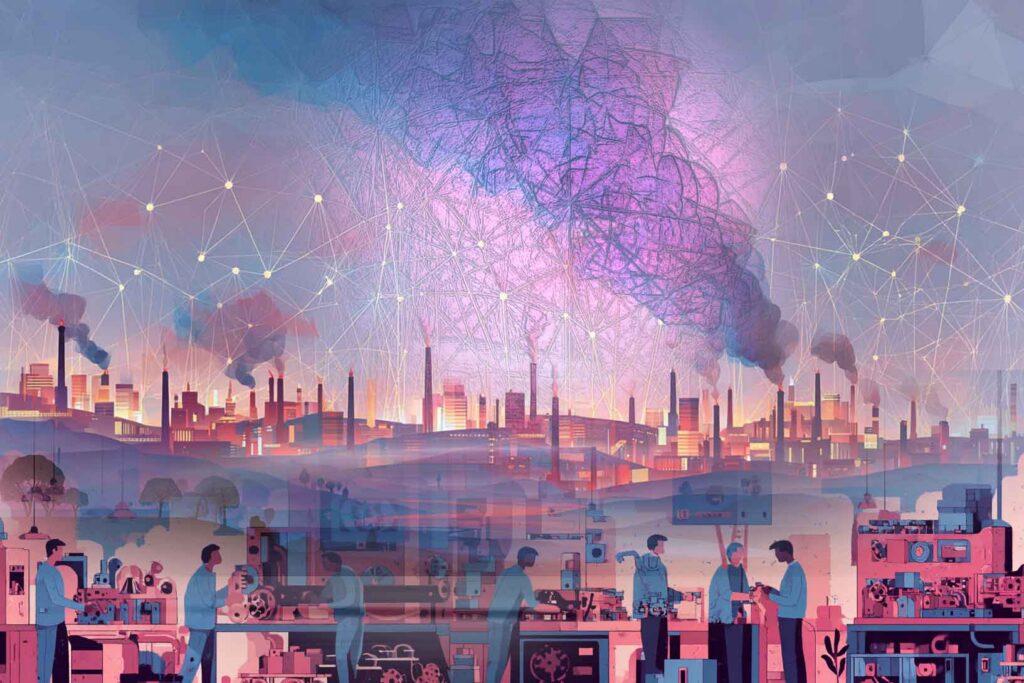
Labor Without Mass Employment
The most controversial implication of micro-automation is labor displacement without a preceding industrial employment boom. Traditional development created millions of factory jobs before automation reduced them. AI may compress that timeline.
Rather than employing large manufacturing workforces, micro-automation creates smaller numbers of technical, maintenance, and coordination roles. Economic value rises even as formal employment grows slowly.
This challenges long-standing assumptions linking industrialization to mass job creation. Governments may need to rethink taxation, education, and welfare models around productivity rather than employment volume.
Some economists argue this represents a “post-labor development pathway,” where prosperity depends on system ownership rather than wage participation.
Why this matters:
Nations that equate development solely with employment statistics risk misreading economic progress in an automated era.
Digital Sovereignty and Platform Dependency
Micro-automation depends heavily on software ecosystems, cloud training environments, and proprietary AI models. This introduces a new form of dependency distinct from colonial resource extraction but structurally similar.
If local industries rely on foreign AI platforms, economic autonomy becomes fragile. Software licensing, data access, and algorithmic governance may shape national productivity more than domestic policy.
However, open-source AI and regional computing cooperatives offer alternative models. Smaller nations could pool resources to build shared AI infrastructure, reducing reliance on external technology monopolies.
The struggle for digital sovereignty may define development politics as strongly as trade policy once did.
Why this matters:
Technological independence increasingly determines whether automation wealth remains local or flows outward.
The Rise of Distributed Industrial Ecosystems
Instead of industrial zones, future economies may resemble networks. Thousands of specialized automated nodes coordinate through digital marketplaces and AI planning systems.
A local entrepreneur might operate a micro-factory producing drone components, supplied by another automated materials processor across town. AI systems dynamically match production capacity with demand, minimizing waste.
Such ecosystems resemble biological networks more than industrial hierarchies—adaptive, decentralized, and resilient to disruption.
Crucially, this structure may favor smaller nations, where regulatory agility and compact geography allow faster experimentation.
Why this matters:
Development becomes an ecosystem design problem rather than an infrastructure accumulation challenge.
Ethics & Societal Implications
Leapfrogging industrialization raises profound philosophical questions about the meaning of economic development. If societies achieve productivity without mass employment, traditional social contracts built around work may weaken. Identity, dignity, and social cohesion have long been tied to participation in labor markets.
There are also risks of technological stratification. Nations capable of deploying micro-automation may accelerate ahead, while those lacking connectivity or education infrastructure fall further behind. Within countries, automated productivity could concentrate wealth among system owners unless governance frameworks ensure broader participation.
Yet the model also offers possibilities for equity. Distributed automation can empower rural regions, reduce urban overcrowding, and localize production in ways that lower environmental impact. Development might become less extractive and more adaptive—if institutions evolve alongside technology.
Conclusion
AI micro-automation suggests that industrialization was never the destination, only a historical method. Intelligence embedded in machines may allow smaller nations to construct prosperity without replicating the factory age that defined the twentieth century.
The deeper question is no longer whether countries can industrialize—but whether societies can redesign economic meaning when growth no longer depends on mass labor. If production becomes decentralized intelligence, who truly owns the future economy?