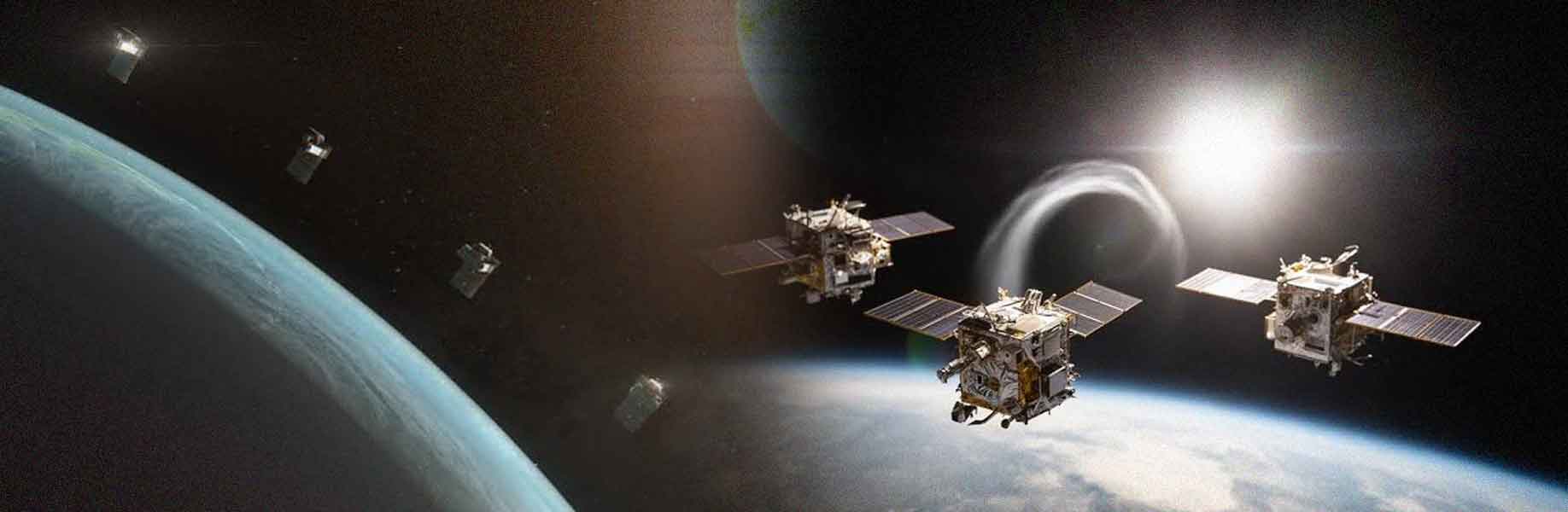

NASA's PUNCH mission has predicted the arrival of a coronal mass ejection at Earth to within a 30-minute window, roughly ten times more precise than existing methods, in what scientists are calling a potential paradigm shift in space weather forecasting.
The results come from a proof-of-concept test using a coronal mass ejection that erupted from the Sun on May 31, 2025. By feeding hundreds of wide-field images captured by PUNCH's four satellites into a computer model, researchers predicted the CME would reach Earth's magnetosphere between 5:00 a.m. and 5:30 a.m. on June 1, and the storm arrived right on schedule.
"We thought PUNCH would be good at this, but it's a stunning result," said Craig DeForest, principal investigator for PUNCH at the Southwest Research Institute's Solar System Science and Exploration Division. DeForest likened the advancement to "the space weather equivalent of going from a steam engine to a modern internal combustion engine."
Coronal mass ejections are massive expulsions of charged plasma from the Sun, sometimes containing a billion tons of matter traveling at millions of miles per hour. When they strike Earth, the impact can knock out power grids, disable satellites, disrupt GPS navigation, and endanger astronauts aboard the International Space Station. Yet until now, forecasting their precise arrival has been a crude science. Previous models could typically only track CMEs for the first 20 percent of their journey from the Sun, a blind spot that left emergency planners guessing.
PUNCH, short for Polarimeter to Unify the Corona and Heliosphere, overcomes that limitation. Its four small satellites in low-Earth orbit capture continuous 3D imagery of the inner solar system every four minutes, tracking CMEs almost the entire way from Sun to Earth roughly 93 million miles. For the May 31 test, the model analyzed the CME's leading edge and velocity over a 12-hour tracking period before settling on its final prediction eight hours before impact.
The PUNCH data also revealed that CMEs are "clumpier" than previously believed, with structures that evolve as they travel across the solar system, information that could refine future models further. Scientists say the approach, even in this basic first iteration, produced an order-of-magnitude improvement over the state of the art.
The practical implications are significant. Power grid operators, satellite companies, aviation authorities, and military agencies that depend on precise space weather warnings could gain critical hours of lead time to safeguard infrastructure. As the Sun approaches the peak of its 11-year activity cycle, the need for reliable forecasts is growing. NASA says further testing will determine whether the 30-minute precision holds across multiple storm events before the system is ready for operational use.