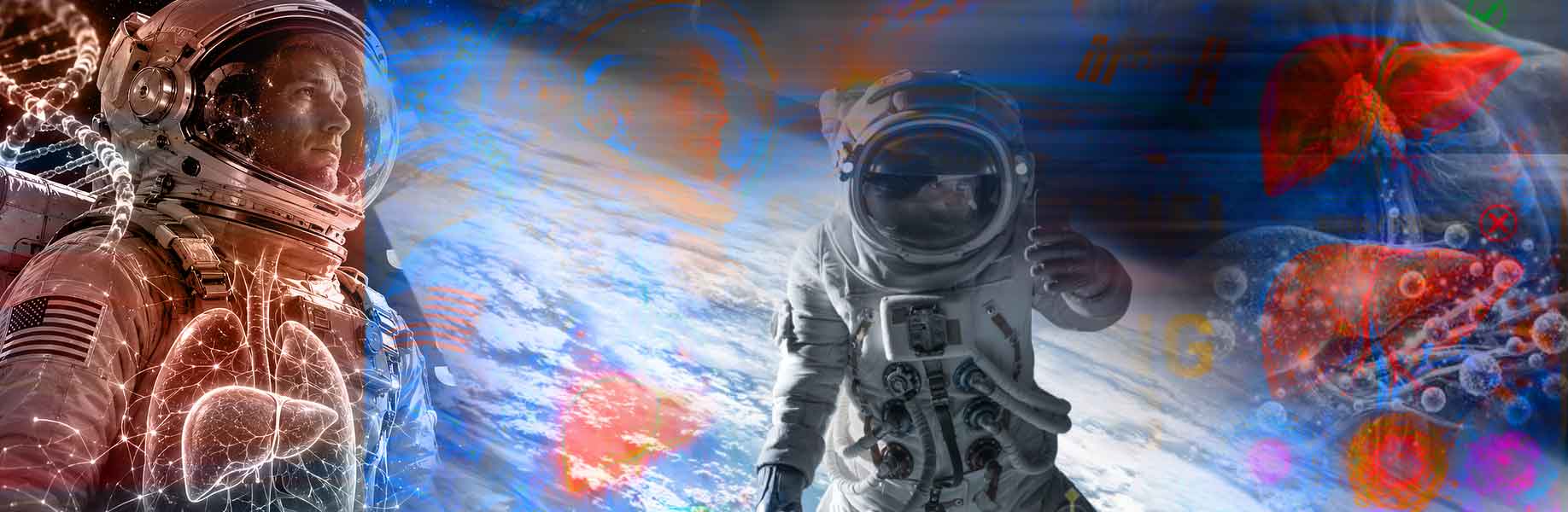

A new study of simulated deep-space exposure has sharpened a difficult question for Moon and Mars planners: can astronauts be protected from the biology of aging without trading one risk for another?
A study published in GeroScience found that radiation and simulated microgravity altered gene-regulating microRNAs in mouse livers, disturbing the TGF-beta network, a molecular system involved in inflammation, cellular senescence and fibrosis. The work adds organ-level detail to a growing body of evidence that spaceflight can trigger aging-like molecular changes. But it also delivered a caution: an experimental RNA-blocking treatment corrected some stress-linked signals while increasing expression of fibrosis-associated genes [1].
The team exposed female mice to 14 days of hindlimb unloading, a ground-based microgravity analogue, then to either simulated galactic cosmic radiation or a solar-particle-event radiation dose. They measured RNA changes 24 hours later. Both radiation types increased p21, a marker associated with senescence; solar-particle radiation also increased two genes linked to fibrosis. The patterns varied by radiation type, underlining why “space radiation” cannot be treated as a single exposure.
The authors then tested an antagomir cocktail, designed to inhibit three microRNAs: miR-16-5p, miR-125b-5p and let-7a-5p. It restored or preserved expression of some TGF-beta, inflammation and senescence-associated genes, and raised the anti-inflammatory IL-10 signal. Yet it also increased the fibrosis markers Col1a1 and Col4a1. That mixed outcome is the study’s central finding: molecular countermeasures may be tunable, but they are not remotely ready to be called protective medicine.
The human relevance is suggestive rather than conclusive. The researchers compared their mouse-liver results with blood-cell data from NASA’s year-long Twins Study and SpaceX’s three-day Inspiration4 mission. Some related microRNA and TGF-beta patterns appeared in people, even though those astronauts received far less radiation in low-Earth orbit and blood is not liver tissue.
That distinction matters as agencies prepare for missions beyond Earth’s magnetic shield. A 2023 review described long-duration spaceflight as an unfamiliar “exposome” in which microgravity, radiation, confinement and circadian disruption can converge on chronic inflammation, or inflammaging. Its authors linked that response to muscle and bone loss, vascular and metabolic changes, and altered immunity, while urging development of countermeasures that may also inform aging research on Earth [2].
This is not evidence that spaceflight definitively ages the liver, nor evidence that antagomirs prevent harm. The new experiment measured early gene-expression shifts, not liver function, tissue scarring or long-term outcomes; it used a single acute radiation exposure and only female mice. Still, it identifies a plausible molecular fault line for deep-space medicine: the same RNA networks that may blunt one aspect of stress can amplify another.