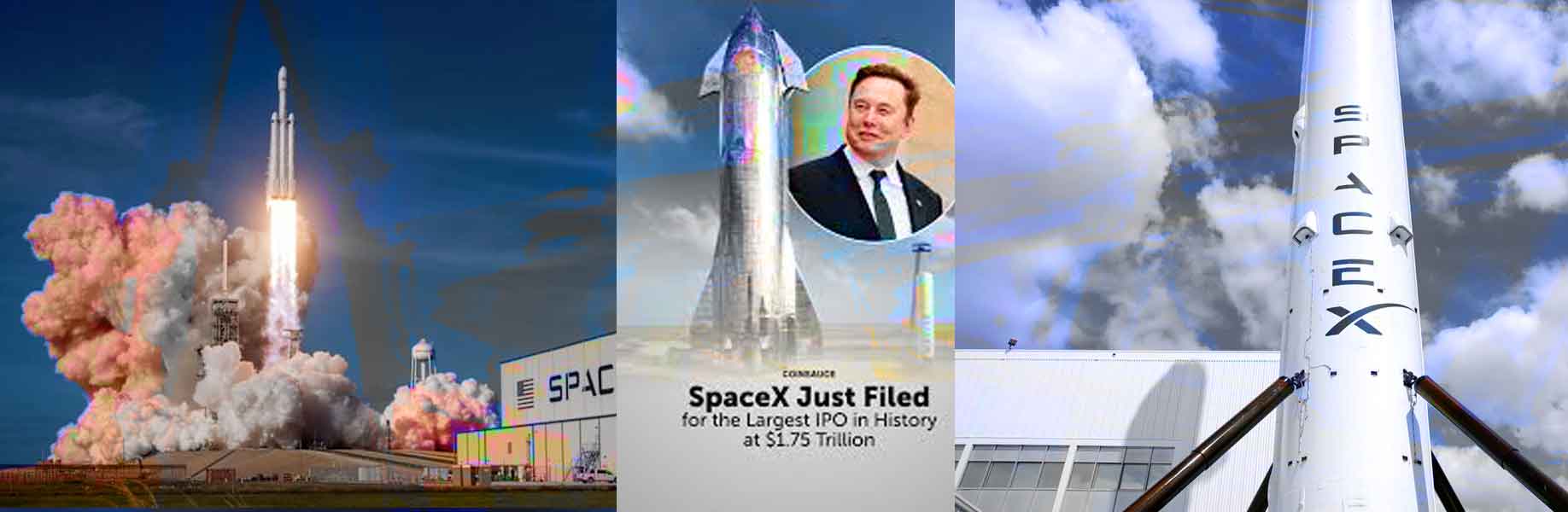

SpaceX filed its long-awaited S-1 registration statement with the U.S. Securities and Exchange Commission on May 20, 2026, after the markets closed, marking a significant step toward what could become one of the largest initial public offerings in history. The company, which plans to list on the Nasdaq exchange under the ticker SPCX by mid-June, is seeking to raise up to $80 billion at a valuation of approximately $2 trillion, WSJ reported last month (open copy). The preliminary filing, which omits final details on share count and pricing, provides the public with SpaceX’s first comprehensive financial disclosures as a privately held entity.
SpaceX organizes its operations into three segments: space, connectivity, and artificial intelligence. The space segment, encompassing launches and Dragon spacecraft activities, generated $4.1 billion in revenue for 2025 and $619 million in the first quarter of 2026. Heavy investment continues in the Starship vehicle, with $3 billion spent on its development in 2025 and another $930 million in the opening quarter of 2026. SpaceX anticipates Starship will begin launching satellites in the second half of 2026 following its upcoming 12th suborbital test flight. The connectivity business, powered by Starlink, remains the primary revenue and earnings driver, accounting for $11.4 billion in 2025 revenue and $3.3 billion in the first quarter of 2026. Starlink now serves 10.3 million subscribers, double the number from a year earlier.
Orbital data centers for AI
The AI segment, established following the February 2026 acquisition of xAI, contributed $3.2 billion in 2025 revenue and $818 million in the first quarter of 2026, though it recorded substantial losses amid aggressive research and development spending of $12.7 billion for the year and $7.7 billion in Q1 alone. SpaceX frames these investments against what it describes as the largest actionable total addressable market in human history. Central to this vision are plans to deploy orbital data centers beginning in 2028, leveraging the company’s vertical integration in launch, satellite manufacturing, and connectivity to achieve lower costs than terrestrial alternatives, Space News reports (open copy).