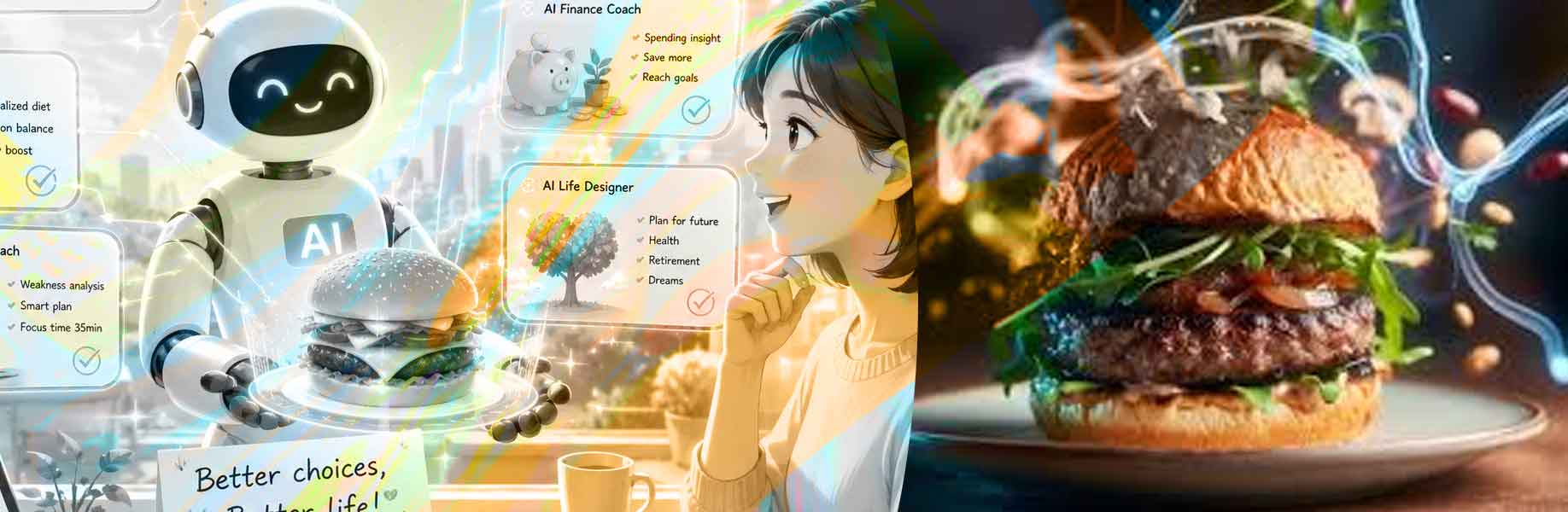

Researchers at Stanford have created BurgerAI, an artificial intelligence tool that generates new burger recipes matched to a person’s age, taste preferences, nutritional requirements, and sustainability targets.
BurgerAI learns patterns from more than two thousand existing recipes and then produces entirely new combinations of ingredients and quantities. It evaluates these combinations against profiles of flavor, texture, nutrition, and environmental impact before selecting those that best meet the stated goals. The system personalizes results according to factors such as gender and physical activity level.
This research is published in npj Science of Food.
How the system creates and tests new recipes
The approach moves artificial intelligence beyond simply predicting outcomes that already exist. Instead the model asks what new design would best satisfy several competing objectives at the same time. The researchers trained the system on data from a public recipe website and then had professional chefs prepare five of the resulting burgers for a blinded taste test involving more than one hundred diners at a restaurant in San Francisco. In direct comparison with a popular fast food burger, two variations of the AI designed delicious burger received equal or higher scores for overall liking, flavor, and texture. One version reduced environmental impact by more than ten times while another roughly doubled the nutritional score.
Research leader Ellen Kuhl directs an interdisciplinary life sciences institute at Stanford that connects work across medicine, engineering, and natural sciences. Food served as a practical test case because daily eating decisions affect both personal health and planetary resources. A second paper from the same project shows that the mathematical ideas behind BurgerAI also appear in diffusion based generative artificial intelligence, a method that builds new outputs by starting from noise and gradually refining it, and that these ideas link to work in materials design, physics, and engineering.
The researchers view the burger project as an early demonstration rather than an end point. The same framework for balancing multiple goals could apply to discovering new medicines, engineering advanced materials, or developing other sustainable products where many requirements must be satisfied together.