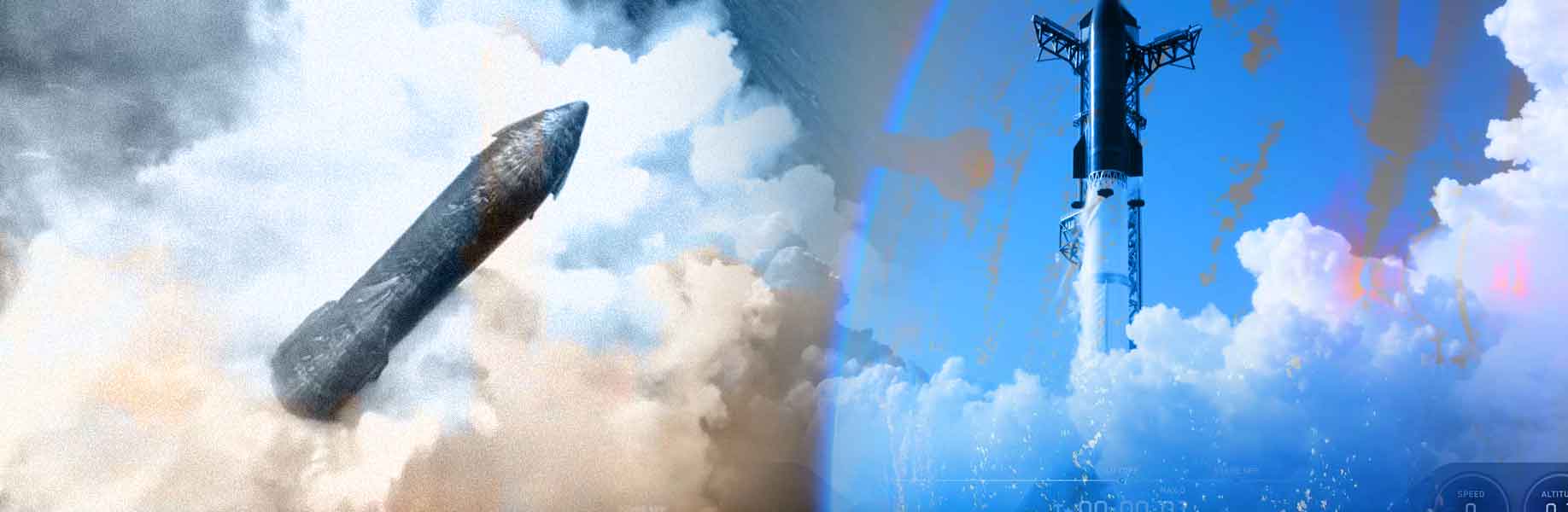

SpaceX launched Starship’s thirteenth flight test from Starbase, Texas. This was the second flight of the Starship and Super Heavy V3 vehicles and the first to deploy next-generation Starlink V3 satellites.
The Super Heavy booster ignited all 33 Raptor 3 engines and completed a successful ascent over the Gulf of America. After hot-staging, the booster performed a directional flip with a modified engine-start sequence designed for greater robustness. It completed the high-thrust portion of the boostback burn on all 33 engines - the first time a Super Heavy V3 achieved this - before ending the burn early. During the landing burn attempt, only a subset of engines ignited, resulting in a hard splashdown in the Gulf of America.
Ship reaches space, deploys satellites, and soft-lands intact
Starship’s upper stage ignited its six Raptor engines and completed a full-duration ascent burn, reaching the planned velocity and trajectory. It then successfully deployed all 20 Starlink V3 satellites. SpaceX established radio-frequency and laser communication with every satellite and downloaded key telemetry. The satellites followed the pre-planned trajectory and were expected to reenter and demise approximately 20 minutes after deployment. Starship also demonstrated an in-space relight of a single Raptor engine, a core capability needed for future orbital missions.
During atmospheric reentry, the vehicle gathered critical heatshield performance data and executed a dynamic banking maneuver to simulate the trajectory future missions will use when returning to Starbase. Using its four flaps, Starship guided itself to the designated splashdown zone in the Indian Ocean. It relit all three Raptor engines, performed a landing flip and burn (transitioning from three engines to two and then one), and achieved a soft splashdown, coming to rest intact. This provided the first clear views of an intact heatshield after flight.
Overall, Flight 13 delivered major progress on satellite deployment, in-space engine relight, heatshield testing, and controlled soft landing of the ship, while the booster provided valuable data on V3 boostback and landing-burn behavior.
Elon Musk stated shortly after the flight that, unless problems are discovered during the mission data review, the company will attempt to catch the Starship upper stage with the launch tower’s mechanical arms on the next flight. This would represent the first tower catch of the Ship itself and likely involve a longer-range trajectory, potentially reaching low Earth orbit, enabling a return to the launch site for recovery.