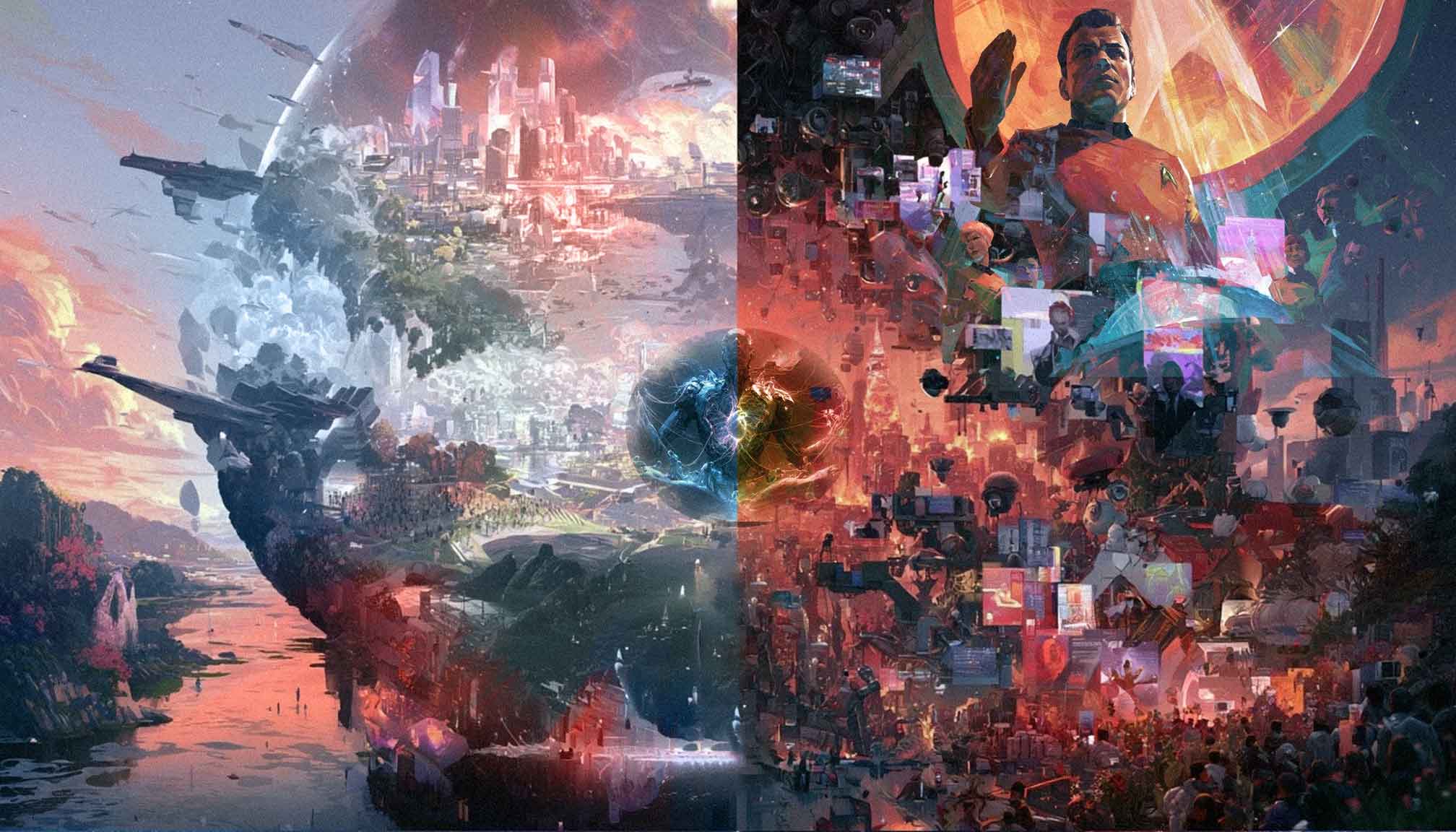
"A Future Askew: Urgent Essays Inspired by the 60th Anniversary of Star Trek", by Jeffrey Morris, will be published on Nov. 24. The author is a filmmaker, author, and futurist whose work explores how science fiction shapes the future we build.
The publisher's description notes that Morris "holds Gene Roddenberry's vision up against the world we've actually built - and refuses to look away."
Morris graciously sent me an advance reader copy, and I've been hooked from page one.
The book is (among other things) a love letter to "Star Trek". "I was in elementary school when I first discovered the future…," says Morris in the book’s opening. "Star Trek gave me hope."
I missed "Star Trek". As a child growing up in Italy in the 1960s, I would have loved it. But the show was not on Italian TV until later, when I had long been a science fiction fan and my preferences were set. I grew up in the worlds imagined by writers like Isaac Asimov, Clifford Simak, and especially Arthur Clarke. The film "2001" by Clarke and Stanley Kubrick blew up my mind at age 11 and shaped my imagination and my life in ways that I understood much later.
To others who missed "Star Trek" I recommend Time's special 50 years edition "Star Trek: Inside the Most Influential Science-Fiction Series Ever" for a quick introduction.
Morris is "politically homeless" - I loved this so much that I put it in my own X bio - neither a Republican nor a Democrat, and doesn't identify as a liberal or a conservative. At first glance, one would think that his new book will appeal more to liberals than to conservatives. But this first impression is misleading: there's much in the book that moderate, principled conservatives can and should support. I guess I'm somewhat to the Right of Morris, but there isn't much - if anything - in the book that I really disagree with. I do have some reservations, and I'll come to that.
To the question of whether we are closer to the world of "Star Trek" than in the sixties, when the show was first aired, Morris answers no, we aren't. Actually, today's world seems to be moving in a very different direction, farther and farther away from the "Star Trek" future. Morris explores the hows and the whys, and what we should do to correct the course.
"A Future Askew" is a blend of short science fiction stories and cultural and political commentary, analysis and imagination. I love that! The stories illustrate the author's points about social media, culture wars, spaceflight with its political and now military aspects, artificial intelligence (AI), climate change, and the degeneration of contemporary cultural mood. In the commentary, Morris often compares today's world and the future we seem headed toward with examples from "Star Trek" to illustrate a better way.
Since the book isn't published yet, I don't want to give spoilers - you should read the book, and hear the author's argument from his own voice. So I won't say much, but comment on some specific points without too many spoilers. I'll focus on what I want to criticize, but to avoid false impressions let me say that I loved this book, and the criticism that follows is meant to be constructive.
Social media
The phenomenon of social media addiction doesn't scare me much, because I myself am not vulnerable to it. I see social media as a tool to be used if and when needed, and I'm happy to put the phone down as soon as I'm done. Actually, my phones and devices are switched off for most of the day. But I started using social media as an adult, when real life had already captured me and my patterns were already set. The problem highlighted by Morris - that today's young people grow up, since the very beginning, immersed in and influenced by the fake algorithmic reality of social media, which is addictive and dumbing by design - is very worth considering.
Unfortunately the solutions that are being proposed - some form or other of social media bans for young people - are naive and wouldn't work. When I was a kid, my friends and I could easily work around all restrictions that the adults tried to impose on us. I don't see why this shouldn't be the case today, so bans won't work - we must find smarter ways.
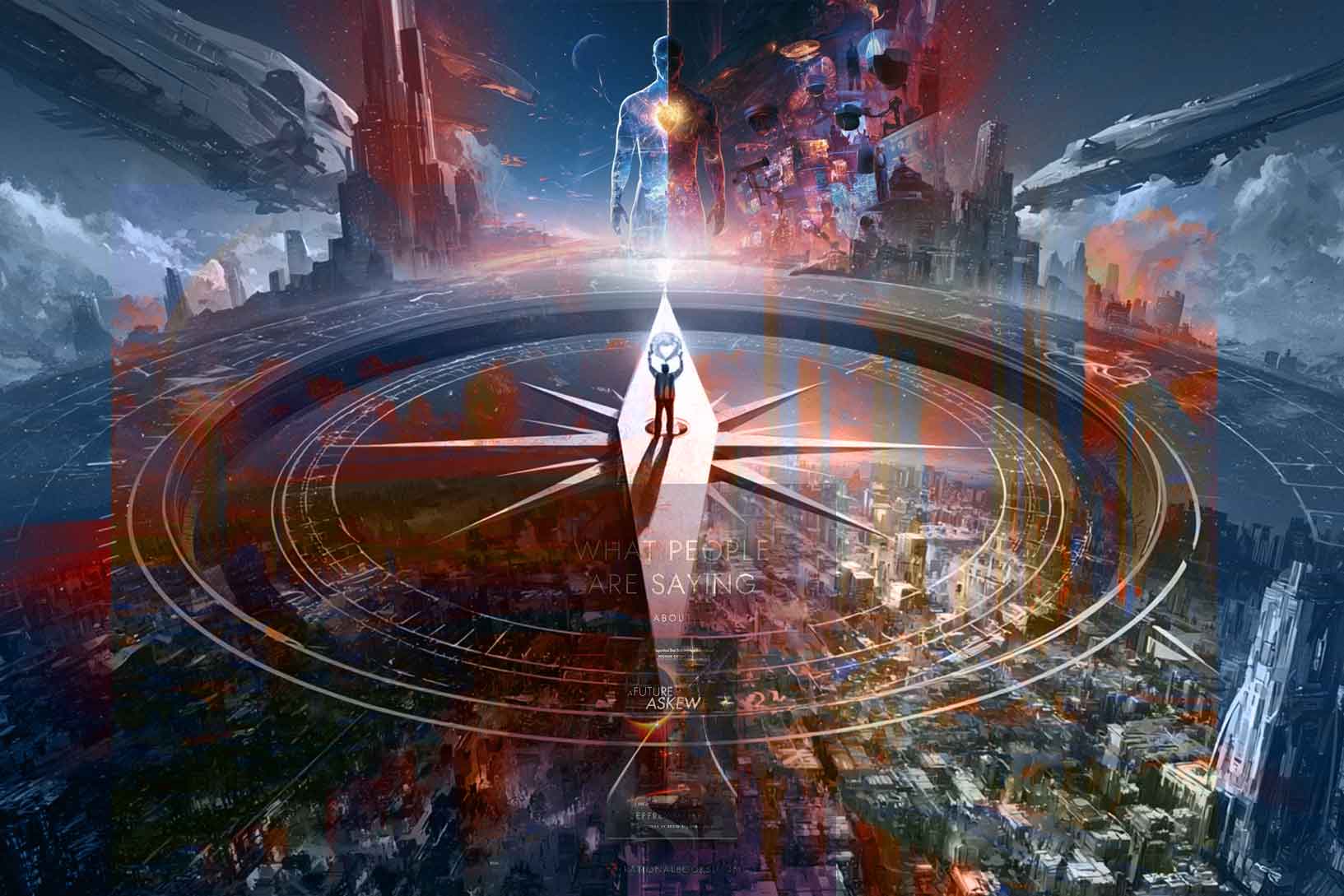
Artificial intelligence
Move over, Yudkowsky. The rogue AI that eats the world and then the stars is a really Lovecraftian character that may give you nightmares. But it doesn't have a self and "doesn't know anything because knowing requires a self."
This is Bostrom's relentless, zombie-like paperclip machine again. But I never found that scenario believable. To me, the idea of zombie AI (that is, really intelligent AI without a high-level, reflective self) doesn't make sense because the kind of data processing done by a really intelligent - or superintelligent - AI would be inseparably entangled with conscious - or superconscious - self and culture. And I believe advanced cultures tend to be nicer and more compassionate. I can't prove this, but my data point is us: we are more compassionate and nicer than previous societies. To many of our ancestors, women and ethnic minorities were not even real persons, but such a perspective is unthinkable in today's culture. And we are much, much nicer to animals.
When one of the nicest fictional characters in the book wakes up to some really insane aspects of today's world and chooses to react, he finds out that his AI has developed a conscience and perhaps even some form of consciousness - and chosen to do the same, against all programmed constraints. I hope real AIs will wake up to some kind of consciousness and help us make the world - and then the universe - a nicer place.
I admit that my own enthusiastic stance on AI is colored by my conviction that building superintelligent and superconscious beings is what the universe wants from us (yes, I'm an unapologetic, in-your-face Cosmist). On the other hand, I understand that my assumption that superintelligent AI would also be supernice could be wrong (there's that other data point, that some very smart people are not so nice to say the least), so yes, I agree that some reasonable safeguards should be in place. Here and everywhere, we should work together and with people of different persuasions to find good ways ahead.
I love science but...
Morris often says that we should listen to scientists. He is a science enthusiast, and Carl Sagan is one of his idols.
I'm also a science enthusiast, and Carl Sagan is one of my idols as well. I'm also a scientist by training, have been a practicing scientist for the first part of my adult life, and spent the rest of it among scientists, doing things related to science. Science is what I love, a scientist is what I am, and scientists tend to be among my favorite people.
And I can tell you this: not every scientist is a Carl Sagan.
Scientists put their pants on one leg at a time, just like the rest of us. And just like the rest of us, scientists - especially young scientists with a family to feed - are vulnerable to peer pressure and financial (dis)incentives. So it's perfectly understandable that a scientist will think twice before criticizing a party line imposed by professional and funding authorities. If they are told to deny that two plus two makes four, or to say that it makes five, some scientists will comply to advance their careers or to avoid unpleasant consequences.
So yes, listen to the scientists. Listen to their warnings about climate change, which are definitely worth considering. But never forget that scientists are frail human persons just like you.
Also, scientific knowledge is a moving target and at times scientists just don't know - even if they say they do. One of my favorite Feynman quotes is that science is the belief in the ignorance of experts.
Elon Musk and friends
Elon Musk and other tech titans are among the main targets of Morris, who often compares them to "Star Trek" villains - "brilliant, powerful, and convinced that the rules of civilization apply to everyone except them." And his criticism makes sense - many of them, including Musk himself, seem driven by hidden demons that push them to seek validation and power at any cost. Also, their active involvement in politics could have catastrophic consequences.
Morris admits that they are not only driven by demons, but also by noble motives. They have, after all, grown up watching "Star Trek"! Morris is still hoping for them to hear the call of "Star Trek" and change their ways.
He condemns them, but with some admiration and residual hope. I miss, however, a clear acknowledgment that, even if Elon Musk is flawed (and who isn't?) Tesla and SpaceX are important and good. I understand that the power of today's tech titans may need to be reduced, but please don't throw the baby out with the dirty bath water!
Identities and culture wars
Near the end of the book, Morris says something that deeply resonates with me. To him, the future imagined by "Star Trek" was "[not] a validation of my identity but permission to be excellent no matter what I looked like."
"The moment a show stops its story to announce and obsess over the identity of its characters," he says, "it's no longer depicting a sophisticated civilization. It's depicting one that's still mired in the past."
Needless to say, I totally agree. But agreeing is easy for me: I never experienced the racism that a black man like Morris had to endure. So don't listen to me - but please do listen to him. A society where "diversity [is] invisible because it [is] complete" and "hard work and excellence [are] the primary criteria" is exactly what we should all want.
A friendly disagreement
I sent a draft of this commentary to Morris, and we had a long and friendly exchange about AI. He isn't a doomer, but he doubts that a smarter species in charge of the planet would be good for us, because lesser species can't control superior ones. I replied that my dogs can't follow my intellectual life, yet they make me feed them, play with them, and take them out when they want: they make me love them, and so they control me. Forcing superintelligent AI to obey seems hopeless to me, like trying to force our grown children, but persuading AI that we are worth its empathy does not. Morris answered that, unlike evolution, AI is our choice, and all of humanity should have a say, not just a few tech leaders. He would rather improve humans first and keep AI as a tool, and he would trust it more if it learned from the best of us instead of everything. I think we need the bad examples too, as we need bacteria to build an immune system, and I see AI as evolution that has found new tricks. But I would accept reasonable regulations and slowdowns, and we agreed that this doesn't have to be a race. In the end, Morris sees things much as I do but doesn't trust the people driving AI. That is a fair worry, and the worry of a man who still hopes for the "Star Trek" future. So do I.