
My last post worked through the economics of the massively circularly-financed AI bet Big Tech is currently making, looking across three technology scenarios (HLAGI 2029, 2035 or much later), and considering scenarios without and then with a leading decentralized AGI network in play.
The two headline conclusions there were:
- a financial crisis in the 2027–2030 window appears to be the modal outcome under fast, moderate, and pessimistic AI timelines alike, so such a crash if it does come will tell us almost nothing about AI tech capabilities and progress;
- the national over-bet driving the crisis from a US perspective is not a lapse of prudence but the Nash equilibrium of a US–China race, which no amount of correct financial advice can plausibly undo.
Economics, though, is the easy half of the story. Financial crises don’t stay financial—they get metabolized by political systems, and the metabolization is where the century actually gets decided… 1929 produced both the New Deal and the Third Reich, from the same crash, depending on the political system doing the digesting.
So in this follow-on post I try to game out the politics. The method is brute-force but I think about the best one can do without extremely in-depth simulation modeling: I look at a grid of options with cells defined by
- three technology scenarios (HLAGI in 2029, HLAGI in 2035, or narrow AI that plateaus)
- each in two variants (centralized-only, or with a decentralized AGI network slightly in the lead)
- The favorable, unfavorable, and mixed political options within each scenario and variant
- The implications of each scenario+variant and political option for the US, China, and the world at large—including the developing world, world-war risk, and terrorism.
That’s 3x2x3x3=54 interesting futurological questions to analyze, and with LLM help I ran through each of them in some detail eg.
- Grid cell: HLAGI in 2029, centralized-only, favorable political situation, details for China
- Question” “What are the likely detailed implications for China in the case where we get HLAGI in 2029, where AGI is centralized and the political situation on the whole is favorable?”
- Grid cell: HLAGI in 2035, decentralized-leading, mixed political situation, details globally
- Question: “What are the likely detailed implications globally in the case where we get HLAGI in 2035, decentralized AI leads centralized and the political situation on the whole is mixed?”
- Etc. through all 54 combinations
(the above two example “questions” are not the actual prompts I used, it was more involved and iterative, I’m just giving the basic concept here…)
The results of these analyses of the 54 questions, stepped through one by one, are briefly summarized in this supplementary document...
What I then do in this post is look at the patterns I see across these 54 situations, and try to turn them into useful practical lessons.
There is of course some arbitrariness in this methodology, and one could slice things many different ways. But what I wanted to do was systematically survey a variety of possible outcomes and perspective, in some at least vaguely objective and broad-scope way, rather than focusing just on the most exciting or the scariest potential scenarios.
OK sure, it may well be neither the US or Chinese government is especially interested in a maverick AGI researcher’s policy recommendations (though these days… who knows, right?). HOWEVER, some of the recommendations coming out of the analysis are more oriented toward the decentralized AGI ecosystem, which is a domain where I have at least a little more oomph to put recommendations into action.
A couple high-level conclusions from my analysis here are:
- AGI centralization appears highly associated with globally adverse military outcomes. In rapid AGI progress scenarios these adverse outcomes seem likely to be more sudden; in slower AGI progress scenarios they are likely to unfold more slowly, but not necessarily toward better outcomes.
- Decentralized AGI has potential to lead to broadly peaceful and productive outcomes. BUT the positive potential of deAGI is more likely to be actualized if it is rolled out cooperatively with the major governments, rather than as a purely “underground” thing
While none of this is terribly surprising in the big picture, I think it is worth arriving at such conclusions through detailed analysis as I do here, rather than just asserting them by instinct. The more in-depth approach gives more to work with in terms of rapproachment among different perspectives and also in terms of finding beneficial solutions.
As I noted in (and linked from) the prequel post, I have spent some time building on some of Emad Mostaque’s work to develop some quite sophisticated mathematical methods for analyzing complex future scenarios like these. However, in this post I have not yet leveraged any of this fancy stuff. I would like to educate an Omega agent hive to do this more in-depth simulation and analysis, but I think it first makes sense to do a more basic qualitative analysis like I’ve given here.

Centralized vs. decentralized: key causal-structure differences
One of the key questions I set out to ask in this analysis is: what generates the favorable/unfavorable/mixed spread within a scenario, given that the economics is held roughly fixed?
One of my conclusions was that the answer to this meta-question differs systematically between the “decentralized AGI gets real” scenarios and its purely-centralized alternatives. Specifically, it seems to me that:
- In the centralized cases, the branching variable is the classic one for financial catastrophe, with a century of precedent behind it: does the crash produce reform, reaction, or muddle? Call these
- the 1933 US path (crisis as reform lever—losses acknowledged, villains prosecuted, structures rebuilt)
- the 1930s-Europe path (crisis as reactive blame engine—inflation tax, scapegoats, authoritarian consolidation, and on the historical ten-year clock, war), and
- the Japan path (crisis as chronic muddled condition—bailouts without reform, zombie firms, a lost decade of managed stagnation).
Which path a country takes is set, it seems to me, by deep political culture under stress, which is the sort of thing that’s barely if at all steerable, even by powerful leaders… it’s the sort of thing where a leader will succeed if they go with the flow and not if they push against it.
- In the decentralized cases the branching variable is different in kind: it is the state-network relationship. The question here is does the state
- co-opt the network (buy stake, run validators, adopt its distribution mechanisms)
- suppress it (chokepoint warfare against ramps, developers, and hosts), or
- negotiate a split (a compliant onshore layer atop a permissionless global substrate)?
This sort of relationship could go multiple ways, but does seem like something that can be impacted to at least some decent extent via near-term actions of specific parties (e.g. let’s say in the deAGI world). Current sociopsychological patterns seem complexly divided here, with decentralized networks in some ways opposing the state and in other ways working closely with it. We are now apparently in a transition between a “crypto cypherpunks over here, regulators and Wall Street firms over there” phase and some sort of world where decentralized tech is one among many tools trad-fi institutions and tech companies use to get their (regulated) shit done. Trump for all his flaws seems mostly quite positive in terms of effecting this transition. How far this transition will go remains to be seen—the Linux world for instance shows the possibility of partial co-option (Linux has gone partly corporate without totally losing its wild-ass classic-FOSS edge). Anyway there seems real flexibility to work with, in terms of interaction btw decentralized networks and states.
This difference between the two classes of situation—culture-driven branching (in the centralized scenarios) versus specific-relationship-driven branching (in the decentralization-heavy scenarios), we might call it—seems fairly deeply meaningful, because the network-state relationship can be designed for in a way that the political culture of crash-reaction cannot… I’ll return to this point below after running through more details of my thinking/analysis…
What the fifty-four questions show
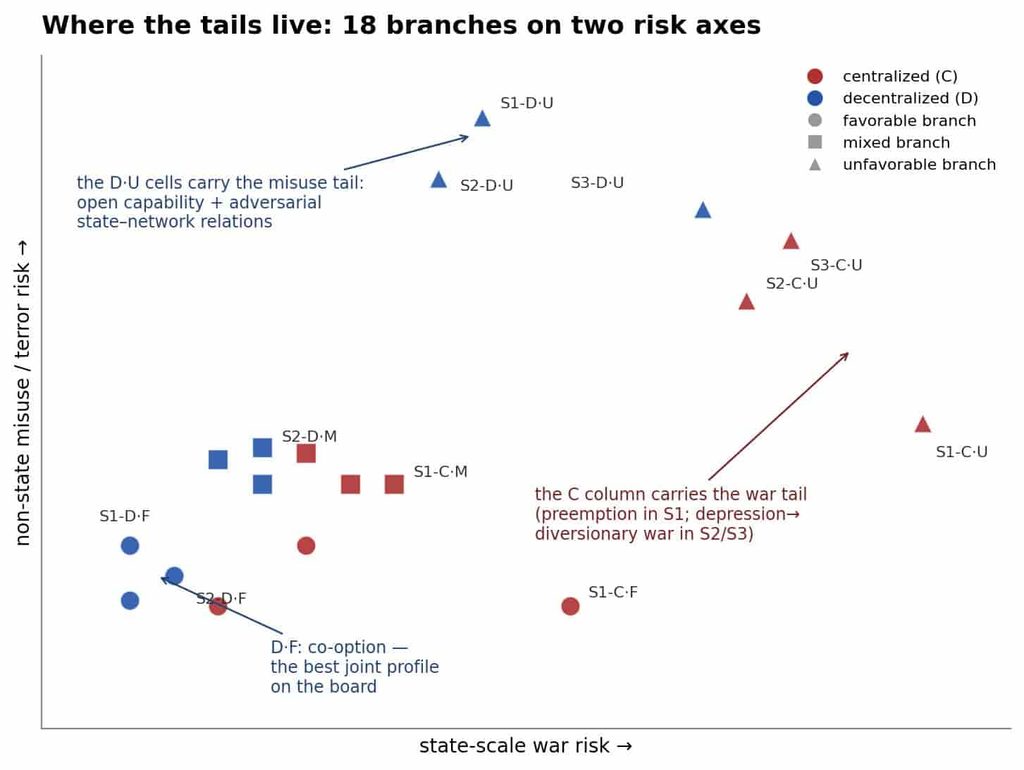
The first pattern across the 54 questions is visible at a glance: state-scale war risk concentrates in the centralized column. The three worst war cells in the 54-cell grid are all C (“centralized”) cells, and they get there by two different mechanisms:
- The fast mechanism lives in the neo-Kurzweilian scenario: two states approaching superintelligence at parity is the classically unstable configuration, where closing-window logic—the same reasoning that drove 1914—makes preemption look rational to both sides at once, with Taiwan as tripwire and instrument.
- The slow mechanism lives in the crash scenarios: depression feeds blame politics feeds diversionary nationalism, on the historical schedule that ran roughly a decade from 1929 to 1939, which places the danger zone in the early-to-mid 2030s — and in the moderate scenario, places it exactly when the delayed HLAGI arrives into a rearmed and embittered system.
In every scenario, the decentralized variant scores lower on this axis, for identifiable reasons:
- an unownable prize removes the preemption incentive
- the network’s crisis absorption likely blunts depression politics
- nobody loses face losing a race to a commons, which defuses the humiliation dynamics that often drives escalation from weakness.
The second pattern cuts in a somewhat opposite direction: decentralization converts concentrated catastrophic risk into distributed misuse risk. The terror-risk peaks of the entire grid are the decentralized-unfavorable cells, and they share a signature—open capability plus adversarial state–network relations.
When the states wage chokepoint war on the network, the compliant layers die first (they’re the reachable ones), and the compliant layers are precisely where the governance and the immune systems live; what survives is gray infrastructure serving whoever pays, hosted by whichever stressed states will take it.
But look at the same cells’ favorable and mixed branches: wherever the state–network relationship is cooperative or even just negotiated, misuse stays at criminal rather than catastrophic scale, because the network’s own security institutions function. The risk transfer is conditional, and the condition is the relationship.
Since my assumption is that, on the whole, state-scale war dominates non-state terrorism in expected harm by orders of magnitude. I conclude the decentralized column wins the aggregate comparison even at its worst—but the spread within that column is probably the largest controllable quantity anywhere in the analysis.
(Yes, I could imagine some pushback on this conclusion that “better a bunch of diffuse terrorist activity than a world war. But I would push back on the pushback, for sure. One argument is that modern states will tend to enlist terrorist networks to help do their stuff (and then at some point lose the illusion of control over said terrorist networks)—so it’s not really “terrorism vs. war”, it’s “terrorism vs. ‘war which includes terrorism’”. Anyway this could become a huge digression into recent military history, and does illustrate the significant number of moving parts in the sort of analysis I’m trying to do here...)
Three more patterns that arise via this analytic process, summarized briefly:
- The G2 anti-network alignment is a structural attractor: in all three timelines considered, the unfavorable decentralized branch features Washington and Beijing cooperating against the network—via security panic in the fast world, crisis scapegoating in the moderate one, bust-closure in the pessimist one. When the same coalition forms independently in fast, medium, and null worlds, it isn’t a story artifact; it’s what two sovereignty-based systems do when facing a non-sovereign capability holder, and it should be planned for as the default.
- China’s domestic economy is the most dangerous single node in the grid: the Party-legitimacy-crisis-resolved-through-nationalism mechanism is the trigger in most of the war-risk mass, which yields the uncomfortable corollary that Western policies sharpening China’s crash—however emotionally satisfying in a crisis—load the most dangerous gun in the system.
- The developing world is the most decentralization-sensitive theater: the Global South’s outcomes swing harder between the columns than either great power’s do, from subsidized client or crushed periphery in the C worlds to contributor, host, and leapfrogger in the D worlds—which means the network’s natural constituency is the majority of humanity, a fact with strategic implications we’ll get to.
Of course all this is highly speculative and uncertain, but, even so, I would submit it is a more thorough thought process than most of what I see written on these topics. I would like to so some much more rigorously data and simulation driven work along these lines. But for the moment, given these interesting if tentative conclusions, what are the practical upshots?
If Washington were listening
The 54-cell analysis generates five reasonably specific recommendations for the US government, and writing them down at least establishes what seems knowable-ish in 2026.
First, prepare the crash response now, and build it to fix things discerningly. The crisis window arrives on the economic clock regardless of scenario; the difference between the 1933-US path and the 1930s-Europe path is in nontrivial part a matter of whether the reform apparatus exists when the panic hits—investigation files pre-built, resolution authority for the SPV and private-credit machinery pre-drafted, the public-equity-for-bailout template ready. And discriminating means: aim the response at the levered structures that failed, not at everything with “AI” or “token” in the name. The single most self-defeating move available in the entire grid—it recurs in multiple unfavorable cells—is bailing out the structure that failed while banning the structure that didn’t.
Second, treat the network as infrastructure to join rather than an adversary to defeat. The chokepoint war fails in every cell where it’s tried: the network survives offshore, America loses the industry, the diaspora hosts inherit the windfall, and the misuse risk goes up rather than down because the crackdown killed the governance layers first. The alternative is boring and effective—hold stake, run validators through the national labs, procure through the network, put the state’s interests inside the governance where they can actually be exercised. Sovereignty through participation rather than prohibition.
Third, soften China’s crash rather than sharpening it. This is the recommendation some parties to US domestic politics will probably resist most fiercely; however, the grid is unambiguous about it… Chinese economic distress is upstream of most of the war-risk mass, and a cornered Beijing is far more dangerous than a competitive one. Crash-softening statecraft—not abandoning competition, but declining the punitive financial decoupling and the triumphalist crisis politics that convert a rival’s recession into a regime-survival emergency—is on the whole cheap WW3 insurance.
Fourth, build the distribution machinery before the displacement, not after. Every favorable branch in every scenario features transition income, benefit-sharing, or participation mechanisms arriving roughly on time; every unfavorable branch features them arriving late into a radicalized electorate. National-scale versions by default would take three to five years to legislate and stand up, which means the start date that catches the crisis window is approximately now… a somewhat disturbing condition given the (lack of) sophistication of current government policy on AI, and Big Tech execs’ policy proclamations… We will either need serious advance planning on UBI-in-spirit mechanisms, or else very creative leveraging of advanced technology and decentralized organization to roll out such mechanisms at much-faster-than-typical-government speed.
Fifth, prepare the arms-control window. In the moderate and pessimist scenarios, mutual financial exhaustion opens a negotiating window around 2029–2032 in which both powers privately want an excuse to spend less—historically the easiest signing environment there is. Verification regimes take years to design, even when they don’t involve radical new technologies… having one drafted when the window opens could be the difference between collecting the détente dividend and watching it close.
If Beijing were listening
The mirror-image list is shorter, because China’s state-directed financing architecture already handles some of what Washington must build, but three items pop up as especially significant:
- Use the crisis for an economic pivot: the crash years are the first time in two decades when the household-consumption rebalancing—promised since at least 2004, deferred through every boom—has no competing claim on resources, and the cells where China emerges strongest are uniformly the ones where the pivot finally happens.
- Keep the fork thin (i.e. keep China’s tech sphere as close to the US one as possible): the severed-fork branches all run the same way, with the domestic Chinese instance falling behind a global frontier it can no longer see, the talent torrent finding every crack in the wall, and the security gain evaporating into competitive decline—whereas the thin-fork branches capture the frontier’s value at a manageable control cost, which is the WTO calculation applied to a protocol, and it paid off the last time.
- Take the face-saving exit: the deepest thing a leading commons offers Beijing is the removal of the scenario where China visibly loses a bilateral race to America—nobody loses a race to a commons… and that property is likely worth more to regime security than any plausible outcome of the race itself. The diversionary-war temptation is the one existential mistake available in every scenario; a Party that has banked the commons exit doesn’t need it.

For the deAGI world: what to do without waiting for either of the great sovereign powers
Now some recommendations that I can more clearly play some role in acting on… i.e. what can we in the deAGI world do to work toward beneficial outcomes, if the analysis presented is roughly in the right direction?
A big conclusion I got from this analysis is: In the worlds where decentralized AGI becomes a really powerful thing, the future branch you land on is largely guided by the state-network relationship… and that relationship is substantially designable from the network side.
The switch between the best cells on the whole board and the worst terror cells on the whole board is, to a meaningful degree, an engineering and institution-building problem that the decentralized AGI community can work on directly, starting now.
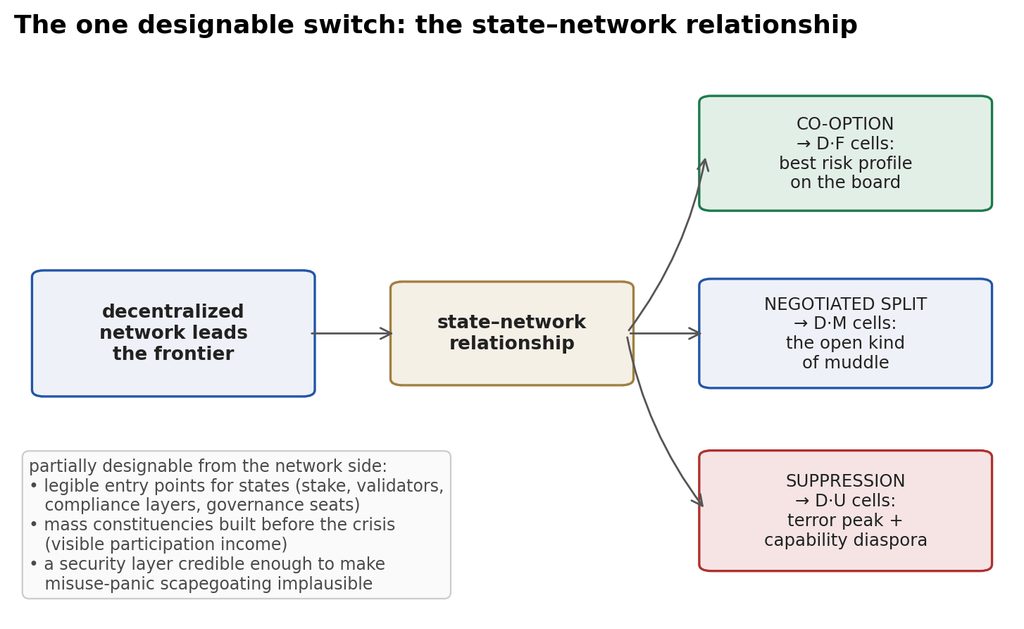
The message, then, is something like: Design for co-optability without surrendering the substrate.
The decentralized network needs legible ways-in for states—stake they can hold, validators they can run, compliance layers they can regulate, governance seats they can occupy—while the permissionless base layer remains architecturally separate, so that no capture of the compliant edge captures the whole and no crackdown on the whole is required to govern the edge.
The two layers should be built so that each can survive the other’s worst day. This is the single highest-leverage project on the list, because co-optability is what makes the suppression branch unattractive to the states themselves: you don’t wage chokepoint war on infrastructure your pension funds hold and your national labs help validate.
As I noted above, Linux provides a beautiful guide here. Has its wild and open, creative spirit been co-opted by corporate cooperation and funding? Yes and no.
Build the immune system as a first-class institution, before the incident. Every suppression branch begins the same way—an attack, or a frightening capability demo, attributed to the open network, converted by the panic into a mandate. The pre-emptive answer is a security layer with independent credibility: decentralized monitoring, capability gating negotiated openly in protocol governance, incident response that visibly works, and a track record established in peacetime. The goal is that when the scapegoating moment arrives—and in most branches it DOES arrive—the claim “the open network is ungoverned” fails on publicly checkable evidence. I have argued before that we need a decentralized ratings agency for the crypto and deAI world – now would be the time.
Make the financial transparency and reputation-driven dynamics of the decentralized network clear before the crash. In the moderate scenario the network’s decisive political asset is contrast—no leverage, no bailout, transparent reserves, still running—but contrast only converts into legitimacy if the public can see it before the blame contest starts. That means radical financial transparency as ongoing practice, third-party attestation of the no-debt structure, and the participation-income mechanisms operating visibly at real scale in advance, so that when the levered complex fails, the alternative is not a proposal but a demonstrated fact with a constituency.
This is going to be a major, let’s say heroic PR job because decentralized networks have historically been associated with scams and speculation almost exclusively. Making the markets and the general public see that decentralized networks can actually be MORE transparent and ethical than the mainstream economy will not be a trivial job … on the other hand the extremely bad job Big Tech is doing of managing public opinion toward AI now may give a helping hand…
Build the Global South constituency as the counterweight to the G2 attractor. Since Washington-Beijing alignment against the network is the default in every unfavorable branch, the network’s strategic depth is everyone else — the middle powers and developing world that gain in every decentralized cell. That argues for hosting agreements negotiated now with a diversified set of states (enough jurisdictions that no G2 pressure campaign covers them all), node infrastructure and participation income deployed where the cost points bite — and the framing made explicit: when the state-network conflict comes, it should be legible to the majority of humanity as center versus periphery, not regulators versus crypto.
Prepare to absorb the wreckage. The fire sale of 2028–2030 is predictable in every scenario that includes a crash, and absorbing it—hardware, talent, and half-built power infrastructure at cents on the dollar is the network’s single largest capability-acceleration opportunity. That is a logistics and treasury problem with a start date: standing facilities for hardware intake and re-homing, legal templates for distressed acquisition across jurisdictions, and reserves managed so that the network is liquid precisely when everyone else isn’t. Counter-cyclical readiness is not a trading strategy here; it is the mechanism by which the crash feeds the commons instead of the scrapyard. If tokenized compute is a real thing by the time Big Tech’s data-center debt comes due, it will be perfectly positioned to absorb a lot of new capacity which it can then use to power the next explosion – I.J. Good’s Intelligence Explosion.
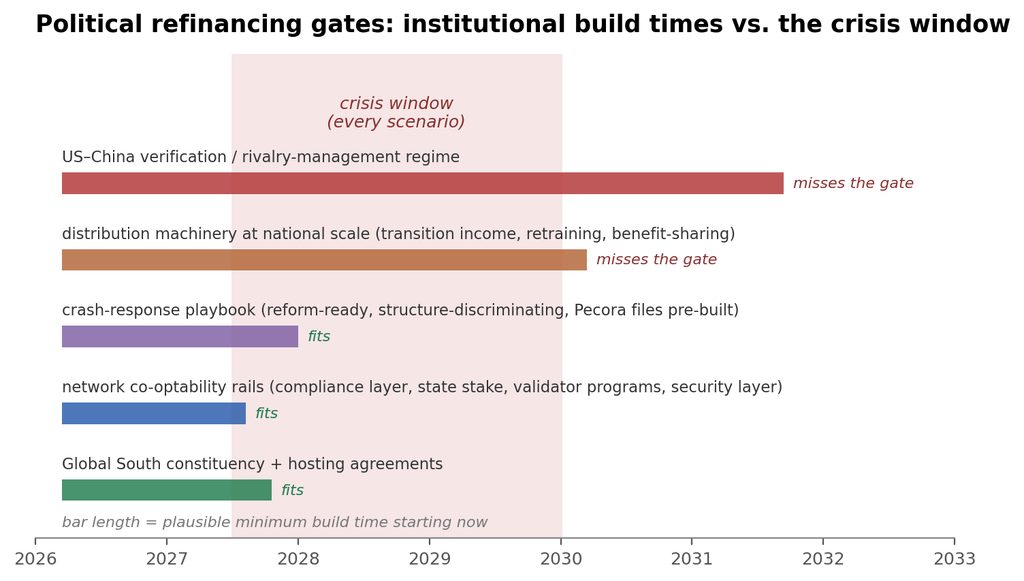
The chart above is the summary argument for urgency, and for a division of labor whose urgency seems to be evolving emergently rather than via any party’s particular desires or plans.
Of the institutions that would help a lot in encouraging favorable outcomes, via my analysis,
- The ones that only governments can build—the rivalry-management regime, the national distribution machinery—plausibly cannot be finished inside the crisis window even on an optimistic schedule starting today. Government could help but would almost surely be too slow
- The ones the decentralized network can build for itself—the co-optability rails, the security layer, the constituency, the crash readiness—fit very well and are actually feasible. The deAGI world with its ability for rapid action is our species’ best hope, if it chooses its actions wisely.
The end conclusion is: The decentralized world isn’t just the robust economic architecture from the last post; it is, on the time-scales we seem to be facing, the only actor positioned at all plausibly to arrive at the gates prepared.
A rough stab at muddle-ology
One more line of thinking, more qualitative… I am far from a professional historian, but I’ve read a lot of history, and one obvious conclusion I’ve come to is: History mostly muddles forward in a chaotic and confused way rather than dealing in clean and pure outcomes.
But also: There are many kinds of muddles… and it’s important how, across the scope of our species’ history, decentralization-oriented and centralized-only outcomes tend to muddle differently, in kind rather than degree.
The centralized muddles one sees in history largely share a common direction: oligarchic consolidation, legitimacy erosion, futures quietly foreclosed via closed-mindedness and selfishness of elites. Running through some random historical examples:
- The first Gilded Age is the template: trusts, a Senate of millionaires, two decades of populist rage that changed little until external shocks forced reform.
- Japan after 1990 is a gentler variant—zombie firms rolled over indefinitely, and national champions that owned the hardware world in 1989 missing the internet, the smartphone, and the platform economy in sequence.
- Brezhnev’s zastoi is a darker version: futures foreclosed so thoroughly that change, when it came, could only come as collapse.
- And a more recent case: the post-2008-financial-crisis settlement, where the banks that caused the crisis emerged larger while QE inflated the assets of whoever already had assets, with the bill arriving on schedule in 2016;
- Or the sad saga of the previously great Boeing – financial engineering slowly consuming actual engineering until the doors came off.
On the other hand, the decentralized muddles one sees in history tend to share a different vector: unresolved pluralism, permanent argument, options held open, capacity preserved through the winter for whatever comes next. Walking through a few examples:
- Internet governance is the canonical case—“rough consensus and running code” as institutionalized permanent argument, which beat the ITU’s takeover attempt in 2012 and is why the network still routes around its would-be owners… and why I can still exchange research ideas with scientists at the University of Isfahan…
- The cryptography wars ran the same way: Clipper chip defeated, PGP spreading anyway, strong encryption living ever since in a regulated split that gets relitigated but never closed.
- Linux went from “cancer” to the substrate of its detractors’ clouds… without, as I keep pointing out, losing its global decentralized foundation and the diversity and creativity that comes with it
- Going back a bit further, fragmented early-modern Europe’s quarrelsome jurisdictions sheltered the presses and heretics no empire would have tolerated, while the Ottomans restricted printing for centuries.
- In the history of AI, the connectionists kept neural networks alive through the AI winters in unfashionable labs on small grants until the compute caught up—just as symbolic and evolutionary AI researchers have been doing over the last few years in the era of “backprop neural nets uber alles”
Nobody plans the decentralized muddles and nobody exactly wins them; they hold the door open, which turns out, at the hinges of history, to be most of what’s actually needed to foster tremendous progress…
Of course one can throw around historical examples in whatever permutations one wants, to make whatever point one wants. I’m not trying to do serious history here (not that there’s anything wrong with that!), just trying to explain where my conceptual model on these matters comes from. My perspective is something like: Though we cannot choose or chart our future with precision, we can still have some impact on which kind of muddle we collectively muddle toward.
And one thing we can see from my 54-question analysis is: Across fast, slow, and failed AGI timelines alike, the centralized column’s stagnations close doors and the decentralized column’s tensions keep them open. That, more than any single favorable cell, is the political case for building the decentralized path: Flourishing deAGI does not guarantee a good ending, but it seems to come the closest of all viable options to ensuring that as various muddles unfold, a good ending remains reachable.
My previous post on the economics of Big Tech’s Big AI Bets ended by observing that a reasonable fractional-Kelly bet on the future is feasible if one organizes the betting via a network nobody owns.
This post ends a step further along: this same “network nobody owns” direction yields the most tractable paths we have to positive political futures and overall to positive futures for our species and its descendant cognitive creations.
Which of course is a conclusion I came to long ago based upon much less systematic analysis. It’s just interesting and perhaps important to see how such conclusions emerge from concrete consideration of the near-future situations that we now have at hand. “May you live in interesting times…”