

A billionaire is very rich. A modern centibillionaire is a quite different species, with a unique societal role.
It’s not that the modern tech-founder super-rich who increasingly control our world are younger, slicker versions of Dr. Evil. They are outsized characters in the public eye, but that’s what our media machine does. The main point is, these uber-wealthy geeks are trying to figure out what cool and impactful things can be done with the absurd amount of money their good luck, hard work and post-industrial-era positive feedback dynamics have somehow garnered them. What do you do with all your wealth and power once dominating a regular industry, buying an election, buying a newspaper and buying a super-yacht are not enough? Buying your own country is a big pain in the butt to pull off – and colonizing a new planet just takes so very long as Elon has discovered – so instead you DOMINATE A GLOBAL COMMONS. It is not who these people are, primarily, that drives this dangerous dynamic; it is WHAT THAT AMOUNT OF MONEY WANTS.
One hears a lot about the social, economic and ethical problems posed by billionaires, whom many on the left largely feel “should not exist.” I can understand the feeling – the accumulation of that amount of money tends to be due to large-scale social dynamics involving numerous people/industries/social-networks … and a society is not required to structure itself in such a way as to allow so much wealth to accumulate in one person’s pocket.
It is tempting to argue that billionaires are responsible for poverty by hoarding all the wealth, but it doesn’t quite hold up – there would be plenty of policy regimes that would wipe out poverty without also wiping out billionaires.
The question I want to explore here is a little different, though. I want to look at what practical impact the existence of billionaires actually has on our society and economy – especially as related to the unfolding AGI revolution.
When you really dig into it, the overall social and economic impact of billionaires looks to be two different topics: 1) the general impact of overall wealth inequality, 2) the specific impact of modern centibillionaires on the modern tech-centric economy.
The first of these, the impact of overall wealth inequality, is certainly super important, but also very longstanding and deeply embedded in society and fairly well understood. Thomas Piketty’s Capital in the 21st Century, while controversial in some aspects, very nicely charted the rise of income and wealth inequality in the West over the last centuries and enumerated its various implications, such as:
- Inefficient capital allocation, away from entrepreneurial innovation from lower-class individuals with poor access to capital
- Capture of democracy by wealthy political donors
- Social stratification, decreasing the intelligence of society as lower-class individuals come to consider certain sorts of education not worthwhile due to limited career options even after education is obtained
- Wage stagnation as labor loses political and economic power
These are all meaningful factors to think about, and to address with policy improvements – though some of Piketty’s specific policy suggestions, such as a global wealth tax, feel not terribly practical in the immediate term.
What I want to talk about here, though, is the second point, which is substantially distinct from these general factors: There has been a specific social and economic and technological role for not merely the very rich but the very, very, very rich – i.e. a huge and very special role of tech centibillionaires in reshaping the world socioeconomic system over the last couple decades. That is what I want to dig into here.
The Cost of Major Influence
A billionaire sounds super rich to me, like it probably does to most people reading this. But it’s interesting to think a bit about the limitations of what a “mere” billionaire can actually do with their wealth – on the level of social, political and economic impact, I mean, not mere personal indulgence….
There is a price list for moving a society, and in the US it runs roughly like this. A competitive House seat can be swung with spending in the tens of millions. A Senate race or a statewide ballot initiative runs to the low hundreds of millions. Being the single biggest outside spender in a presidential cycle costs a few hundred million to about a billion. A major newspaper is a few hundred million. A major social platform is tens of billions. Running a frontier AI lab is ten billion a year and rising.
So a billionaire gets to reach one of the lower rungs of big-time influence, once. Buy the newspaper, or be the big spender in one election, and then they have basically shot their shot — and since e.g. company founder wealth is mostly illiquid stock rather than cash, the dent can be bigger than it looks from outside.
Above fifty or seventy billion (i.e. roughly though not quite around centibillionaire level), there seems to be a threshold: The cost of achieving big-time influence stops being a dent and starts being casual. You can influence an election, buy a newspaper, whatever, all at once, and it is a rounding error. Elon spent something like a quarter of a billion dollars on the 2024 election — less than a tenth of one percent of his net worth. Buying Twitter at forty-four billion was about a fifth of it. He can only buy so many Twitters. He can influence a great many elections.
And of course consumption is already boring, at that level of wealth. Sure, you can build a super-super-super-yacht, but in the end it’s not that much more fun than a plain old super-yacht – maybe even less fun as there are so few places to dock it. You have the private plane. You have an array of well-kept luxury homes. You have left the legacy for your family. Philanthropy at the scale of a normal foundation takes no effort at all. So what is left for the marginal dollar is the achievement of uncommon amounts of influence, in one form or another.
The centibillionaire does not sit down one day and decide to convert wealth into inordinate amounts of power. Rather, what seems to happen is the wealth has nowhere else to go – and it would be a shame to let it just sit there, right?
Two other things are also worth remembering here:
- First, the visible spending is the smaller half of the effect. The knowledge that the centibillionaire is out there willing and able to have a certain effect in a certain domain of society, has an impact on everyone; they will adjust their behavior accordingly. In tech for a couple decades for example there was a “What if Google does it?” phenomenon. Any idea a founder pitched to tech VC, would immediately get the pushback “What if Google does it?” There were websites suggesting witty or insightful responses for founders to use. The propensity of the Google founders’ empire to copy or buy any cool tech project out their fitting their own aesthetic taste had a huge impact on what companies tech founders would bother to form and grow.
- Second, this money is rarely a diversified portfolio – it is mostly a controlling stake in one company. A rich person with a bank account reaches the world through purchases; a founder reaches it through the strategy of an enterprise employing a hundred thousand people, with no shareholder vote required. Dual-class share structures at Meta and Alphabet see to that, and outright ownership does the same at X and the Washington Post.
It is worth remembering how new all this is. Gates brushed against a hundred billion nominally at the top of the dot-com bubble, but as a durable category the centibillionaire dates from Bezos crossing the line in late 2017. Depending on the day’s stock prices there are now somewhere between fifteen and twenty-five of them. Nothing in the institutional landscape—antitrust, campaign finance, the norms of philanthropy, the governance of open-source projects—was designed with these people in mind, because when it was designed they did not exist.
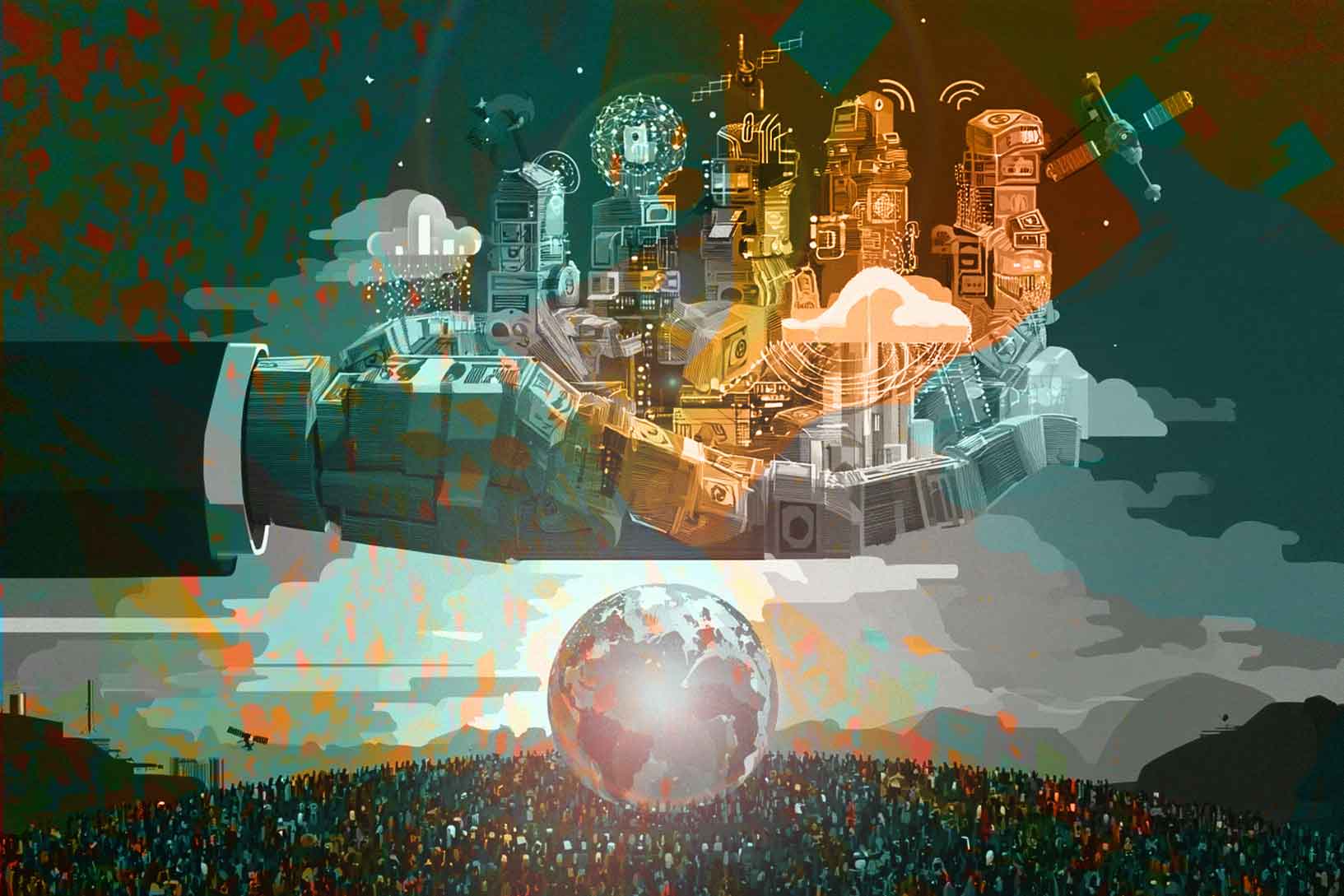
Who the centibillionaires are
The old rich—the people who inherited retail or luxury fortunes, or own industrial conglomerates, plus one extremely successful investor in Omaha—are a minority of the elite centibillionaire class, and they are not the ones shaping technology.
Most centibillionaires are founders of software and hardware companies started since about 1975: Microsoft, Oracle, Amazon, Google, Facebook, Tesla, Nvidia, Dell, and so on. That is the sector that has had an outsized influence, for good and for bad, on our society.
So anything you conclude about the super-rich and technology is mostly a conclusion about a couple dozen tech founders.
And it’s pretty obvious, but perhaps worth clarifying that it was generally the tech that made these people super-rich. Unlike say Donald Trump, these folks tended not to get their start from super-rich parents, and then try to amplify the wealth they inherited. Musk came from a reasonably privileged background but built up his wealth entrepreneurially through a series of tech ventures … and he was worth on the order of two hundred million dollars when he founded SpaceX and he put money into Tesla. Rich, but not super super super rich. Bezos started middle-class and was a mere single-digit billionaire for the first ten or fifteen years of Amazon. Zuckerberg built Facebook in a dorm room. While there was a lot of feedback involved, on the whole these guys used certain fairly novel technologies to get their fortunes – more centrally than using the fortunes to build the key technologies underlying their success. In fact, once they became insanely wealthy, their success at introducing fundamentally radical technologies has often decreased rather than gone up.
Centibillionaires and the four stages of technology growth
Since these are tech billionaires, to understand their trajectories it helps to say something about the stages a technology passes through as it develops, because concentrated money affects each of them differently.
- Discovery is inventing utterly new things — the transistor, packet switching, the transformer architecture. That is largely universities, occasionally industrial labs, occasionally independent inventors.
- Development and scaling is taking something that came out of academia or wherever and blowing it up into something big that works reliably at scale. China has recently started doing a lot of this; historically the US has been supreme at it. Fundamental discovery happens all over the world, but turning an invention into something real at scale has been the American speciality.
- Deployment is the question of which things actually get built, in what form, and for whom. China has been godlike at deployment. The US has been pretty good too.
- Governance is controlling the thing once it is out in the world: who decides what the platform permits, what the model is trained on, what gets opened and what stays closed.
Centibillionaires have influenced these different stages in importantly different ways.
It is particularly interesting to ask what did they do at the founding stage, with founding-stage money, and what did they do afterwards, when the money was effectively unlimited? The answers are not the same, and the gap between them is informative…
The founding bets were real, and they were big compared to my bank account or most people’s — but not big compared to a hundred billion dollars. A hundred million here, a few hundred million there. SpaceX was seeded with roughly a hundred million dollars of Musk’s PayPal proceeds and came within one launch of bankruptcy in 2008; the fourth Falcon 1 flight succeeded in September of that year and a NASA cargo contract landed in December, and without either the company was dead. Tesla went through a comparable near-death in the same year. No committee makes those bets. To the extent the super-rich accelerated technology, this is where it mostly happened: at the hundreds-of-millions stage, when the money was scarce enough to demand discipline and the founder was personally exposed.
What happens when the money stops being scarce
Then when the emerging centibillionaire gets more and more money, hundreds of billions bouncing around, the technology acceleration in their surround gets a lot less obvious.
The space industry provides something close to a natural experiment. Blue Origin and SpaceX were founded two years apart, in 2000 and 2002, by two of the richest men in the world, with the same broad ambition. SpaceX operated under existential financial pressure and, from 2008, under NASA contracts with milestones attached. Blue Origin operated with a patient owner who said in 2017 that he was selling about a billion dollars of Amazon stock every year to fund it, and who imposed no deadline on anybody. Two decades on, SpaceX has made reusable orbital rockets routine, built the largest satellite constellation in history and taken a dominant share of the world’s launches. Blue Origin flew its first orbital rocket in January 2025. The personalities are surely part of the story, but the experiment does not support the idea that more patient money buys faster technology. SpaceX was hungrier, and hungry is why they made such efficient use of the resources.
Meta’s Reality Labs tells the same story from the other end. The headset it grew out of was an Oculus Kickstarter that raised about two and a half million dollars in 2012. Facebook bought the company for two billion in 2014 and has since spent well over sixty billion dollars, at ten to twenty billion a year, on a metaverse vision that has produced some modest hardware and not much else. That money was not even personal — it came off the corporate balance sheet — but a dual-class share structure meant one person could decide to spend it, year after year, over the objections of essentially every outside shareholder. The superintelligence spending spree has the same shape.
So the pattern we see is that private money accelerates technology while it is scarce enough to impose discipline, and stops helping — and may start hurting — once the discipline is gone. The centibillionaire tier is by definition on the far side of that line. Once you have that much extra cash to burn you don’t have the discipline there that Zuckerberg had rolling out Facebook, or Musk had building Tesla.
This leads us to another aspect often blurred when talking about these tech business heroes, which is the difference between discovery and scaling. These companies are extraordinarily good at scaling — at taking a capability that exists in a lab and making it work for a billion people. They are much less clearly good at discovery. The mid-century record of state-funded and monopoly-regulated research is insanely awesome by comparison: the transistor at Bell Labs in 1947, the integrated circuit in 1958-59, the laser in 1960, packet switching and ARPANET at DARPA in the 1960s, Apollo, recombinant DNA in 1973, GPS. The transformer came out of a Google research group in 2017, but the ideas underneath it came from decades of academic work, and what the frontier labs have done since is scale it. This scaling work has been impressive, expensive, and a very different sort of activity.
The super-rich as a structured noise source
One further point to note about the role of these centibillionaire dudes in technology advance is the simple fact of their randomness. I.e., one can argue that, just by virtue of being individual people with their own peculiarities in positions of huge societal power, they have introduced a lot of noise and variance into the technology growth process.
Committees fund the median project. Public agencies avoid the embarrassing failure. Diversified shareholders punish the ten-year bet. A few idiosyncratic people with unlimited money and nobody to answer to are a variance generator that no institutional process can match. This can actually be a highly valuable thing, because some degree of out-there random stimulation is necessary to fuel the creative aspect of any evolutionary process.
Reusable rockets, a private satellite internet, the malaria and vaccine work, the early funding of the AI safety field, the entire large-language-model race — none of that would have happened on the rapid timelines we’ve seen through normal channels. The variance of centibillionaire peculiarities has definitely made the world more interesting!
On the other hand, countering the fun random nature of having a few weird individuals come up with and actually get to implement out-of-the-boring-mainstream ideas … we have the fact that this is not an unstructured white noise source – the noise has a specific shape. Yes, what we have is one crazy guy controlling so much that he can make a lot of crazy things happen … but the population of crazy guys generating the noise is a couple dozen people drawn from two industries, one country, one sex and a narrow band of birth years. So society inherits these peoples’ fixations – both their individual eccentricities and the biases of their social groups and cultural and business histories – as if they were its own priorities.
Mars, personal space-tourism for the rich, immortality, permissive social network content policy, giant balloons floating over Africa providing Internet… tunnels routing under traffic … brain-computer interfaces. Pretty much what we see is a bunch of youngish white male geeks in the US thinking random cool stuff in accordance with their culture and mentality, and having an enormous effect on the world. From the standpoint of aggregating judgment well, that is an ensemble of a few correlated and overconfident models. So creative noise-generation combating the lowest-common-denominator-ism of large institutions, yes, – but creative noise-generators that are heavily statistically coupled in ways not necessarily oriented toward broad human benefit.
What the route to a hundred billion selects for
The nature of the bias exercised by modern centibillionaires is worth unfolding a bit. It is tempting to explain the weirdness of centibillionaire activities psychologically — they are narcissists or sociopaths, the money warped them, etc. All this could be true for some of them. But you do not need these sorts of explanations to understand what’s going on fundamentally, because there are clear systematic effects coming from evolutionary selection: from what the process of becoming a tech centibillionaire filters for, regardless of who a person is when they enter the process.
I.e., many entrepreneurs enter the pipeline that could make them centibillionaires – but most get filtered out. By far the biggest factor filtering out the rest is luck, but there are other factors too:.
One filter is a passion for control. You do not get to a hundred billion dollars by founding a successful company. You get there by founding a successful company and then refusing, through five orders of magnitude of growth, to dilute your ownership or cede control — through seed rounds, venture rounds, an IPO, two decades of public-company pressure. Founders who accept normal dilution end up rich. Founders who hold on end up, sometimes, sper duper rich. Being obsessed with centralized control is not a prerequisite for entering tech; it is a prerequisite for staying in control of the winnings after you enter. And it would be very surprising if people with that relationship to control applied it only at the office.
A second filter is miscalibration – overestimation of one’s own accuracy and capability. To make your tech company huge, you usually had to make a weird bet nobody else wanted to make. Your priors about what some complex thing could be made to do had to differ from everyone else’s, and anyone who becomes a successful entrepreneur overestimates both their own odds and what the technology can do. These guys overestimated and were right, so now they are insanely convinced of their own rightness and systematically overestimate what a determined guy can do when he wants to. Their intelligence is real and usually considerable. It is their calibration that got selected to be wrong, in one particular direction.
A third is a bias toward particular cognitive skills differentially useful in the tech world. The skill set that builds a tech company is fast, reversible, high-feedback decision-making in a competitive market where you can measure success pretty well: ship, measure, pivot. Social policy and culture are slow, weird, low-feedback, sometimes irreversible, and have no clear metrics. That is precisely the regime where overconfident engineering-style judgment performs worst, and it is also precisely where the money flows once it is unlimited.
A fourth filter is comfort with severed social feedback. Everyone else in the socioeconomic system sits in some corrective loop — elections, boards, markets, peer review, a spouse who says no. The centibillionaire is surrounded entirely by people who want something from him, so the loop opens. Whatever the judgment was at the founding peak, it drifts from there and nothing pulls it back.
So what do you get when you look at the people who have passed through all these filters and become centibillionaires? Control freaks with massive hubris, who enjoy being surrounded by yes-men, and are skilled mainly at making rapid-fire decisions in highly competitive situations well-described by clear metrics.
The ”clear metrics” part is worth emphasizing. Some folks have described the rise of modern centibillionaire-led companies as a triumph of engineering over humanity, but I think that names it slightly wrong. Real engineering cultures — Bell Labs, NASA at its best, old aerospace — were reliability-and-safety cultures, often to a fault. The modern tendency toward moving fast and breaking things was a rejection of engineering culture, not an expression of it. What these founders have optimized is not really quality engineering but rather one or another growth metric: engagement, adoption, daily actives, a benchmark score, the scaling curve. Engineering is the instrument and human beings are the substrate the metric is measured on.
The reduction of humanity to metrics is a phenomenon primarily of Internet-era society, and it is one that fits extraordinarily well with the filters that have selected modern centibillionaires. These people are smart at thinking about, and ruthless at controlling, systems that drive large groups of humans in directions optimizing chosen metrics … and they are surrounded by yes-men to an extent that they tend not to experience deep interactions with the people who are affected by this hyper-optimization in diverse and individually and culturally variant ways.
Exclusionary layers on the commons
So now we come to the core thing I actually want to say here. What these centibillionaires have largely done, after becoming insanely rich, has been to take commons — the worldwide web, the corpus of human writing, the corpus of human code — and use their money to suck them into their own empires. The modern tech super-rich are the owners of exclusionary layers built over large commons, and their wealth is thus disproportionately captured commons value.
To grok how this works, start by thinking about the “stack” comprising the modern tech economy (which increasingly is coming to be the whole modern economy). At the bottom are physical networks and the protocols that let machines talk to each other. Above that, operating systems, languages, libraries, tools. Above that, the applications people actually touch. Running through all of it, the body of human knowledge and expression the applications operate on. Value is realized at the top, where the users are, but it is produced jointly by every layer.
And the lower layers were overwhelmingly built as commons, in Elinor Ostrom’s sense: resources produced by many contributors, governed by shared norms rather than ownership, with nobody holding the power to exclude anybody. TCP/IP came out of DARPA-funded research in the 1970s and was given away. The web was invented at CERN, a publicly funded physics lab, and put in the public domain in 1993. Linux has been built by volunteers and salaried contributors since 1991 under a license designed to keep it free. Compilers, databases, cryptographic libraries, web frameworks — a commons. Wikipedia — a commons. The scientific literature, funded by taxpayers and written by researchers who are paid nothing for the papers — a commons. And the corpus of human writing on the open web, produced by hundreds of millions of people over three decades for reasons that had nothing to do with anyone’s business model, is the largest commons ever assembled. Yochai Benkler documented how productive this mode of production had become; James Boyle warned around the same time that fencing off the intangible commons amounted to a second enclosure movement, an echo of the fencing off of common land in early modern England.
Now we see some structural economics come into play. In a layered system, economic rent flows to the lowest layer that can exclude — that can say you may not use this unless you pay, or agree, or behave. Open layers cannot exclude, by design; that is what makes them open. So they emit their value upward, to be captured by the first layer above them that can fence something off, through network effects, user accounts, proprietary data, closed interfaces. Call it the excludability gradient. What it implies is that the money does not go to whoever produced the most value. It goes to whoever owns the first chokepoint above the commons at the moment the commons scales. This is the origin of the modern tech fortunes.
There is a further twist that turns the commons from an input into a precondition. Because the lower layers were free, the capital and time needed to build a global service collapsed — from a national utility’s balance sheet over decades to a few programmers, some rented servers and a couple of years. Google’s founders wrote PageRank as Stanford grad students on a digital-library project backed by the National Science Foundation. Facebook ran on free software on a cheap server. That collapse in cost is exactly what let a single founder keep control through hypergrowth without diluting, which is the filter that manufactures centibillionaires in the first place. Nineteenth-century capital-intensive industries needed decades of consolidation to concentrate comparably. So the commons is not just something these fortunes drew on. It is the structural reason fortunes of this shape can exist at all.
You can feel this when you look at individual companies and ask why they are shaped the way they are. Google captured the web. Facebook and Twitter captured everyone’s social posts. Amazon captured everyone’s books and killed the bookstores, then captured online marketplaces, which ought to just be people all over the world selling things to each other. Uber should just be people running their cars for each other. Why is Uber not a decentralized network? Why is Amazon’s marketplace not one? Why is Twitter not one? They utterly could be. You could build them that way. They are not, because somebody captured themCred
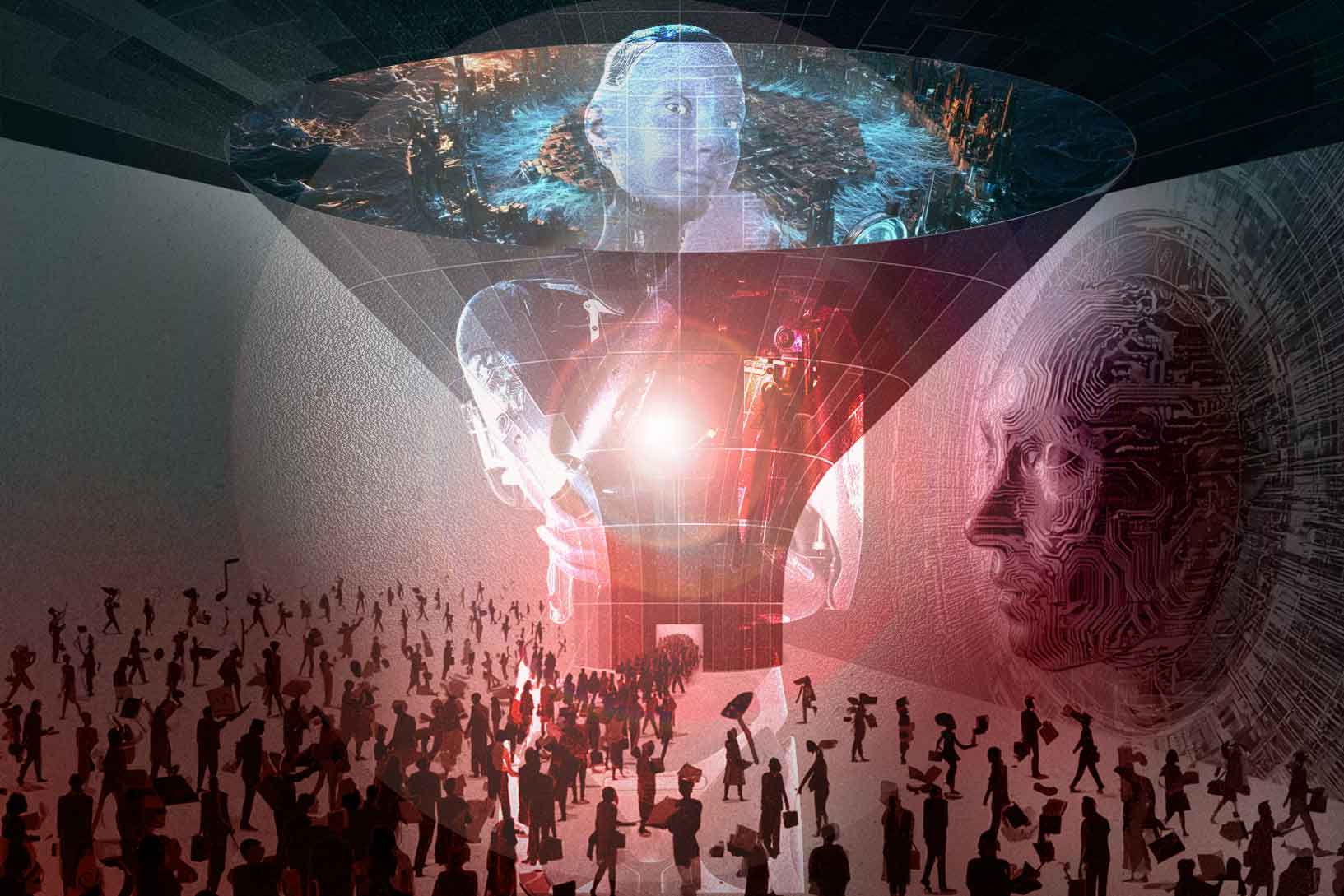
What you do once you hold the chokepoint
One subtlety here is that, sometimes, there is also real contribution back to the commons from the centibillionaire sphere. It just runs in a particular direction. Once the chokepoint is held, the incentives point four ways, and you can watch all four operating.
- First, close the interfaces below you. The platforms that grew up on open protocols have dropped them one after another: Google and Facebook both abandoned XMPP federation for chat in the mid-2010s, RSS was left to wither, Twitter and Reddit both repriced their APIs in 2023 to shut out third-party clients. Cory Doctorow’s word for how this sequence feels from the user’s side has deservedly entered the language.
- Second, extract from the layer above. User data and user-generated content are the raw material of the business, supplied for free by the users.
- Third, contribute back to the commons exactly where doing so weakens a competitor’s chokepoint… and never where it weakens your own. Joel Spolsky called this commoditizing your complement. Google open-sourced Android so nobody else could own the mobile operating system and threaten search. Meta open-sourced PyTorch and later the Llama weights so nobody else could own the machine-learning layer and threaten the social graph. Chinese labs have released open-weight models partly so that OpenAI and Anthropic cannot monopolize everything. These contributions are real and genuinely valuable — and they are steered by the chokepoint, which means the commons ends up being managed by its capturers as a competitive instrument.
- Fourth, decline to refresh the commons’ own inputs. Linux is ridiculously underfunded compared with how much of every big tech company rests on it. When the Heartbleed vulnerability turned up in 2014, OpenSSL — which secured most of the world’s encrypted web traffic — had one full-time developer and about two thousand dollars a year in donations. When Log4Shell hit in 2021, the logging library at the center of it was maintained by unpaid volunteers. Nadia Eghbal’s report Roads and Bridges documented the pattern in detail: trillion-dollar stacks resting on infrastructure maintained by a few geeks nobody pays.
None of this requires extraordinary villainy. Each of those four moves is the locally rational response of a firm holding a chokepoint, and a saint in the same seat would face the same incentives – and would need a great deal of depth and wisdom to resist them. The outcome is predictable from the shape of the system – it is not mainly about the character of the individuals, though the system itself has also certainly biased the centibillionaire population to comprise individuals with particular characteristics, as we’ve gone through already.
A quick tour of some major captures
Just to make sure the concrete point is driven home – what commons are we talking about here?
The web and social platforms. The commons was the web itself plus the open protocols for chat and syndication that grew up beside it. The chokepoints were search and the social graph. On deployment the record is extraordinary: several billion people connected, most for the first time, and the sum of human knowledge made searchable. On the commons it is the four moves above, in order. And the governance concentration — two individuals with voting control over the information diet of a third of humanity — has no precedent.
Open source and the cloud. The commons was Linux and the open-source stack; the chokepoint was the rented computer. AWS launched in 2006, took free software, ran it on Amazon’s hardware and sold it by the hour. The GPL requires you to share your modifications if you distribute the software — but AWS does not distribute it, it runs it, so the obligation never triggers. The most profitable business in computing was built on software its owners had not written and were under no obligation to fund. Elastic, MongoDB, Redis and HashiCorp all eventually abandoned open licenses for restrictive ones, which is the commons defending itself by ceasing to be a commons.
Mobile. Apple built the iPhone closed and captured its chokepoint, the App Store, outright, at thirty percent. Google bought Android in 2005 and released it under an open license in 2008, not out of idealism but because a free mobile OS meant no rival could own the layer between users and search. It worked. This is a centralized decision to decentralize a layer, and it is the thing the simple villain story cannot accommodate: the capturers routinely open parts of the stack, precisely when it protects the part they own.
Space launch. The case that comes out best for the world, to be honest. The commons was NASA’s half-century of publicly funded research and human capital, plus contracts that gave a private company customers before a market existed. In a way launch has been opened up and taken away from NASA, and good — it should be entrepreneurial. SpaceX did in twenty years what the agency had not done in thirty. The commons argument bites in one place: Starlink is a captured layer over a commons that had essentially no governance — low earth orbit, the radio spectrum, the night sky as astronomers see it — and the decision to put thousands of satellites there was made by one person and ratified after the fact by regulators with no framework for saying no. And the risk now is that space goes from one government monopoly to one or two big companies instead.
Crypto. Instructive because the technology was explicitly designed to resist capture. Bitcoin’s architecture is an answer to the excludability gradient: no layer that can exclude, value held at the protocol level by the participants. The last fifteen years answered the question of whether concentrated money can capture a system built to prevent it, and the answer is yes — by building chokepoints alongside the protocol instead of inside it. Exchanges became where most people touch the system, and exchanges are ordinary excludable businesses; the collapse of FTX in 2022 was a chokepoint failing, not a protocol. Mining and staking concentrated into a few pools. Venture funds — a16z’s crypto funds alone raised many billions — ended up holding huge allocations of every altcoin, which reproduces the standard startup wealth distribution on top of a system designed to avoid it. The protocol layer stayed uncaptured, which is a genuine achievement and a foundation for what some of us are doing with decentralized AI. But the value got recentralized one layer up — not even by centibillionaires, just by billionaires and decibillionaires, which turned out to be plenty, because the commons of crypto is smaller than the commons of the main economy. And a great deal of what got built on top was fraud, which is the other lesson: decentralizing a protocol does not make anything humane.
The counterexample. It’s probably a poor rhetorical move to point it out here, but of course not everything these people do is capture. The Gates Foundation spends on the order of eight billion dollars a year, co-founded Gavi in 2000, and has been a principal funder of the work that cut malaria deaths substantially over two decades. Measured in lives it is plausibly the most beneficial deployment of a private fortune ever. It is centralized, and the critiques — agenda distortion, the WHO’s dependence, a technocratic preference for vaccines and bed nets over health systems — are the governance critique in another domain. But there is no chokepoint, no enclosure and no commons consumed: the research gets published, manufacturing is licensed cheaply, the delivery systems belong to countries. There was no easy way to monopolize global health, and they did a good thing there. Which tells you that the objectionable feature is not centralized decision-making as such. It is unaccountable direction combined with capture.
AI, the ultimate commons capture
So now we get to the money shot … the grant finale of all this centibillionare commons capture… and the main topic of this blog overall…
All the data being fed into AI, all the processing power being fed into AI — this stuff could be a global commons. There is decentralized software that lets everyone contribute compute and data to global AI networks and get compensated for it. Instead that commons is being eaten, and every centibillionaire is plowing into it.
This is the excludability gradient at its steepest. The commons that large language models are built from is the entire corpus of human knowledge and expression — the open web, Wikipedia, the scientific literature, the world’s public code, the books — produced by hundreds of millions of people under norms that never contemplated this use. The models trained on it are excludable: weights proprietary, access metered, and the compute needed to train at the frontier running to tens of billions a year per lab, with hundreds of billions now committed in announced capital programs. The largest commons ever assembled, captured at a layer perhaps five organizations can afford to occupy.
What makes it different in kind from everything else we’ve discussed in this post is what happens next. Every previous enclosure left the commons standing underneath. The platforms captured the web, but the web kept existing. AWS captured open source, but the projects kept being written. Foundation models substitute for the commons in use. When the answer comes from the model, nobody visits the forum, edits the article or answers the question — and the evidence is piling up: Stack Overflow question volume fell by half or more in the two years after ChatGPT’s release, Wikimedia reported a measurable decline in human traffic in 2025, publishers across the open web have documented the collapse in visits as search results turn into generated summaries. The model was trained on the commons, the model’s success starves the commons, and the next model has less to be trained on. Capture on the input side and depletion on the output side at the same time. Nothing earlier does that.
The governance picture for AI is the concentrated version of everything above: how fast to push, what to release, what to withhold, what the systems are allowed to say and do, being decided by a few dozen people with democratic input close to nil. And here the variance argument really does run both ways, because the same class of people funded the race and the brakes. The early AI safety field was financed almost entirely by super-rich money — Open Philanthropy, Jaan Tallinn, Musk’s 2015 grant to the Future of Life Institute, Vitalik Buterin’s gifts. OpenAI was founded in 2015 as a non-profit counterweight to Google’s dominance, with money from some of the same donors, before becoming the thing it was meant to counterbalance. Meta’s open-weight releases have spread frontier capability more than any public program ever has — and they are a centralized decision to decentralize capability, made by one person for competitive reasons and revocable by the same person on the same grounds.
Which is the caution I would most want people in the AI field to take away. Decentralized does not entail human-centric. Open weights are decentralized capability with no human-centric governance attached. Crypto was decentralized infrastructure that produced an unprecedented volume of fraud. The variable that is actually broken is unaccountable direction over a captured commons, and decentralizing the capability only fixes the core problems if the decision-making decentralizes with it— if e.g. the people whose knowledge the models were built from get some standing in what gets built and on what terms. The decentralized-AI projects I know best, mine included, have so far had more success with decentralizing capability than with decentralizing governance in a functional and pragmatic way… though the need for both has been very clear.

So what have the centibillionaires actually contributed?
Summing up, distinct from the merely ridiculously rich who have exerted a gradually increasing version of the same old political and economic influence that rich people have exerted in every economy since time immemorial, what have the modern centibillionaires contributed to our rapidly evolving tech economy? –
- On discovery, they have done fairly little. Most of it came from academic and big corporate research labs, and their money went overwhelmingly into scaling.
- On scaling and deployment, they have been incredibly helpful and valuable— billions connected, computing rentable by the hour, launch made cheap, language made computable. And created mostly by founders at the earlier stage, before they got so ridiculously rich. The marginal contribution of the centibillionaire stage is much smaller than the story implies.
- On direction, their impact has been huge. These super-rich geeks had an enormous influence on where technology went. Elon liked electric cars, so there were electric cars. The Google guys saw the singularity coming — not as long ago as me, but a long time ago — and steered things that way. The effective number of people deciding what got built collapsed to a few dozen, with the biases described above.
- On governance, they have had nearly total power, and to mostly very bad effect: taking over these commons, throttling decentralized alternatives, milking and sucking value out of the open-source ecosystem while giving back only minimally, and now consuming the substrate that made the whole thing possible.
The Psychedelic Furs, back in the day, had a great song That’s What Money Wants. What we see here is the 21st century sequel: That’s What A Really Really Really Huge Amount of Money Wants….
And what’s next?
None of this is necessarily irreversible nor unstoppably dominant. Linux is still there. The internet is still there. We have decentralized AI infrastructure and open-source AI, and we can push back. But if the analysis I’ve given here is right, the remedy sits somewhere other than where the moral critique puts it: the character of the capturers is nearly irrelevant and the governance of the commons is nearly everything.
The commons of the 1990s and 2000s chose, in effect, to be capturable — permissive licenses that permit anything, a reciprocity clause in the GPL that never anticipated software being run rather than distributed, a norm that anything on the web may be crawled that was adopted before anyone imagined it would be used to build a replacement for the web. Those were governance choices, made by people who wanted their work to be free and did not foresee the evolution of the incentive gradient.
Fixes to these errors of prior decades are simple enough to sketch out: Reciprocity that triggers on use, data licenses that attach obligations to training, funded institutions for the infrastructure everybody depends on, interoperability mandates at the chokepoints, public compute so more than five organizations can train at the frontier. Some of this is being attempted.
However, these social/technology-policy fixes are not currently rolling out nearly as fast as AI is developing. Which leads us to the biggest possible “fix”, which is what I’m pushing toward with my own work at SingularityNET, the Hyperon project and BGI Labs: “All” we need to do is roll out the next huge AI innovation as open-source code on a global open network with decentralized capability and governance as well…