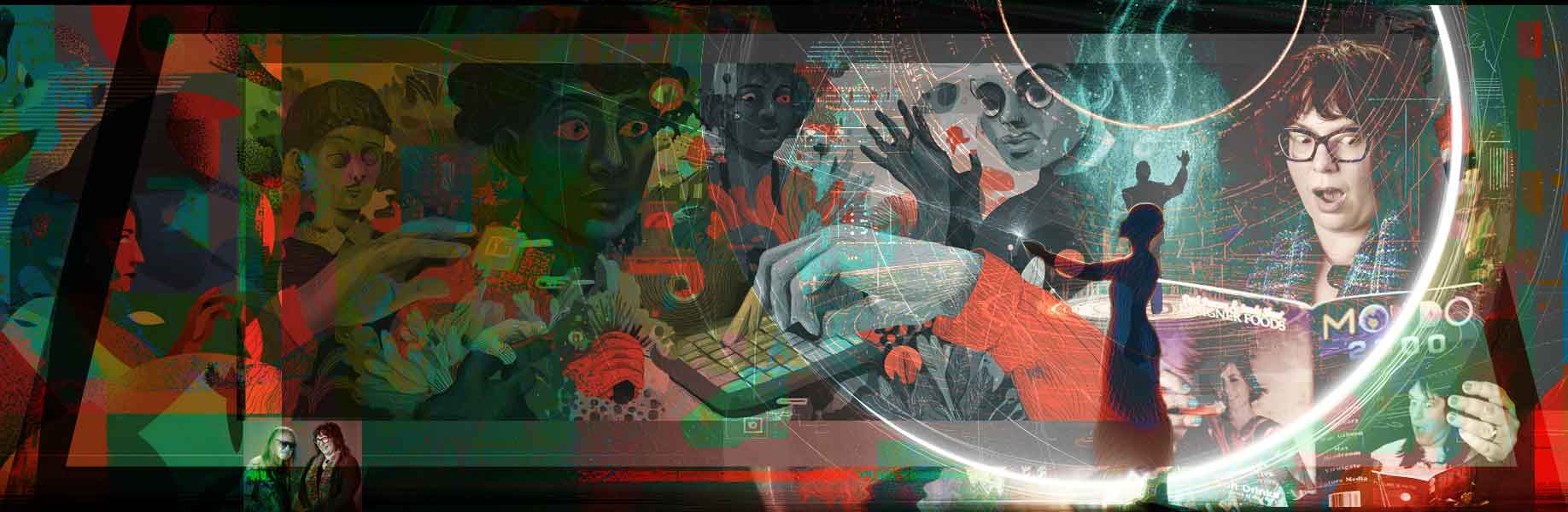

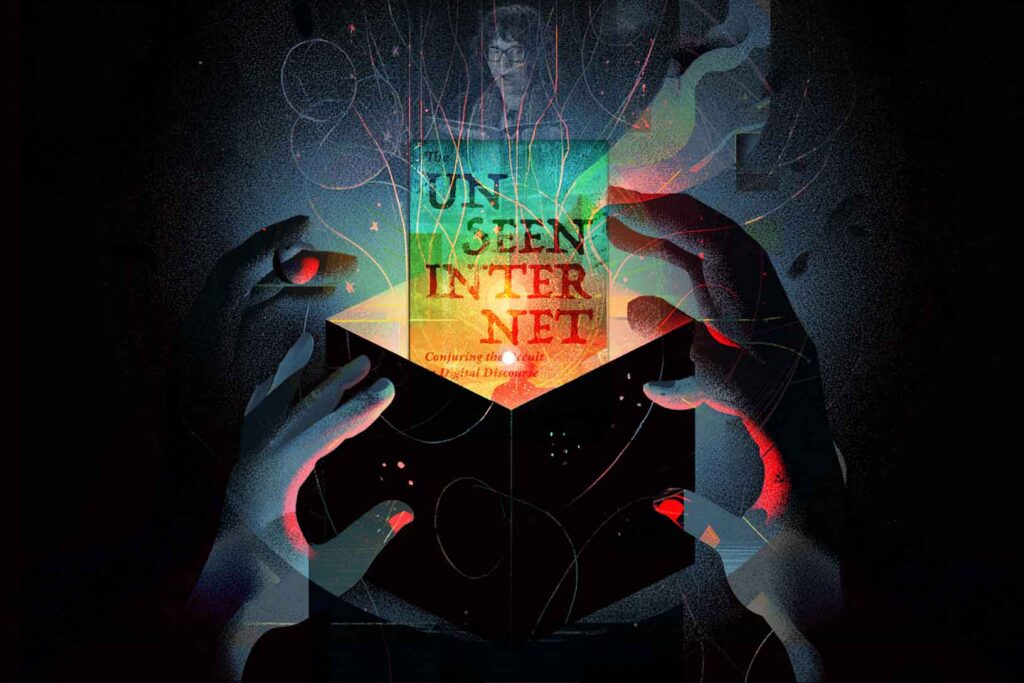
Are there freaks in the machine? Are there ghosts in the machine? Or R.U. agentic? I discuss and explore Shira Chess’s new book The Unseen Internet:Conjuring the Occult In Digital Discourse with the author.
Shira Chess is an Associate Professor of Entertainment and Media Studies at the University of Georgia. Prior to writing the book I’m asking her about today, she had largely applied her feminist critique to games and digital culture. In recent years, she turned her study to how the occult has influenced (and continues to influence) the evolution of the internet and digital technology.
Earlier books include Play Like a Feminist, Ready Player Two: Women Gamers and Designed Identity and Folklore, Horror Stories and the Slender Man: The Development of an Internet Mythology,(co-authored with Eric Newsom).
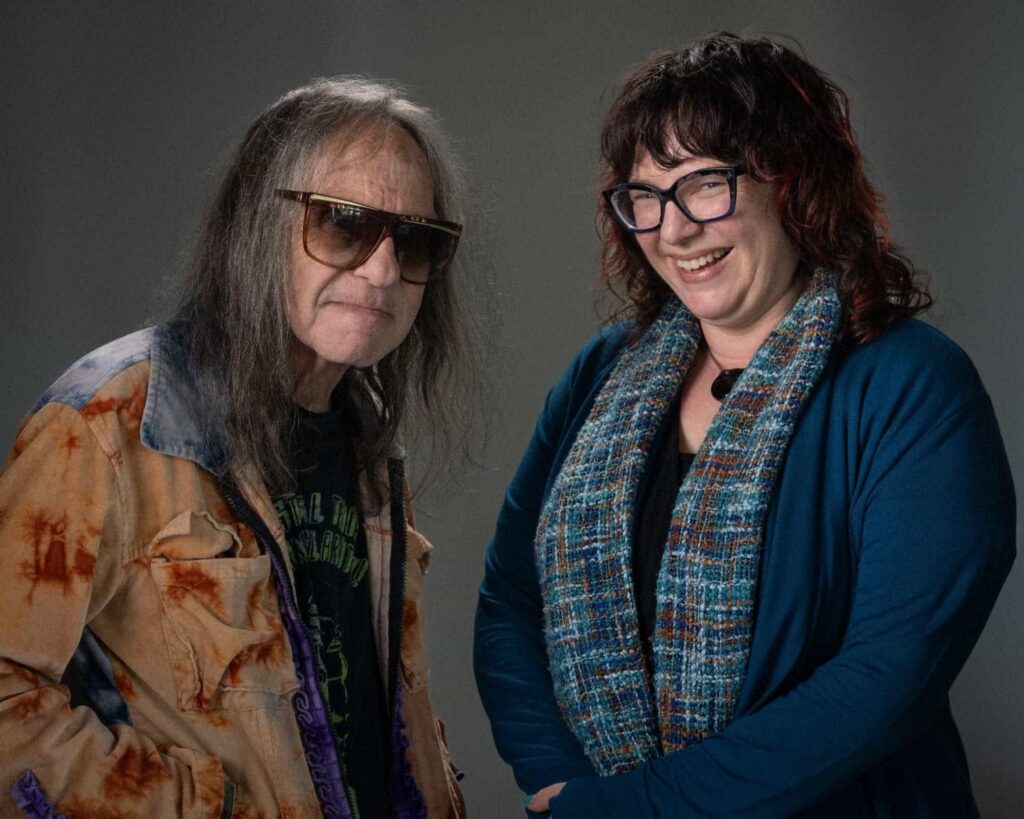
The virtual elephant conjured into the room—the necessary confession here—is that Dr. Chess has also become my coauthor for the upcoming book Freaks in the Machine: Mondo 2000 in Late 20th Century Tech Culture, which will be published by Strange Attractor Books. I shall, however, insist that if this original and relevant text had crossed my transom delivered by an angel or a demon posing as a UPS delivery person, I would have been thrilled to ask Dr. Chess for the Mindplex interview.
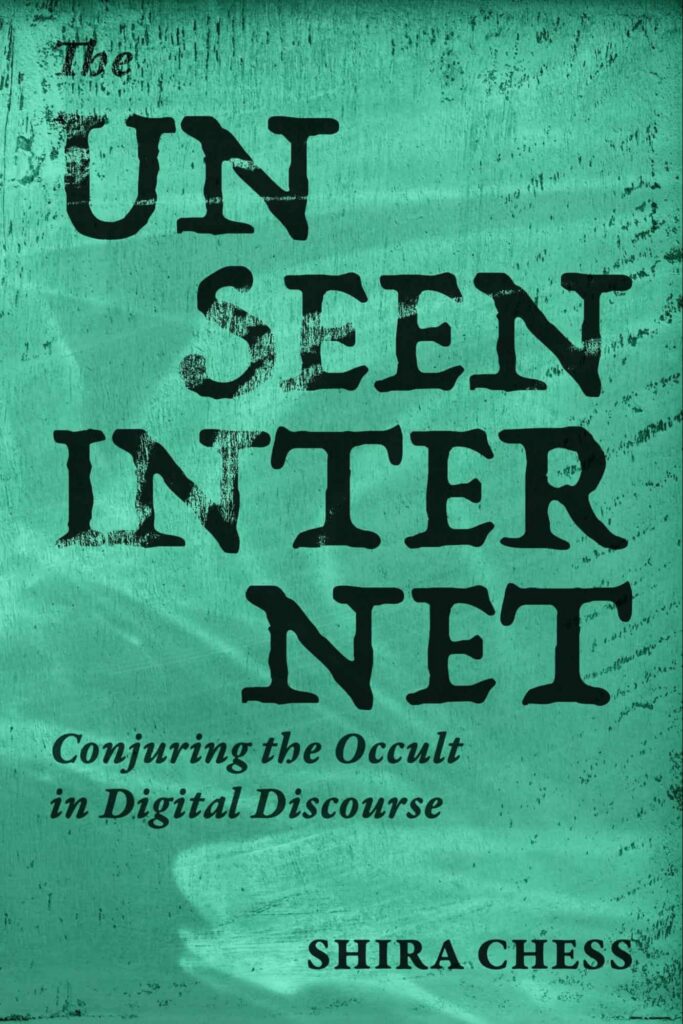
RU Sirius: The title of your book The Unseen Internet (subtitled Conjuring the Occult in Digital Discourse) plays on the original meaning of the word occult. This raises all kinds of interesting thoughts. For example, I don’t think people who were into occult practices were necessarily hiding their influences, and yet, there hasn't been a lot written and said about it. Do you agree? And if so, why has it been largely ignored?
Shira Chess: The title of the book, in some ways, began with my own reticence towards the word ‘occult’ which I honestly think is an ugly sounding word. The word ‘unseen’ seemed to be closer to the thing that I was clocking in on, the sort of spiritual-not-spiritual nature of the things online. Certainly, in a lot of cases, people owned their occult practices. But, just as much, I have seen versions of what could be understood as occult that are not identified in that way.
I think I'd also add that you (being from a West Coast Big City) saw more people who were brazenly owning the occult during the satanic panic. In other places, people had to be quieter, more reserved. Living in somewhat bohemian Berkeley and doing giant rituals at a Maybeck house is one thing, but in small town that got people shunned, arrested, or worse. (For example, what happened to Damien Echols and the West Memphis Three). My point is that geographical ideology defines our relationship to these things. The internet helped to shift the rhetoric of the satanic panic because it created a space where texts could be infinitely preserved and passed around and where people could enjoy semi-anonymous existence if they chose.
Some people have written about some aspects of it, and others have written about other aspects. What I was trying to do in the book was connect the dots.
RU: Following on, in a way, from the previous question—in my world in which counterculture merged with cyberculture in the 80s and 90s, attaching oneself to ‘the occult’, far from being unseen or hidden, occasioned a certain flamboyance, and could even be linked to public spectacle and stage magic. Does the spectacular aspect of magic impact your thinking and the writing of this book?
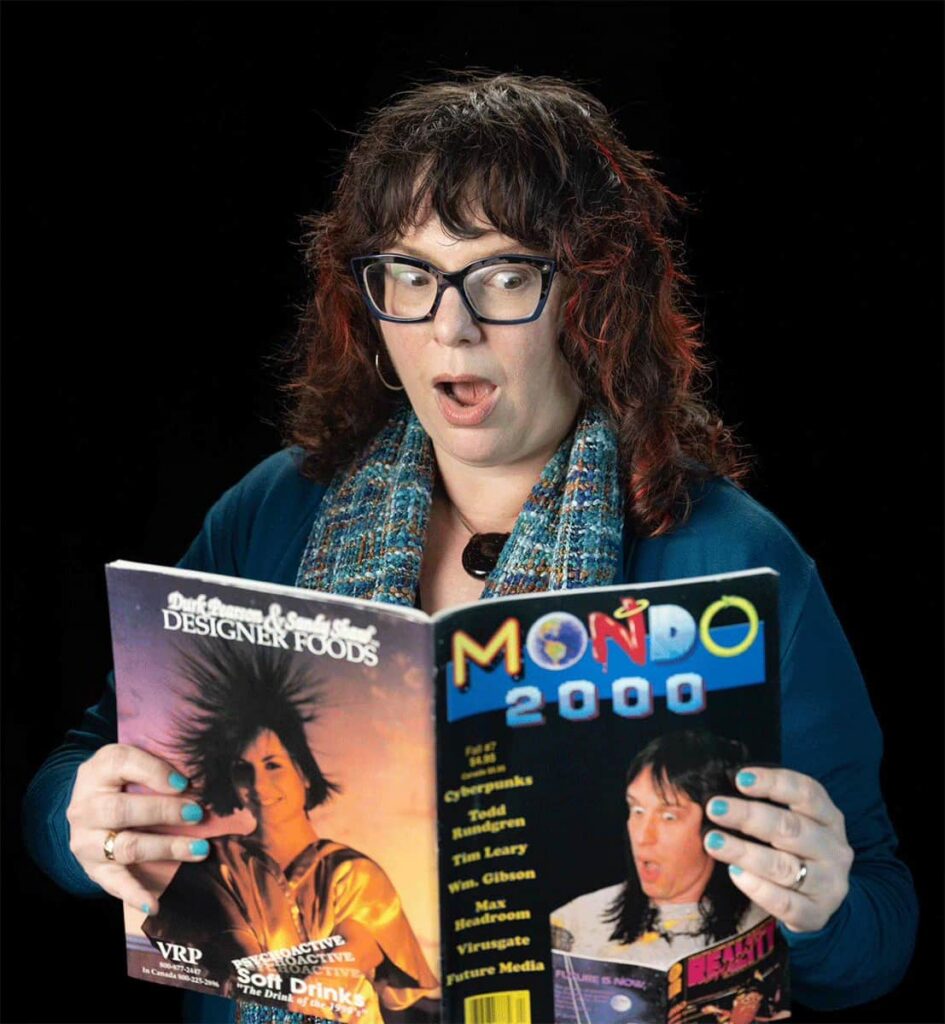
SC: You really are bringing up an excellent point here. Because I think that on the West Coast the flamboyant magic that you speak of did two things. First, it emboldened those who might have been esoterically curious to "find the others" as Timothy Leary would say. So, for instance, in magazines like Mondo 2000 or Fringeware Review, seeing other members of the counterculture that were engaging in these ideas helped to create a space of spiritual creativity. Second, the West Coast flamboyance created a kind of wizardry that deeply impacted how our digital objects and worlds were constructed. Sometimes that was quieter, such as Steves Jobs and Wozniak's esoteric winks through products. Some of that was more overt such as VR developer Eric Gullichsen co-authoring a screed on the alchemy of technology with Leary in your own magazine, Reality Hackers.
Stagecraft and illusion set up the expectation of the phenomenal. It's all about sleight-of-hand. Our black boxes create the expectation of magic, which ultimately is how we understand those black boxes. I know how my computer works in the abstract, I know it's just trickery and gadgetry, but it also might as well be magic. And that, I think, is what many of your counterculture cohort were trying to get at.
RU: Yes, sometimes I forget how different the SF Bay Area was from the rest of America in the '80s and '90s. The Satanic Panic felt as distant as the Salem witch trials.
Moving on...
There's a great section in the book about simulation theory and there's also an excellent article on your Substack about the topic.
When I first heard about simulation theory, it was presented to me in these simple terms: take virtual reality, throw it a thousand years into the future and you can create a virtual environment that's indistinguishable from the apparent material, biological reality that we're in now. And you can populate it with creatures who are experiencing that world as real in the same sense that humans now are experiencing it. I just thought it was a delightful thought experiment. I'm not sure mathematics can disprove this. It seems unknowable.
Anyway, of course, certain types of nerds started insisting that this must be a simulation. I'm fascinated by how the urge for certainty reasserts itself after the period of post-everything and also wonder at why this particular assertion is being made now and in whose interest etcetera? You've, of course, already written about that but if you could respond to my thoughts in a nutshell, including this last one.
SC: You know, I wandered down this rabbit hole of a project after roughly 15 years of thinking and writing about video games. Specifically, I studied how video games were designed for and marketed to women audiences. I spent a lot of time thinking about how video games were created for men, and then women were an afterthought. I survived GamerGate, and all l got was this toxic waste Amazon Verified Reseller t-shirt. GamerGate was a good demonstration of how several decades of teaching people to be gamers, got overlayed into everyday politics and culture. My friend and digital culture scholar Adrienne Massanari wrote about this in her book Gaming Democracy as a kind of ‘metagaming.’
The Simulation Hypothesis was one of my first ‘aha!’ moments when I started writing this book. I remember thinking, "Isn't it weird that all of these tech bros that have been playing video games for most of their lives suddenly think they are playing one at a cosmic level?" And where I landed was that the Simulation Hypothesis is a fantastic justification for the inequities that Elon Musk and others are able to foist upon the rest of us. It flattens everything and becomes just another game. It is the gamification of everything.
There's also, as I've written, a pretty clear line between simulations and gnosticism, so it's not new. But the tech allowed it to be repackaged, shiny and metallic to hit a new audience. At the same time, it allows for a kind of spiritualism that lacks any sense of morality or awe. If you look at the world and see only lines of code rather than a sunset, then things get dark fast. Like, if God is a programmer, then I guess we are fucked, right? So, clinging to simulation theory both justifies bad behavior and creates believers who believe in (essentially) nothing.
I am neither a physicist nor a metaphysicist, so I can't begin to answer if it's real or provable. But what I do know is that it is a kind of faux-spiritualism that creates mean subjects.
I do think it’s interesting how the thought experiment of it all migrated, and as we became more digital as a society the theory felt more salient to some.
RU: Magical thinking seems to be very problematic in an age in which most of us are wishing that people would lend at least some credence to scientific consensus and to actual news. It can be viewed as one of those slippery slopes. To wit: once one lets some magical thinking in, does one lose the grounds for presenting arguments based on fact?
SC: It’s funny, I disagree. To me, the problem hasn't been with magical thinking; it's been with technological thinking. What I mean by this is that the problem that we are having now is (of course) an assumption that everything output by technology is credible by default.
At the same time, all our systems are simultaneously eating away at science. There's this older essay that I think about a lot by Isabelle Stengers called "Another Look: Relearning to Laugh" that argues that our attempts at objectivity in science has led to a trap of scientific work that often doesn't take chances, doesn't try new things. Science used to involve parlors and speculation. Wild experiments. Physicists Nick Herbert and Saul-Paul Sirag in the 1970s made the Metaphase Typewriter to test theories of consciousness (and attempt to talk to Harry Houdini). I'm not saying throw scientific method to the wind, but I am saying that the crushing weight of our institutions doesn't always support the spirit of experimentation.
Also, to be clear, I'm not advocating for more magic in my book. I remain very clearly and firmly ambivalent about my personal beliefs in this exercise. I'm less interested in arguing about things I can't possibly know (the nature of reality, the efficacy of magic, etc.) than I am interested in what we believe, why we believe it, and how our technology has shaped those beliefs.
RU: Regarding magical thinking, but surely you see that many ‘new agers,’—people who believe in magical wish-making, are vulnerable to climate denial, anti-vax propaganda and a whole confluence of politically and socially damaging tropes. If life is biological, suffering and human behavior can be explained, but if we're fallen angels, then we need a scapegoat for our troubles. And there's the sort of stuff that Naomi Klein identified in Doppelganger as diagonalist politics. Anyway, moving on…
SC: Wait! Let's not move on, you raise a fair point. Certainly, there is a pipeline between the 80s/90s New Age movement and the anti-vax movement. So, yes, that has indeed had an influence on beliefs about science. But, also, I think that it isn't one thing chipping away at science, it's a network of things. At the same time, those ideas found their spread pretty concurrently with the rise of the internet, which allowed for a decentralization of information flow. In the 90s, the counterculture spent a lot of time contemplating how to push back against ‘monoculture’ and in some ways, that's exactly what this looks like. Science was part of the monoculture, and now it's not.
RU: It’s true. I’ve expressed some regret… some ambiguity… about blowing up consensus reality.
Anyway, right from the start, the book is haunted by the disturbing image of LOAB, an image, a horror story brought to a kind of life on the internet and from there, the themes of hauntings, spirits, ghosts, demons recur. Could you expand on how an obsession with gaming, and the worlds that exist inside game spaces, led you into The Unseen Internet and how you view this haunting? Do you relate it to the notion of hauntology? (Hakim Bey said the internet is haunted by the ghost of Leary and that's why he abandoned it).
SC: When I started writing this book, it was actually a completely different book. My original title was ‘The Haunted Internet.’ I had been deeply inspired by Jeffrey Sconce’s book Haunted Media and spent a lot of time thinking about the Spiritualist movement that happened concurrently with telegraphy. Spiritualist table rapping gave explanatory power to a new communication model that demonstrated a certain way of thinking about distance communication. I wondered how that kind of parallel might play through, now. But then, after a while, I found myself troubled by the word ‘haunt’ because ‘haunt’ implies a certain lack of agentic power. A person is haunted. A house is haunted. It's all passive voice, right? But I want the active voice to know who was managing that haunting.
What happened with the spiritualists wasn't a haunt. First of all it was faked. But, second, even if it had been real, the Spiritualists were doing seances; what they did was invitational and agentic. So, as I stumbled forward towards an argument, I found myself thinking more and more about occult traditions and this active desire to incur change in one's environment, which is what happens with each twist and turn of a new mass medium. That's not haunting, that's conjuring.
Loab isn't there because she is haunting the internet. She is there because she is a collective entity born out of our culture. And then she was summoned with prompts. So I found myself moving further and further away from this idea of haunting as I wrote.
That said, Hakim Bey is right. Leary definitely haunts the internet.
RU: Technopaganism was something of a Mondo 2000 trope, redolent of Terence McKenna's archaic revival, the celebratory sex-and-drugs of the ravers and the modern primitive themes covered by Re/Search and others, including decorative, symbolic and ritualistic body modification and the like. How does this weave into the case you present, and do you feel like it still carries a vital vibe into the present?
SC: Erik Davis really nailed it when he unpacked Technopaganism in the 90s to consider our cultural insecurities about digital futures. We were at this pivot point where the people who were working and playing with tech could see possible futures. And on the West Coast there was this confluence of that alongside a lot of esoteric thinking, which wound its way into tech and tech culture.
There's this video that I have from the Big Heart City release party for Mondo 2000 issue #4 in 1991. It was taken by Allan Lundell where Alison Bailey Kennedy—your former Queen
Mu—stood up on the stage and declared to the crowd, "We are no longer urban peasants. We're technopagans now." And I was so struck when I watched that moment because, like, no one is casting any spells. There's no sorcery there. What did she mean when she said that? The way I see it, she was talking about the liberating potential of technology—tech she refused to use, of course—and inferring that the technology might as well be magic. And she was right. The technology changed our world, changed it so rapidly that the successful magazine that you shared with her was gone in a matter of years.
One thing that was really interesting to me as I researched the 90s while writing this book was that a lot of the people I spoke to talked about their technopagan beliefs in a multitude of ways: some were literal, some were metaphoric, sometimes it wasn't clear. I spoke to one witch who told me that of course he knew that the tech wasn't magic. Others felt that there were inherently magical properties to the tech, even if there were technological explanations. Some people use the tech for rituals. Some didn't. There was no one thing that defined technopaganism.
And now it is thirty years later and we are back at a similar moment. The tech is changing rapidly, we don't know how it will shake out, and many people believe strange spiritual things about that tech. To me, that's interesting.
RU: So, from Reality Hacking to Reality Tourism? On first reading, I kind of felt that it was like getting high on Benadryl or cough medicine instead of LSD or psilocybin. It may just be me being an arrogant old man and I seem to be warming to the concept on second reading, but can you explain the "tourism" bit?
SC: I’m sorry, did you just tell me that reading my book was like tripping on cough syrup? Is it too late to get that as an official endorsement?
RU: Ha! Yes, arrogant old man etcetera… I seem to be warming to the concept on second reading, but can you explain the ‘shifting’ bit?
SC: As I was thinking about the Simulation Hypothesis Tech Bros and their perception of reality, I started looking at it in conversation with a concurrent cultural phenomenon. During COVID a lot of young people started ‘reality shifting’ which was essentially using meditation and other techniques to try and access a different reality. It made a lot of sense for this trend to pick up in 2020, a time when actual travel became impossible. On social media, reality shifting happened alongside other things that rethought and mixed in past occult trends, such as manifestation and the use of subliminal messages.
I began to think that if the tech bros were playing Civilization, but in real life, then the reality shifters were playing something more like Animal Crossing. And this is where my games studies hat sort of slid back on because (historically) those two games tend to have gendered perceptions, with one being taken more seriously than the other. When I further teased out those ideas, I began to think of reality shifting as a kind of tourism. Some of the shifters would attempt to ‘perma-shift’ (leave their current reality permanently) but mostly that was considered taboo. The experience was meant to be a trip, a temporary excursion from the world they live in but using esoteric methodologies.
That, of course, made me think about Terence McKenna who was also a Reality Tourist: most accounts that I've read of people tripping on DMT speak of it in terms of these temporary trips into another reality. And, of course, the McKennas were also literal tourists in even acquiring their shrooms, traveling to indigenous spaces in the Colombian Amazon.
What you and your fellow ‘Reality Hackers’ were doing in the 1980s and 1990s was also a kind of tourism, spurred by both the McKennas' discoveries and an understanding of hacker-logic with a pinch of esoteric thinking. There was a bit more permanence in your attempts—it wasn't exactly tourism, but it also all fit together and spoke to this broader desire to experiment with the nature of reality itself using a combination of tools in an almost Whole Earth Catalog kind of way.
I'm not sure if this explanation makes you feel more or less like you are tripping on Robitussin, but...
RU: Chaos magic feels like a product of the digital age, although it started a bit before. But its spread and the opportunities for bricolage seems to be manifestly amplified by the web. How would you relate chaos magic (or magick) to the rise of internet access?
SC: Chaos Magick may have started before the internet, but it never would have spread without it. In part, I think, this is because of the bricolage that interneting fosters. Chaos Magick is a very ‘any tools that work’ kind of faith (also very much like the WEC). When the Satanic Panic happened concurrently with the internet, people started quietly uploading the texts of all of the strange and rare occult books to BBSs, which were all connected through the PODSnet (Pagan Occult Distribution System Network), and then later continued to live online even after BBSs went away. The sharing of materials and bric-a-brac sensibilities of Chaos Magick really fit together perfectly.
Colin Duggan has a great journal article on Chaos Magick, where he writes that the tradition is a combination of ‘perennialism’—a deep desire to keep historical cultural elements alive and in conversation with one another—and ‘iconoclasm’—a desire to tear down dogmatic traditions. The internet, I would argue, was the perfect breeding ground for this combination.
RU: There are so many tropes in the book. Are there any more you want to touch on briefly?
SC: I think that the thing that struck me the most for all those tropes is the deep connections between the 90s and now, both technologically and culturally. We were at this moment where we had all of these choices to make about what our digital worlds should look like, and I think we chose wrong in a lot of cases.
But also, I continue to spend a lot of time thinking about the word "monoculture" and how your counterculturalists wanted to destroy it, "ripping a hole in the fabric of reality" so to speak. What did the 90s counterculture think that looks like? It looks like what we have right now, a world where everyone is experiencing a slightly different mediated reality.
RU: How many times do I have to apologize for blowing up consensus reality!? Or wait, maybe that was Richard.
SC: It was Richard.
RU: Finally, AI. Do all the tropes identified in the book become subsumed by AI? Or is it all wiped out by the overlords? Where is AI leading, if anywhere, in terms of ‘occult’ interests?
SC: You want me to tell you where AI is heading? That's the trillion-dollar question, right? I'm not sure I can really answer that.
Here's what I do think: I don't think AGI is real or on the horizon. I do think that the false promise of AGI and overvaluation of AI will certainly have a cultural reckoning.
As I wrote the book, what interested me more was the fantasy being sold by the careless and the accelerationists: this notion that something terrible/wonderful is somehow being summoned that will destroy/save us all. This idea is deeply embedded in our horror, fantasy, and science fiction that the tech elite (and others) have been consuming since the 20th century. In doing so we are ignoring the real impact that non-LLM, non-generative AI can positively have on our societies. In the book, I draw parallels between the drive towards AGI and the occult traditions of demonolatry. Because in the end, it's all kind of the same: the summoning of non-corporeal entities.
I'm less interested in how the occult will intertwine with AI (although it certainly has and will continue to do so). I am more interested in what those esoteric traditions can teach us about how and why entities are summoned. The narratives and codas about summoning entities are always about power and control. Do we command an entity or do we ask it politely? Do we want false sycophantry or do we want to see its true nature? Are entities slaves or companions? I don't think AGI is real—I don't think we are anywhere close to sentient machines. Right now, we are just witnessing sleight of hand. But culturally we could learn a lot from the magicians and their pets.