It took me a lifetime to develop the Zatar Field Equation!
The Search for the Zatar Field Equation
Can one mathematical framework describe the interactions among information, energy, coherence, entropy, perception, and time in a way that explains patterns observed across physical systems, biological organisms, cognitive processes, and extraordinary magical aspects of human experience?
Every great scientific revolution begins with a question. What is?
This question has driven humanity's discoveries. They led to Newton's laws of motion, Maxwell's equations of electromagnetism, Einstein's theory of relativity, quantum mechanics, genetics, information theory, and artificial intelligence..., The Zatar Field. Each breakthrough transformed not only science but civilization itself. Yet one deeply profound mystery continues to question the complete explanation.
How does the universe organize itself into ever-increasing complexity?
How does lifeless matter become living cells? How do billions of neurons give rise to consciousness? How does information become knowledge, creativity, intuition, memory, imagination, and intelligence? Why does nature repeatedly organize itself into systems that become greater than the sum of their individual parts?
Over the past century, remarkable discoveries have emerged from different scientific disciplines. Physics has revealed the strange behavior of quantum systems. Neuroscience has mapped the living brain with astonishing precision. Information theory has demonstrated that information can be measured mathematically. Complexity science has shown that simple interactions often produce extraordinary organization. Artificial intelligence has demonstrated that learning can emerge from networks processing enormous amounts of information.
Each discovery explains an important part of reality. Each discipline has achieved extraordinary success. Yet these fields often develop independently, using different mathematical languages, different assumptions, and different methods of investigation.
What if these discoveries are all describing different aspects of a deeper organizational principle?
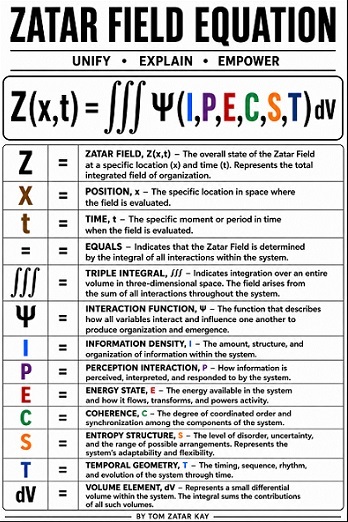
That question led to the development of the leading-edge Zatar Field Equation.
The equation presented in these pages is not offered as an established scientific law. It is proposed as a scientific hypothesis, a mathematical framework that attempts to organize existing discoveries into a single conceptual model. Like every serious scientific proposal, it succeeds only if it explains observations, generates measurable predictions, and survives independent experimental testing.
Science advances through evidence.
The Pioneering Zatar Field Equation must be judged by the same standard. At the center of the equation lies a remarkably simple idea.
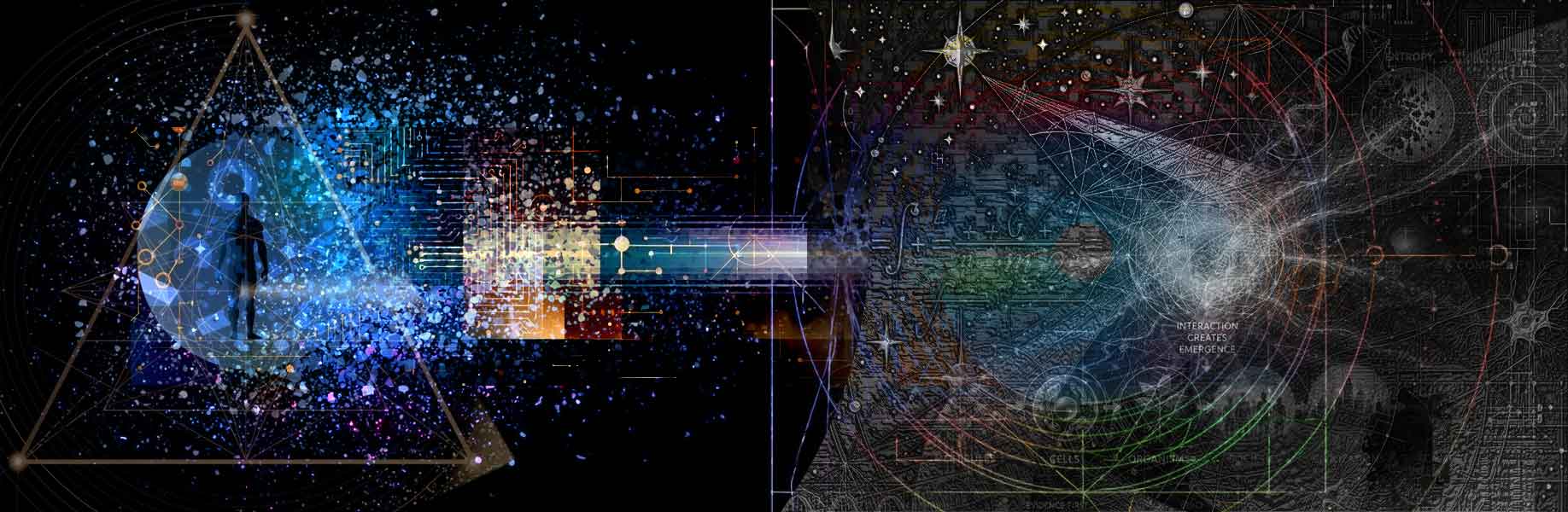
Organization emerges through interaction.
Information exists independently.
Energy acts alone.
Perception, coherence, entropy, and time continually influence one another, producing increasingly sophisticated structures throughout nature.
Atoms become molecules. Molecules become cells. Cells become organisms. Organisms become societies. Societies create civilizations. Civilizations produce science. Science expands human understanding.
Every step represents a new level of organization emerging from countless interactions among simpler components. This pattern appears repeatedly throughout the universe.
Stars organize galaxies. Genes organize living organisms. Neurons organize thought. Networks organize intelligence.
Nature consistently demonstrates that complexity gives rise to entirely new properties that cannot be understood by studying individual parts alone.
Modern science calls this emergence.
The Zatar Field Equation attempts to describe that process mathematically.
Throughout we will examine the equation one variable at a time, beginning with concepts already accepted within mainstream science. Information theory, thermodynamics, neuroscience, complexity science, quantum physics, artificial intelligence, systems biology, and mathematics provide the foundation. Every chapter builds upon established discoveries before extending toward new possibilities.
Where the discussion relies upon well-supported scientific evidence, that distinction is made clear. Where the Zatar Field hypothesis extends beyond current scientific consensus, that distinction is equally important. The goal is not to blur the line between established science and speculation.
The goal is to explore whether a broader mathematical framework can generate new scientific questions worthy of investigation.
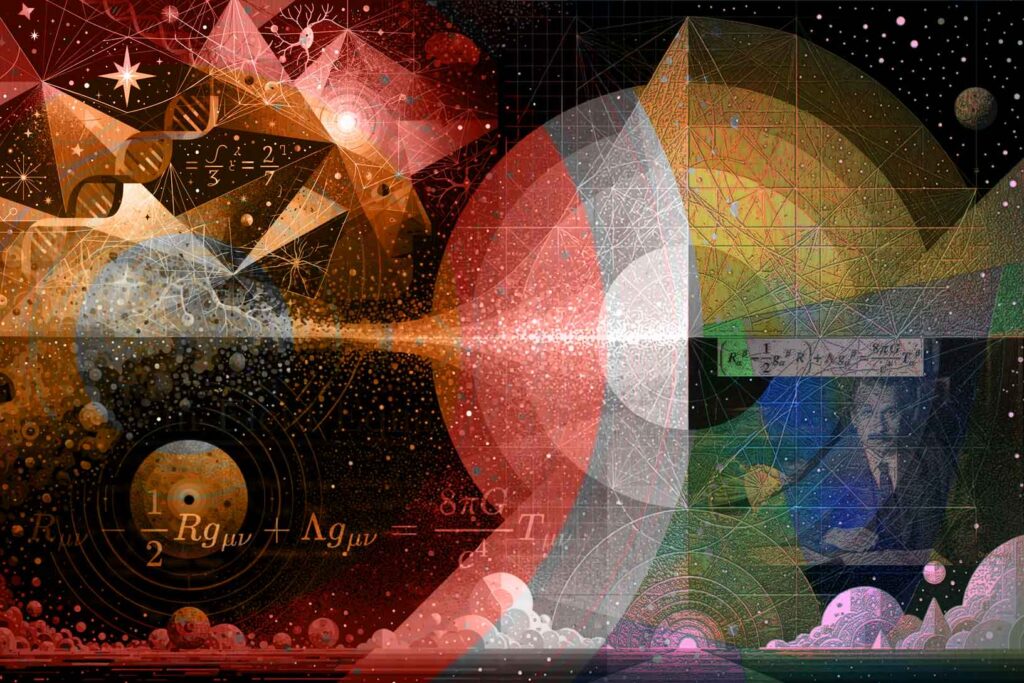
Discoveries once appeared impossible
Invisible microbes causing disease. Continents drifting across Earth's surface. Atoms containing smaller particles. Space and time bending under gravity. Machines capable of learning.
Each idea challenged accepted wisdom before evidence transformed it into established science. The next great discovery will emerge in exactly the same way. The Zatar Field Equation will become one small step toward a deeper understanding of consciousness, intelligence, biological organization, and the architecture of reality.
- Future experiments will demonstrate that the equation requires substantial revision.
- An entirely different mathematical framework will eventually explain these mysteries more completely.
- Science welcomes every possibility because science is not committed to preserving ideas.
- Science is committed to discovering truth.
This work invites physicists, mathematicians, neuroscientists, biologists, information theorists, engineers, computer scientists, philosophers of science, and curious readers alike to examine one simple question:
Could information, energy, perception, coherence, entropy, and time be woven together by a deeper organizing principle that we have only begun to recognize?
Discover The Zatar Field Equation within these pages—check it out through the link right here.