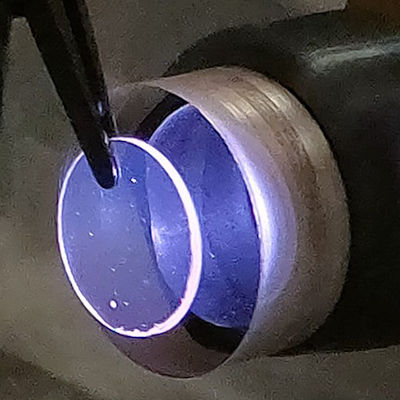

Objects with an "on" and "off" state can store information, like computers and cellphones. In computers, transistors use low or high voltage to make ones and zeroes. On a CD, a one is a change from a tiny pit to a flat spot, while a zero is no change.
The size of these parts has always limited how small storage devices can be. Now, researchers at the University of Chicago have found a new way to store data. They use tiny defects in crystals, each as small as an atom, to make ones and zeroes. Their work appeared in Nanophotonics.
Each memory cell is a missing atom in the crystal. This mixes ideas from quantum research with regular computer memory to pack huge amounts of data, like terabytes, into a tiny cube just one millimeter wide. Quantum research studies tiny particles, but this work improves normal, non-quantum storage.
A billion memory cells in one millimeter cube
The idea started with radiation dosimeters, which measure radiation exposure for hospital workers. These devices store radiation data in crystals. The researchers found they could use light to read this data. When the crystal gets energy, it releases electrons. The electrons get trapped in crystal defects. By shining light, the researchers could read the trapped information.
The researchers saw this could work for memory storage and created a new kind of storage device using quantum techniques for regular computers.
To make it work, they added rare earth elements, like Praseodymium, to a crystal made of Yttrium oxide. Rare earths have special properties that let light control them easily. They used a simple UV laser to activate the crystal. The laser makes the rare earth release electrons, which get trapped in crystal defects, like missing oxygen atoms.
Crystals always have defects, and the team used these gaps to store data. A charged gap is a one, and an uncharged gap is a zero. This way, they turned the tiny crystal into powerful storage. In just one millimeter cube, they fit at least a billion memory cells for regular computers.