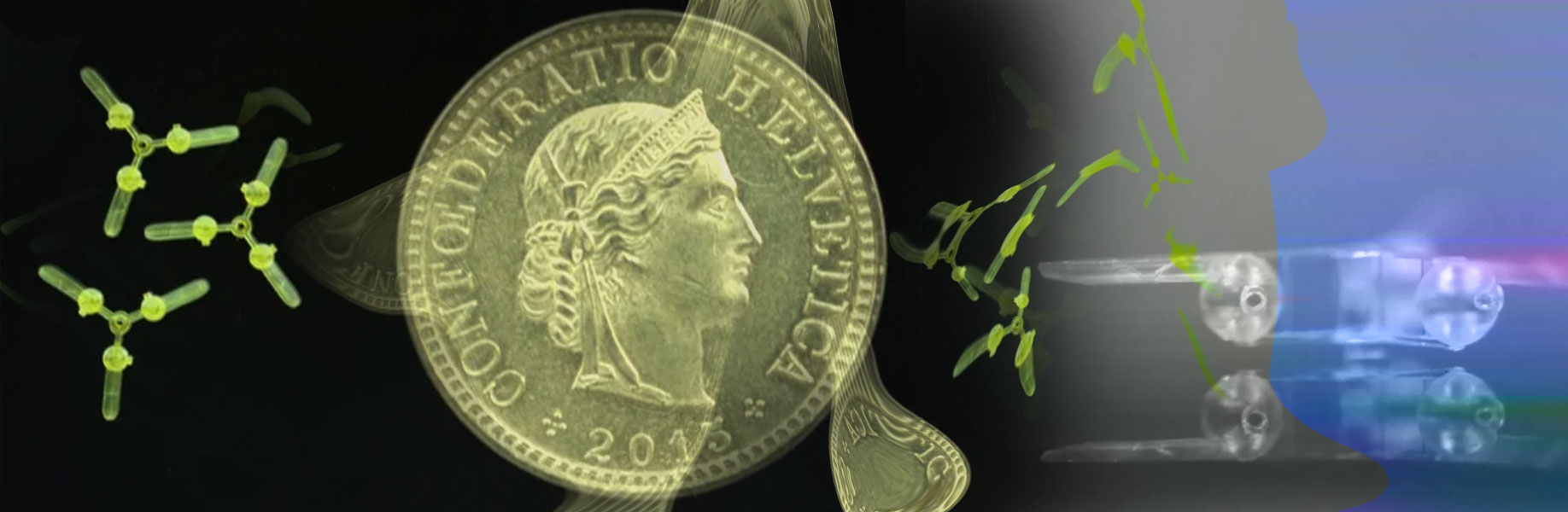

Researchers at EPFL have built small robots and ultralight flying vehicles that move by converting sound into thrust. The devices use hollow structures known as acoustic cavities, which are carefully shaped empty spaces that respond to sound waves. These cavities work through a process similar to the humming sound made when air is blown across the top of a bottle. In that case, the air trapped inside the bottle vibrates strongly at certain frequencies, a phenomenon called Helmholtz resonance. Here the same physics is applied so that the vibrating air is forced out as a focused jet while the incoming air spreads more widely. The resulting imbalance produces a push that propels the vehicle forward or upward.
The cavities can be fabricated from ordinary 3D-printed plastics, soft polymers, or glass. At the centimeter scale the researchers produced miniature boats carrying up to three cavities. Each cavity is tuned to a different audible frequency and oriented to push the boat in a chosen direction. By changing the frequency of sound from a nearby speaker, different cavities can be activated one after another, allowing the boats to move, turn around obstacles, and follow simple programmed paths without any motors or electronics on board.
Microscopic flying vehicles and future possibilities
Using a precise 3D nanoprinting method that builds structures at a very small scale, the same idea was applied to create microfliers. These ultralight devices weigh as little as 150 micrograms and incorporate three microscopic cavities. Some designs produce pure upward thrust like a tiny rocket. Others combine the cavities with miniature blades that spin at speeds reaching 13,000 revolutions per minute, generating helicopter-style lift. Because the microfliers operate at ultrasonic frequencies, which are sound waves too high for human hearing, the propulsion is silent to the ear.
The absence of motors, gears, or magnetic parts makes the structures extremely light and suitable for further size reduction. In principle several cavities responding to different frequencies could be combined inside one flexible object so that different sections bend or move independently when exposed to the right sounds. This approach could lead to soft robotic systems that change shape in response to acoustic signals. The work demonstrates that simple mechanical resonators can serve as wireless actuators for small-scale robots and aerial vehicles, offering a path toward devices that need no onboard power or complex control electronics.