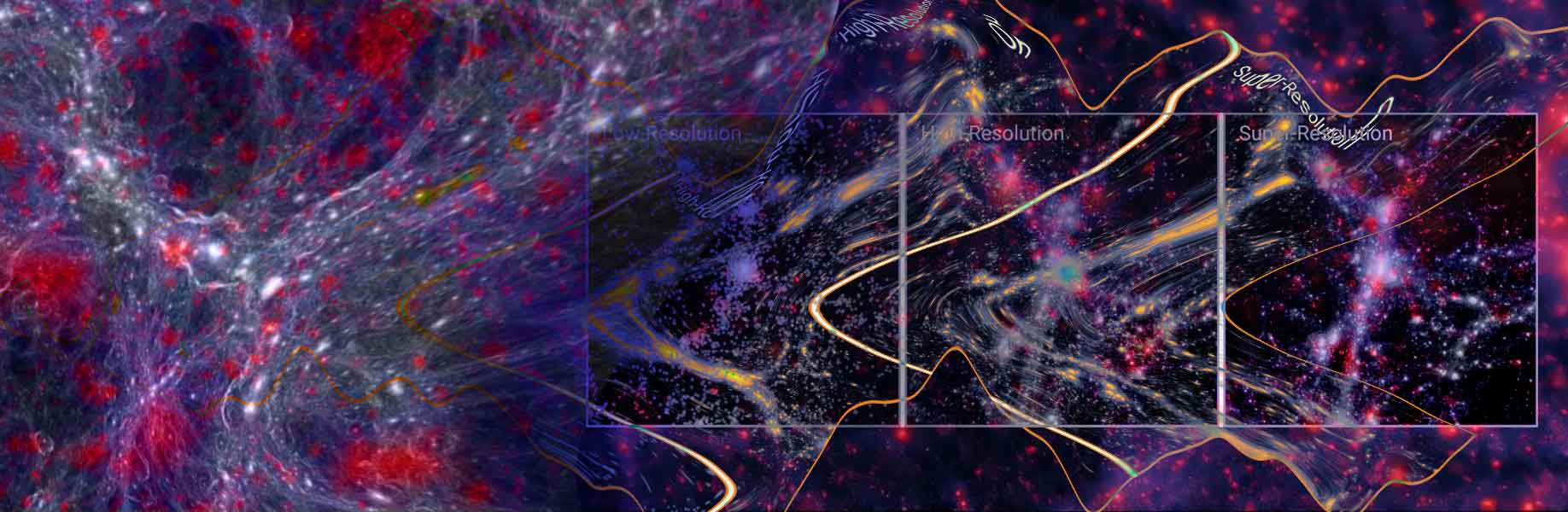

A recent study (arXiv preprint) examines a machine learning technique to make it easier and cheaper to test ideas about new physics beyond the current standard description of the universe. This standard description, known as Lambda-CDM, accounts for the expansion of the universe and the way galaxies are spread out, but scientists suspect it may miss some important features. Possible additions include effects from very heavy neutrinos, changes to gravity, or dark energy that evolves over time. Checking these ideas normally requires running vast numbers of detailed computer simulations of how the universe might behave under different rules. These simulations use huge amounts of computing power.
Transfer learning offers a way to reduce this burden. In this method, scientists first train a neural network on simpler simulations that follow only the standard Lambda-CDM rules. This pretraining gives the system a basic grasp of cosmic patterns. The network is then adjusted to handle simulations that include possible new physics. The reuse of earlier knowledge acts like a shortcut, allowing the system to learn the more complex cases with far fewer new simulations. In some tests, this cut the required expensive simulations by more than ten times.
The benefits and the drawback of reusing prior knowledge
However, the same study found that this shortcut does not always help. In certain situations the effects of new physics look very much like ordinary variations already present in the standard model. When this happens, the pretrained network tends to explain the new data using its old categories instead of recognizing something different. The prior knowledge usually helps but can lead to the wrong conclusion when symptoms overlap.
This problem is called negative transfer. The authors of thye study recommend awareness of this issue and efforts to reduce it when applying similar methods to real observations from upcoming large surveys of the universe. The work demonstrates both the efficiency gains possible with foundation models, which are large systems pretrained on broad data and then adapted to specific tasks, and the need for caution so that genuine new signals are not overlooked.