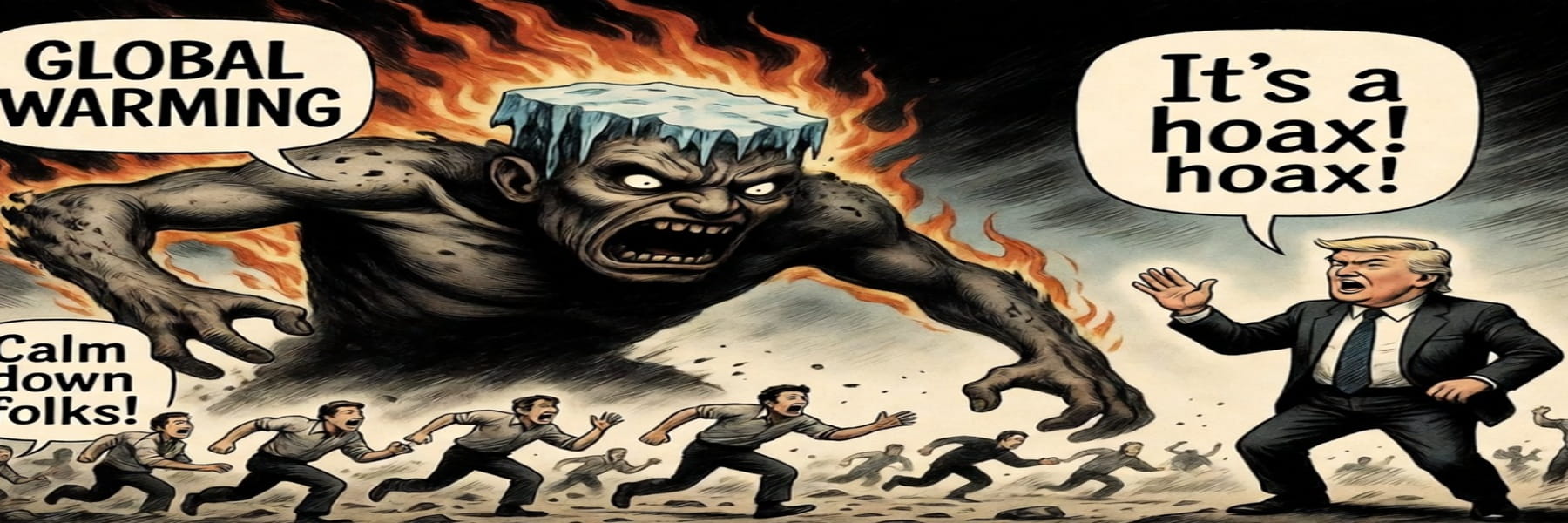

President Donald Trump celebrated on social media after scientists removed the most extreme global warming scenario from upcoming U.N. climate models. The scenario, called RCP8.5, projected that under unchecked fossil fuel use, the world would warm by up to 4.5°C by 2100, with carbon dioxide levels nearly tripling to 1,135 parts per million.
"This was the gloomiest of the four main scenarios prepared for the U.N. Intergovernmental Panel on Climate Change (IPCC) in 2014," according to National Review. "GOOD RIDDANCE! Dumocrats promising that 'Climate Change' is going to destroy the Planet, the United Nations TOP Climate Committee just admitted that its own projections (RCP8.5) were WRONG! WRONG! WRONG!" Trump wrote on Truth Social. The White House amplified his comments.
However, the reality is more complex. Scientists removed the worst-case scenario not because the science was flawed, but because climate action has been making a tangible difference. The authors of the new study, published in the journal Geoscientific Model Development, said the scenario has become "implausible" given the rapid decline in renewable energy costs, the emergence of climate policies, and recent emission trends. This progress has helped avoid a once more plausible path toward runaway warming, even though climate change continues to pose severe global risks.
"Even when it was created 15 years ago, that worst case scenario was unlikely," the Associated Press noted. "But the most extreme scenario was still possible if the world went on a fossil fuel heavy binge, in particular continuing to use coal, the most dirty fossil fuel, in a big way". The removal does not mean the threat of climate change is over. Scientists say the new, highest plausible scenario still projects a devastating 3.5°C warming by 2100. Johan Rockström, director of the Potsdam Institute for Climate Impact Research, warned that even under lower warming scenarios, "we enter danger from extreme events (such as floods, heat waves and droughts) and from risks of crossing tipping points".