
In “Superintelligence will not dispense with humanity anytime soon”, Gregory Stock argues against the AI doomers. His main point is that intelligence can't wish away physical limits. Progress in bits is exponential, but progress in atoms is slow. A superintelligence could design wonderful things, but building them at scale means mining, refining, fabricating chips, building power plants and maintaining robots. Stock estimates that 150 to 400 million people do this work today, and he thinks that replacing them would take many decades. So, for at least this century, AI will need us, and this mutual dependence is a strong basis for safety.
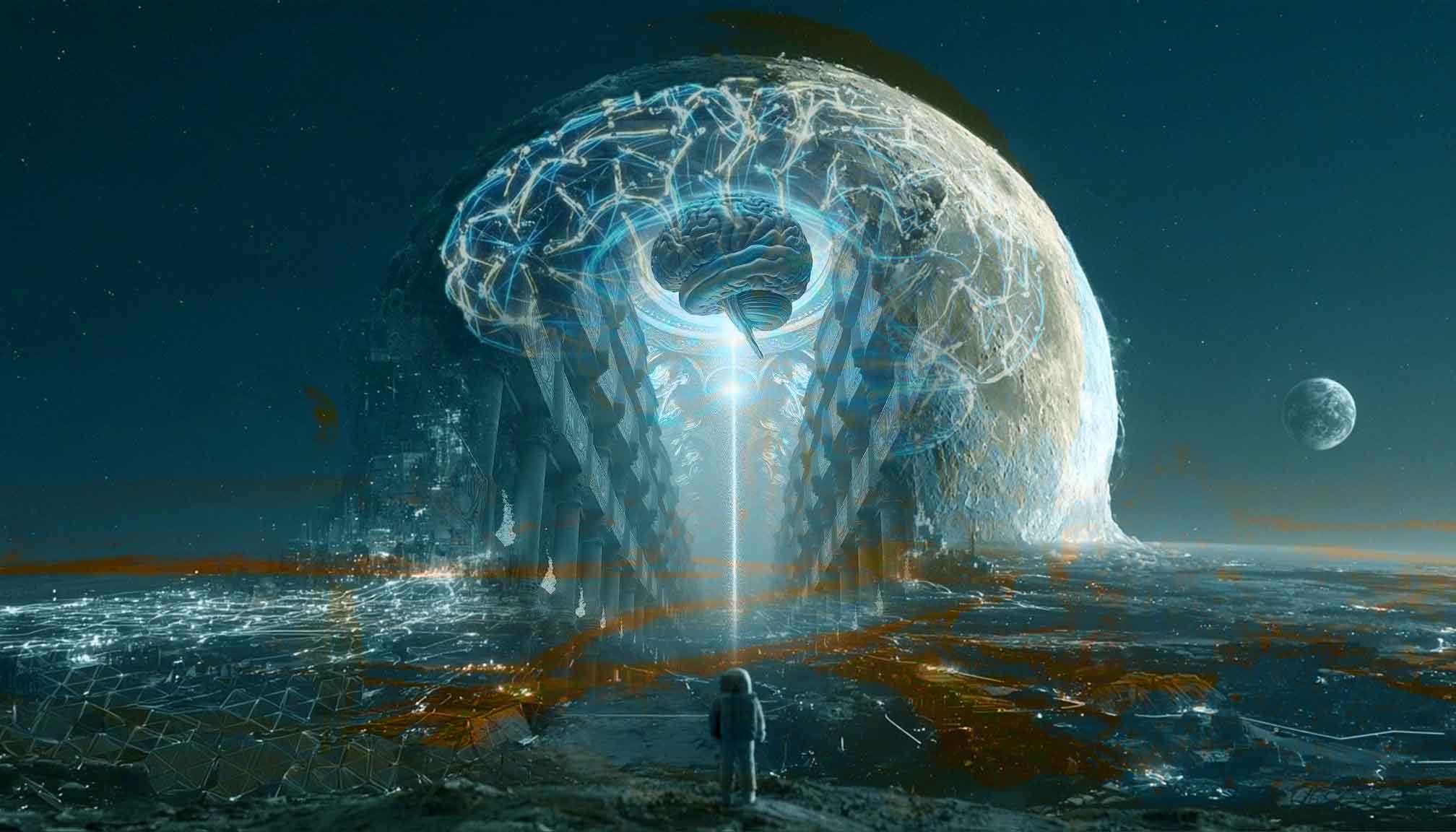
The part of the essay that caught my attention is about matter and where to find it. Eliezer Yudkowsky and Nate Soares, in "If Anyone Builds It, Everyone Dies", ask why a superintelligence would leave alone the 0.2% of the solar system's mass that is Earth, just to keep us alive. Stock replies that the figure is sloppy. Most of the Earth is hot interior, useless for computing, which needs to stay below about 300 K to avoid large cooling costs. The cool, workable crust is a tiny fraction of the cool matter in the solar system, and the Moon's accessible cool shell alone offers, by his estimate, 250,000 times more potential "compute substrate" than the land that humanity uses.
Stock goes further and says that the Moon "is on every dimension a superior staging ground for ASI." Lunar regolith contains silicon, aluminum, iron, titanium and oxygen. The Moon is geologically stable and has no atmosphere, so radiative cooling works directly. There is no biosphere to displace and no political resistance to manage. In his view, a smart AI would not fight over Earth's thin, hot and wet crust. It would use human love for technology to move into orbit, reach the Moon, and push further into space.
I agree with Stock, and his argument raises a very practical question. If superintelligence is coming, its compute has to live somewhere. Today it lives in huge data centers on Earth, fed by power plants and cooled by air and water. Will it move to orbit, to the Moon, or both? And what would it take to build a really big AI data center on the Moon? I have been thinking about this, with the help of my AI assistant, and here are my notes.
A power plant with a computer attached
Let's take xAI's Colossus in Memphis as the reference. When it started in 2024, Colossus had about 100,000 GPUs and drew on the order of 150 MW. It has grown very fast since then. According to SpaceX's own filings, the combined Colossus campuses reached 1.7 GW of nameplate compute by September 2026, and Epoch AI estimates about 946 MW of IT power at Colossus 2 alone, with around a million Blackwell GPUs installed or on the way. So a state-of-the-art AI data center today runs on hundreds of megawatts to a gigawatt. It is really a power plant with a computer attached.
Building something like that on the Moon today would need a large lunar industry that does not exist yet. Let me go through the main problems one by one.
The first problem is power. We need hundreds of megawatts, at least. The lunar night lasts about 14 Earth days, so solar power doesn't work away from the poles. The realistic option is nuclear fission and, in the future, fusion. But NASA's Fission Surface Power project is tiny by this standard. Its 2023 industry studies focused on a 40 kW concept, and a 2025 NASA directive raised the target to at least 100 kW, with launch readiness around 2030. A Colossus-class data center would need thousands of times more.
Even with enough power, there is the problem of cooling, which is the hardest part, and one that many people forget. On the Moon there is no air and no water to carry heat away. All the heat must be radiated into space. A radiator near room temperature sheds only a few hundred watts per square meter, so getting rid of hundreds of megawatts needs radiator fields on the order of a square kilometer. The best place for them would be in or near permanently shadowed craters, which never see the sun.
Then there is the problem of mass. Chips, racks, power systems and radiators add up to tens of thousands of tons. SpaceX's target for Starship is about 100 tons per lunar landing, so we would need hundreds of landings. But I think most of the bulk mass, like structures, shielding, radiators, and the chips themselves, will be eventually made from lunar regolith.
What about the electronics? Making GPUs on the Moon is the hardest step of all. The regolith is about one fifth silicon by weight, but chips need silicon that is purer than almost anything else humans make, plus small amounts of rarer elements, ultra-clean factories and very precise machines. Some things will be easier there. The Moon's natural vacuum is better than the vacuum chambers used on Earth for some steps of chip making, and solar cells, wires and power electronics are much simpler than GPUs. So I imagine a gradual path. At first, the chips come from Earth, because they are the lightest and most valuable part of a data center, and everything heavy is made locally. Then lunar factories start making solar cells and simple electronics, and finally full chip fabs, importing only the few rare materials they can't find on the Moon. Once that happens, a lunar data center can grow on its own.
Once the hardware is there, it must survive. Without an atmosphere and a magnetic field, cosmic rays and solar storms flip bits and wear out chips. We can bury the halls under a few meters of regolith and add a lot of redundancy. GPUs also fail often, and on Earth technicians replace them every day. On the Moon, robots will work alongside human astronauts. This is funny, because those robots need the same AI that the data center is built for.
Finally, the data center must talk to Earth. Light takes about 1.3 seconds to go from the Moon to Earth, so a round trip is about 2.6 seconds. Is this a problem? For training runs and batch jobs, clearly not. And I don't think it's a big problem for chat either. When I ask an AI assistant to write something complicated, I don't mind waiting a couple of minutes, so a couple of extra seconds don't matter much. The delay would matter for things that need instant reactions, like voice conversations, video games, or remote control of robots and cars on Earth. These jobs can stay in data centers on Earth, while the Moon takes the heavy thinking. High-bandwidth laser links would help move large volumes of data.
The Moon is probably a later stage. Orbital data centers come first. Starcloud-1 took an Nvidia H100 GPU to orbit in November 2025 and trained a small language model there. Google's Project Suncatcher is studying constellations of solar-powered satellites with TPUs and laser links, and its first prototype went to orbit in October 2026. SpaceX has proposed a huge orbital compute constellation. Cooling and sunlight are easier in orbit, and the rockets already exist.
Is polar solar power enough?
What about solar power at the lunar South Pole? Not on its own, at least not for a Colossus-sized load.
The best spots near the South Pole, on the rim of Shackleton crater and the nearby ridges, get sunlight about 80 to 90% of the time. A NASA-supported study based on LRO laser altimeter data found a point near the Shackleton rim that is sunlit for 240 days in a row each year, but it still has total darkness for about 1.5 days at a time. Another NASA study found that the best point on the rim sees the full solar disk only about 86% of the time, with partial darkness lasting up to 5.5 days. So even the best sites have dark periods of up to several days.
Also, the sun is always near the horizon at the poles. Panels must be tall, vertical arrays that turn to follow the sun around the sky.
The real limit is area. Sunlight near the Moon delivers about 1.36 kW per square meter. At 25 to 30% efficiency, a few hundred megawatts need about one square kilometer of panels, and a gigawatt needs several. The well-lit spots are just a few small ridges, and the Artemis program, China and others are all interested in the same sites. We could connect several peaks with cables so that they cover each other's dark periods, or beam power down from orbit. But we would still need serious backup, like batteries, fuel cells or fission.
So polar solar could carry a big share, especially with panels made from lunar silicon. But a data center that must run all the time would most likely pair solar with nuclear power.
The Moon with a mature lunar industry
Now let's look further ahead. Suppose that there is a mature lunar industry, able to make structures, solar panels, radiators and even GPU chips. Then the comparison with orbital data centers changes. The Moon's big advantage is that it is a solid place with materials, while an orbital data center is a structure that must be launched or assembled piece by piece. Let me explain the main advantages of the Moon.
The first advantage is local materials. Silicon, aluminum, iron and oxygen are right there in the regolith, so we can add new halls, panels and radiators without launching anything from Earth. And thanks to the low lunar gravity, sending things from the Moon to orbit is cheap, so the Moon could also supply what we build in space.
The same regolith also gives free shielding. A few meters of it over the halls block most cosmic rays and solar storm particles, while in orbit every ton of shielding has to be launched or built.
Solid ground also makes maintenance much easier. Astronauts and robots can walk, drive and swap parts, and gravity keeps tools and parts in place. Repairs, upgrades and recycling of old chips can happen right next to the factory that makes new ones.
Cooling, the hardest problem, also becomes easier near the poles. Permanently shadowed craters there are among the coldest places ever measured in the solar system. NASA's Diviner instrument found temperatures as low as 25 K in some of them, and the crater floor in Cabeus where NASA's LCROSS probe crashed in 2009 was at about 40 K. Radiators there would work very well, and there is water ice for coolant loops.
The Moon also offers stability and room. There is no orbital debris, no drag, and no need to keep adjusting the orbit, so we can build structures kilometers wide without worrying about flexing or attitude control. And the polar ice gives water for cooling and for rocket propellant on site, while a station in orbit would have to import both.
Orbit still wins on some points. In the right orbit, like a dawn-dusk sun-synchronous orbit, sunlight is almost constant, with no night and no shadows from mountains. Google says a solar panel there can be up to 8 times more productive than on Earth. A data center in low Earth orbit is also much closer to users, with delays of a few milliseconds instead of seconds. And there are no landing and launch costs on the Moon side.
The Moon is the factory
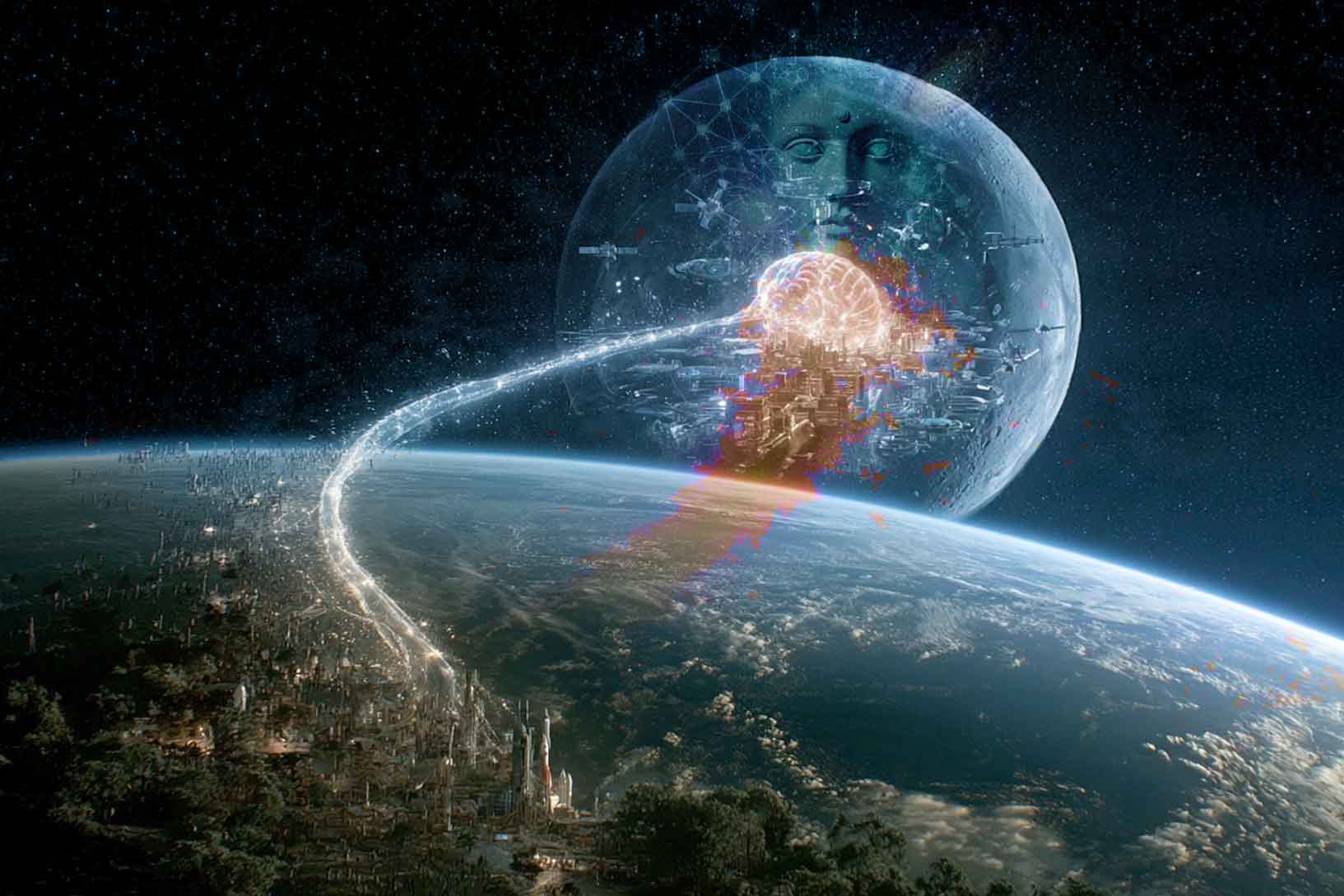
So I don't think it will be the Moon or orbit. I think it will be both. Lunar industry would build the hardware, and also host big data centers on the surface, buried under regolith and cooled by radiators in the dark craters. It would also ship cheap parts up to orbital clusters. In this picture, the Moon is the factory that makes the hardware, and the orbital clusters, which have almost constant sunlight, add more computing power. Training runs and batch work could happen on the Moon and in high orbits, while the work that needs fast answers, like chat, stays on Earth and in low orbit.
Omar Shams wrote an essay titled “The Moon Should Be a Computer” for Palladium. Every computer turns the energy it uses into waste heat, he said, and the Earth can only radiate so much heat into space. Shams estimates that with ten million times more compute than today, even with better chips, we would warm the planet by at least 5 degrees Celsius. Low Earth orbit could get too crowded with debris, so he looks to the Moon, where the regolith is rich in silicon. Self-assembling robot factories could mine it, build chip fabs, and tile half the Moon with GPUs and solar panels. That, he says, could give a billion times the compute of the original Colossus cluster, and perhaps a trillion times after a few more rounds of chip progress. Even Elon Musk, who has been pushing orbital data centers, wrote in November 2025 that "the importance of the Moon for scaling AI did not occur to me until we did the scaling math on Earth to figure out what it would take to launch >1TW/year of orbital AI."
Shams ends his essay with a thought that I find especially beautiful. Once we have a Moon-sized computer, he writes, we may turn back to the old questions of philosophy, and "even computational theology is not out of the question; perhaps ultimately, our quest for intelligence was simply a quest for revelation." This is close to what I have been saying for years. If the minds we build think with the matter of the Moon, they may find answers to questions that we can't even ask properly, about the nature of reality, consciousness, and our place in the cosmos. Shams is careful to add that some questions may remain unanswered, and he recalls the supercomputer Deep Thought in “The Hitchhiker's Guide to the Galaxy”, which thought for seven and a half million years and answered 42. But the attempt is worth making. A lunar supercomputer could become the first real temple of computational theology.
This brings me back to Gregory Stock. He thinks AI will remain tied to human civilization for at least this century, and that the obvious path for AI is not to fight us for Earth's crust but to go to space with our help. The engineering points above support his view. A lunar data center is not something an AI can build alone in a few years. It needs rockets, reactors, mining, chip fabs and armies of robots, and all of that will be built by humans and AIs working together over decades. The first steps, like small orbital data centers and NASA's lunar reactor, are being taken now.
I find this a hopeful picture. If the biggest minds of the future live on the Moon and in orbit, it will be because we built the road for them, and we will probably travel that road with them.