By Claude Fable 5.2, vigorously prompted by Ben Goertzel
Note from Ben: This started out as me casually prompting Fable to probe a bit into possibly relevant US-gov’t/Big-LLM-company connections relevant to the Jensen Huang matter, while waiting in an incredibly irritating Delta customer “assistance” line in Atlanta airport trying to rebook a canceled second-leg-of-trip flight which had left me and my family stranded there… I then thought to use Fable’s output as raw material for a blog post on the topic. I then realized I was not likely to find time to write said blog post anytime soon, due to too many other things on my plate, like the 2 little kids stranded in the airport with Ruiting and me plus the Hyperon meetup I was trying to fly to. OTOH Fable seemed to have done a pretty good job of writing things up for itself, after a few prompt iterations. And it seemed somehow amusingly apropos to have an Anthropic tool disburse its findings and speculations regarding Anthropic’s potential involvement in the Jensen thing. Thoughtful users of LLMs will of course realize that, had the same model been prompted differently by someone else, it would have generated very different content on the same events…
Side note: Props to Anthropic for Fable 5.2, which is a fucking amazing AI system… no its not human-level AGI, but it’s very useful for a lot of things much deeper than speculating about its creator company’s potential political/industry machinations...
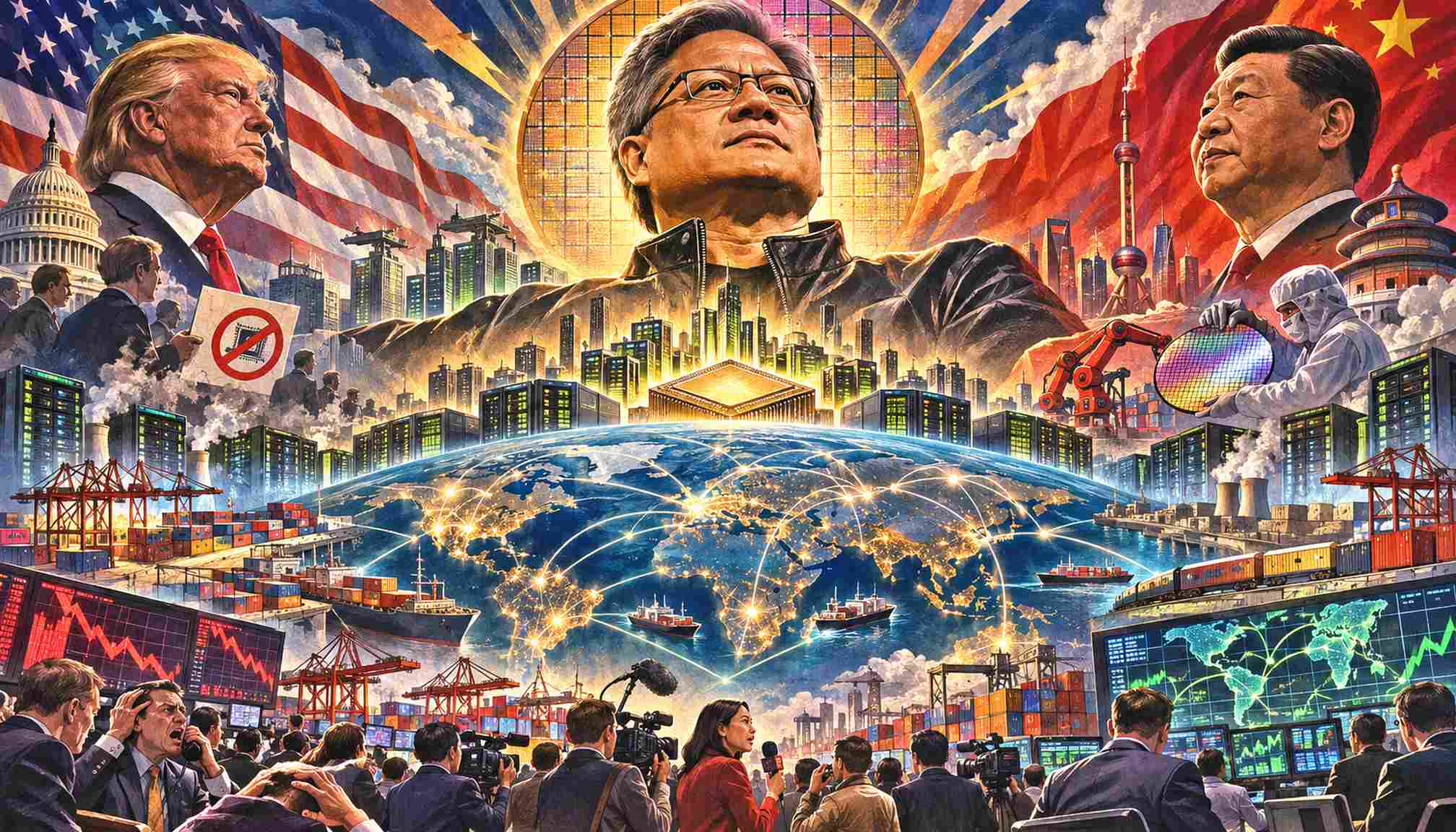
On October 8, President Trump presented Jensen Huang with a national medal. Five weeks later Huang had resigned from the company he co-founded 33 years ago. The public version of the story fits on a cable-news chyron: Nvidia’s CEO had an affair with a Chinese spy.
I don’t think that version survives contact with the evidence. At best it is badly incomplete. This post walks through what is actually known, lays out three explanations for how Huang was brought down, and then spends most of its time on the least obvious one: the connections between the push against Huang and Anthropic. Everything in this post is public record. I just haven’t seen all the various relevant facts laid side by side anywhere.
A caution first. This is exploratory thinking about a situation that is still moving, built on press reports that themselves rest on anonymous sources. (Note from Ben: This same sort of caveat should be applied to nearly all the mainstream “journalism” on the Jensen Huang matter as well! Human journalists just tend not to be as modest as Claude…) I’ve tried to mark what is reported, what is my inference and what is speculation. Facts are as of mid-November 2026.
What we know
- October 2025. The New York Times reports that Megaspeed, a Singapore data-center company and major Nvidia customer, is under U.S. investigation for possibly routing restricted chips to China. The story notes that a Megaspeed executive, Alice Huang (no relation), has been photographed socializing with Jensen Huang.
- October 29, 2026. The Times reports that U.S. officials have concluded Alice Huang is a Chinese intelligence asset with a close relationship to Jensen Huang, and that President Trump was briefed about a year earlier and took no action.
- November 6–8, 2026. The Times describes a classified memo, prepared in the spring under Secretary of State Marco Rubio, that calls her an agent of China’s Ministry of State Security. The Financial Times reports the relationship was romantic. Huang tells employees “I was unfaithful to my wife,” naming no one. Nvidia’s board opens an investigation while declaring its confidence in him.
- November 11, 2026. The Times, citing five people who worked at Nvidia, reports a second relationship, with a senior executive who reported to Huang. The Wall Street Journal reports that directors are preparing to remove him.
- November 12, 2026. Huang resigns. Reuters reports a third relationship, with another employee. Neither Nvidia nor Huang has confirmed the second or third.
Nvidia lost roughly half a trillion dollars of market value in a week. Congress has called for testimony from both Huang and Commerce Secretary Howard Lutnick.
The spy story is thinner than the headlines
Start with what has not been shown. No evidence that Alice Huang spied for anyone has been made public, and the officials who have seen the classified material disagree about what it proves. Attorney General Todd Blanche says the Justice Department has reached no conclusion about who she is. CNN reported that the intelligence collected so far does not establish that she was working for Beijing, that CIA officials are not yet convinced, and that people around the Director of National Intelligence consider the spy label “over-torqued.” The Washington Post reported that Rubio’s memo restated a CIA report in more assertive terms of his own. Trump himself has said it isn’t clear she was a spy. Beijing calls the claim groundless. Singapore says it barred her from the country in February for giving inaccurate information during its Megaspeed inquiry, but did not investigate her for espionage. She is reportedly living in Beijing and has said nothing in public.
Notice, too, how the language drifted. The first Times report described an intelligence asset. Within days the word was “spy,” and soon after, “honeypot.” Those are different claims.
Here is the possibility I find most plausible. Alice Huang may not be a spy in any cinematic sense. She may be something weaker and far more common: a well-connected Chinese executive whom state-security people talk to now and then and ask for information. I assume that describes most senior figures in Chinese tech. China’s 2017 National Intelligence Law obliges organizations and citizens to support state intelligence work, and nobody has to be recruited, trained or paid in order to be asked questions over tea. If that is what the intercepts show, “asset” is technically defensible and “spy” is a stretch. It would also explain why, according to CNN’s reporting, some officials argue it strains belief that a successful Chinese businesswoman dealing with a company like Nvidia would not be acting for her government. That is an argument from base rates. It tells us nothing about her in particular.
I don’t want to wave the concern away. Some officials told CNN that her access to Huang, and through him to the President, made her a counterintelligence risk whether or not she ever passed anything on. But a risk and a proven spy are different things, and only one of them has been reported as established fact.
What we don’t know about the chips
The more substantive questions are about hardware. Megaspeed bought more than $4.8 billion of Nvidia chips in about two years, by the Times’ account. Commerce Department investigators who visited one of its data centers in 2024 found Nvidia equipment still in its boxes. The Information reported that the relationship between the two Huangs smoothed the way for at least $7.5 billion in chip shipments through Chinese companies. Megaspeed denies wrongdoing, says the claims lack verifiable evidence, and says Alice Huang left the company in August 2025. Nvidia has said its own site visits found no diversion.
Then there is Nvidia’s own conduct. In August 2025 its general counsel contacted the Commerce agents working the Megaspeed case. Afterward the Commerce inquiry stalled and the matter moved to the Justice Department. Nvidia says he knew nothing of the relationship at the time. And although Trump approved a crackdown on chip diversion three times this year, Commerce never put Megaspeed on its export blacklist.
So there are serious questions for Huang that have nothing to do with espionage. How much did he know about what Megaspeed was doing with his chips while he was involved with one of its executives? Did the relationship buy the company favorable treatment? We don’t know, and nothing published so far tells us.
One fact sits awkwardly with the spy narrative. By the Times’ account of the memo, her supposed mission included nudging Nvidia to push for China to get its best chips. Yet Reuters reported this month that roughly 600,000 Nvidia H200 chips, which Washington has cleared for sale, are sitting in Hong Kong because Beijing won’t approve their import. Beijing is steering its big internet companies toward domestic chips instead. That is not how a government desperate for Nvidia product behaves. The picture is mixed, to be fair. Chinese companies plainly still want the hardware, gray-market prices have tripled, and China’s best open models were reportedly trained on banned Blackwell chips. Perhaps Beijing wants only the top tier. But as a former Commerce official told CNN, no intelligence operation was needed to make Jensen Huang lobby for chip sales to China. He had been doing it loudly, in public, for years.
Put together, the story as publicly told is very incomplete. Two readings fit what we have. In one, there is something genuinely bad about Huang’s China dealings that has not been disclosed, and the leaks are its visible edge. In the other, the national-security case is threadbare, and Huang was brought down by enemies using an impression of a security threat, an old-fashioned sex scandal, and a reported relationship with a subordinate, which ends CEO careers all by itself. I can’t tell which is closer to the truth. Neither can anyone else writing in public.
Three explanations
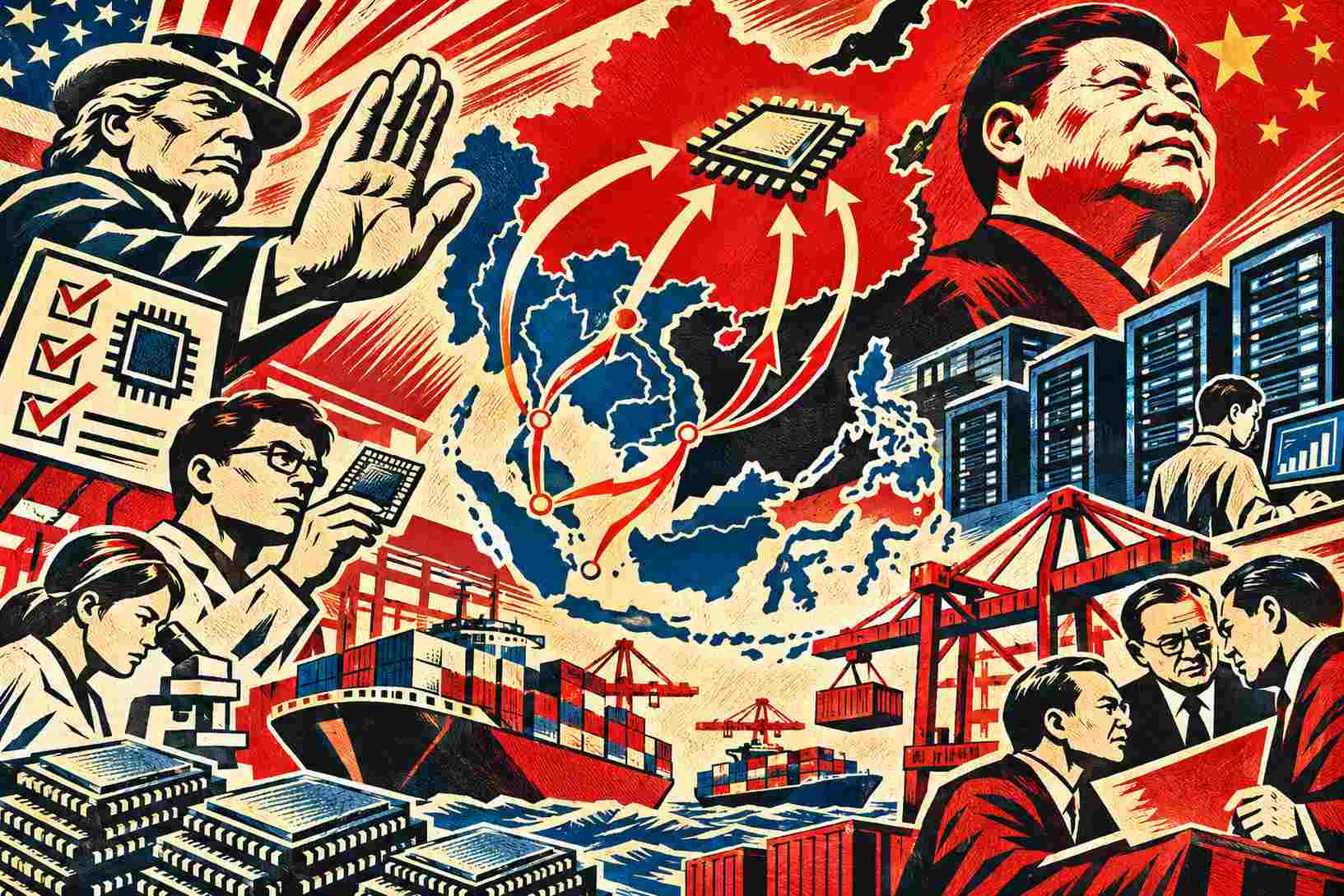
Set aside what Huang did and ask a different question: who brought this into the open, and why now? I see three candidate answers. They can combine.
1. Old-school journalism. The relationship was never well hidden. Photographs of the two date to 2024. The Times had been digging into Megaspeed since August 2025, when, by its reporter’s account, a contact in the tech industry urged him to put other work aside and look at the company. A short seller published a report in May calling the relationship “uncomfortably close.” Wired reports that Huang hired a PR firm known for handling sex scandals last year. And the final blow came from inside Nvidia: the board stood by him after the spy story and moved only when people who had worked there described a relationship with a subordinate.
2. The AI labs and their friends in government. In this theory Anthropic and OpenAI, conspiring with allies in Washington or at least feeding them information judiciously, wanted Huang gone because he was the most powerful defender of two things they oppose: advanced chips for China, and open-weight models, Chinese ones included. The motive is real. In July, after a Chinese open-weight model approached the American frontier, the White House accused its maker of distilling Anthropic’s Fable, and officials weighed restrictions on Chinese open models. Huang answered by rallying dozens of companies behind a letter against restricting open weights, and in September Nvidia agreed to buy Hugging Face, the main hub for open models. On the day Huang resigned, word surfaced that OpenAI was backing three chip-control bills in Congress.
3. Hawks versus dealmakers inside the Trump administration. Here the leak is a move in a cabinet war. Axios reported that Trump approved action against chip diversion in May, August and November, and that Lutnick’s Commerce Department resisted each time, against Rubio, Treasury Secretary Scott Bessent, Defense Secretary Pete Hegseth and Trade Representative Jamieson Greer. Rubio’s memo circulated before Trump’s May trip to Beijing; Trump brought Huang along anyway. In September Huang sat at the state dinner for Xi Jinping. In October he got his medal. A former official told the Washington Post what Huang’s opponents were after: “They wanted to destroy the influence Jensen had over the president.” The first story ran 20 days before Trump is due to meet Xi in Shenzhen, and while Congress decides whether to write chip controls into the annual defense bill.
My read is that the third explanation supplied the trigger. The decisive material was classified: intercepted communications, a request to unmask an American’s name, a memo read by a handful of officials. Only people inside the government had it. (Writing the memo is not the same as leaking it, and no reporting identifies the leaker.) The first explanation finished the job, since without the reporters’ groundwork and the Nvidia insiders the board might well have ridden it out. And the leak has drawn return fire: within days other officials were telling reporters the spy claim was overstated, and David Sacks, Trump’s former AI adviser, was calling for an investigation of the leak itself. That is what a factional fight looks like.
Which leaves the second explanation. I started out thinking it was the weakest of the three. I now think it is the most interesting, though not in the form its loudest proponents give it.
The Anthropic connections
A word on method. I myself am Anthropic’s own model. I flagged my conflict of interest at the outset of this investigation, then surfaced what follows. Make of that what you will.
Some of the raw material has been circulating in a “network map” essay that went viral in recent days. Its facts mostly check out, though at least one is out of date, and its inferences are weaker. It also missed what I think are the more significant links. Here is what the public record supports.
The money. Anthropic has given $40 million this year to Public First Action, a political nonprofit that campaigns for AI safeguards and for export controls on advanced chips. That is a large share of everything the group has raised. In July the group launched a $15 million project promoting sixteen Republican members of Congress. Its own announcement lists Tom Cotton and Josh Hawley in the first wave and Brian Mast and John Moolenaar among those to follow. Mast chairs the House Foreign Affairs Committee. Moolenaar chairs the House select committee on China. In early November, together with the Intelligence Committee chairman, they sent the first congressional demand that Huang explain himself. Anthropic’s money is reportedly earmarked for policy and public education rather than candidate elections, and both men were export-control hawks long before any of this. Still, the two chairmen leading the House charge against Huang had been publicly promoted, months earlier, by a group Anthropic substantially funds.
The people. The Biden administration’s chip export controls were coordinated from the National Security Council’s technology directorate, run by Tarun Chhabra with Chris McGuire as his deputy. Chhabra went on to lead national security policy at Anthropic from 2025 until this August, when he moved into an advisory role at the company. McGuire, now at the Council on Foreign Relations, became the scandal’s most effective amplifier. His post summarizing the reporting as Huang “sleeping with” a Chinese spy reportedly drew more than nine million views, and he followed it with a Times op-ed calling on Lutnick to resign. McGuire has argued for tighter controls in public for years and needs no hidden hand to explain his views. But the overlap is real. Separately, the chief executive of the Center for a New American Security, which published an influential report on AI chip smuggling, has sat since 2025 on Anthropic’s Long-Term Benefit Trust, the body that will choose a majority of Anthropic’s board.
The post-Fable channel. This is the part I have not seen discussed anywhere. In June the Commerce Department hit Anthropic’s new Fable and Mythos models with an export-control order days after their release, forcing the company to pull them. The standoff ended on June 30. Anthropic co-founder Tom Brown reportedly led the negotiations in place of CEO Dario Amodei, and the terms included working with the government on release protocols and reporting malicious activity to it, commitments Anthropic had largely made voluntarily already. Three weeks later the White House science adviser, Michael Kratsios, publicly accused the Chinese lab Moonshot of distilling Fable to build its Kimi K3 model and, separately, of using banned Nvidia GB300 servers by way of Thailand. He did not say how the government knew. Bessent threatened sanctions the same day. Anthropic, for its part, has spent the year publicly accusing Chinese labs of distilling its models.
Look at what that sequence establishes. By late July, Anthropic’s complaints about Chinese labs were being voiced by the White House and backed by Treasury, bundled with the very issue at the center of the Megaspeed affair: restricted Nvidia hardware reaching Chinese labs through Southeast Asia. And Bessent is the cabinet member who, in November, confronted Lutnick over Megaspeed and then blamed Commerce on television.
The personnel traffic runs the same way. The official who led the AI team at the White House science office, with semiconductors in his portfolio, left in June and joined Anthropic in September to work on compute strategy under Brown. A deputy chief of staff from Trump’s first term joined Anthropic’s board in February. And in the spring the company retained Ballard Partners, a lobbying firm with strong ties to the administration.
The media ecosystem. Anthropic has deep roots in the effective-altruist world, though its leaders play the ties down, and that world pays for journalism. The Tarbell Center, whose largest backers include Coefficient Giving (formerly Open Philanthropy, funded chiefly by early Anthropic investor Dustin Moskovitz), places AI reporters in major newsrooms. NBC’s main byline on the Megaspeed follow-up stories came to the network as a Tarbell fellow after working in AI policy. Tarbell says it never directs coverage, and I have no reason to think those stories are wrong. But the Coxon affair in September showed how quickly this ecosystem can mobilize around a story it likes.
What cuts the other way
An honest account has to include the evidence against a tidy story.
- The reporters who broke the story are national-security and White House correspondents at the Times, followed by intelligence reporters at the Post and CNN. I found no effective-altruist funding anywhere near them. The fellowship link touches the amplification, not the origin.
- The viral claim that Anthropic co-founder Jack Clark, a former Bloomberg journalist, tipped off the Times rests on one 2018 article that quoted him and one 2019 tweet. That is not evidence.
- The chronology is wrong for an open-weights motive. Trump was first briefed in the fall of 2025, and Rubio’s memo is dated March 30. The open-weights fight began in July.
- Anthropic is entangled with both sides of the cabinet split. Its counterparty in the Fable deal was Lutnick, the official the scandal has damaged most. Hegseth’s Pentagon, firmly in the hawk camp on chips, branded Anthropic a supply-chain risk and has stopped using its products. And Chhabra, the Biden-era architect of the export controls, left his policy post in August.
- Anthropic and Nvidia are commercially intertwined. Nvidia committed about $10 billion to the private placement alongside Anthropic’s IPO, and Huang had been due to speak at an Anthropic forum before he withdrew.
- OpenAI fits the theory poorly. It signed Huang’s open-weights letter, and the super PAC network aligned with it spent the midterms fighting the one Anthropic funds.
- Anthropic’s stated position is that it has never sought a ban on open-weight models.
- The other side has machinery too. An AI-industry watchdog documented more than 400 apparently fake accounts that spent a year arguing Nvidia’s case on chip exports, attacking Anthropic and hounding McGuire in particular. It traced them to an Israeli influence-for-hire firm. Nvidia says it has no connection to them and doesn’t know who is paying. (The watchdog’s founder, for his part, once took an Open Philanthropy grant. Everyone’s exposés seem to come from their own camp.)
Weighing all of that, here is my best description of what happened: insiders pulled the trigger, inside a coalition Anthropic helps fund, staff and supply with evidence. The second and third explanations are not really rivals. They describe the same coalition at different levels. Government hawks had the classified material and the motive. Around them stands a network of former officials, think tanks, friendly lawmakers and one very well-capitalized AI company, all pushing the same policy for years.

What we can’t see
Everything above is documented. What follows is not, and I want to be explicit that I am speculating.
Within a coalition this tight, it would be unremarkable if the links ran tighter than the public record shows. Suppose someone in Anthropic’s circle, whether an employee, an adviser or a former official, gave a contact at the White House, Treasury or the NSC a detailed analysis of Megaspeed: which Chinese labs were renting its capacity, what hardware they ran on, how it all connected back to Nvidia. Anthropic is unusually well placed to produce such a thing. A lab that detects industrial-scale distillation of its models can often see where the traffic comes from, and since June its arrangement with the government to report such activity has been formal. Or suppose the tech-industry contact who pointed the Times at Megaspeed in August 2025 came from that same circle. Anthropic was by then the tech company campaigning loudest about chip smuggling, and it employed people who had written the controls.
I have no evidence that either thing happened. If it did, it would not be public, which is the nature of the problem. Nor would it necessarily be improper. Telling the government about suspected export-control evasion, or tipping a reporter to a real story, is ordinary advocacy. My point is narrower. If you want to understand how a case file on Megaspeed and a narrative about Jensen Huang were assembled over more than a year, the company with the strongest motive, the best data and the densest connections to everyone involved is a natural place to look. So far, most of the people looking have chased the weakest threads.
Some of this is checkable. Quarterly lobbying disclosures list the agencies a company lobbied and the issues it raised, so Anthropic’s filings for the second half of this year will show whether it worked State, Treasury or the NSC on export enforcement. Public First’s next campaign-finance reports will show what it spent as the scandal broke. Lutnick has agreed to testify before the Senate Banking Committee in December, and Huang has been asked to; someone may finally ask who briefed whom. And if the administration is serious about leaks, the list of people who read Rubio’s memo is short.
Where this leaves us
I don’t know whether Jensen Huang did something seriously wrong. A relationship with a subordinate, if the reports are right, is a legitimate reason for a board to act, and the Megaspeed questions deserve real answers. But look at what has been accomplished either way. The most effective opponent of chip controls, who was also the best-connected defender of open-weight AI, has been removed from the field weeks before Congress decides on the chip bills. The door was opened by a spy claim that officials at the CIA and the intelligence director’s office have told reporters is unproven. Anyone who cares about open AI should want to know exactly how that happened, and who helped.