Who The F*** is Mark Fisher? and Why You Should Care: They Made A Film About Making A Film About Mark Fisher
A DIY film about Mark Fisher becomes something stranger: a living artwork where theory, protest, and post-punk collide into a restless search for life beyond capitalist realism.
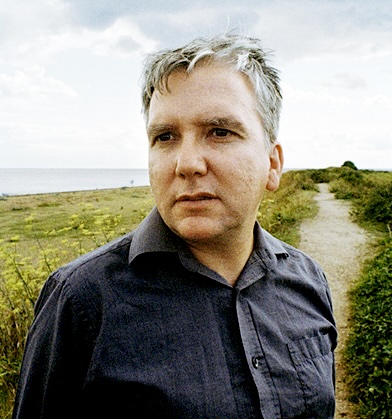
For the purposes of this international and tech oriented webzine and readership, let’s identify Mark Fisher as a leading British cyberpunk figure, although it’s more like he was part of the “cyber” explosion of the 1990s through his participation in the legendary (in some quarters) CCRU (Cybernetic Culture Research Unit). And he was part of postpunk rock culture through k-punk, an early post-punk blog that created a huge following and then cult status around Mark Fisher’s writing.
Fisher may be one of the last in the tradition of serious intellectual rock writers who had a voice that got read by significant numbers (again, mainly in Great Britain, but rock writing is a grand tradition there.)
One thing that attracted me to Fisher was his obsession with The Fall. And if you don’t love Mark E. Smith get off of my cloud and my lawn.
Some of you may be familiar with a different persona outcropping from CCRU who has captured a portion of the public intellectual accelerationist imagination—Nick Land. And there were several others engaged in this unofficial, informal, cranky-yet-influential sort-of think tank, including the noted feminist artist (interviewed in Mondo 2000!) Sadie Plant.
To put it in a clear gelatin capsule (and since the extant CCRU website is even more unfriendly towards those seeking easy answers then this damn film I’m interviewing about, I’m just going to grab some text from the top of the Wikipedia page about CCRU:
The Cybernetic Culture Research Unit (CCRU, sometimes typeset Ccru) was an experimental cultural theorist collective formed in late 1995 at Warwick University, England which gradually separated from academia until it dissolved in the early 2000s. It garnered reputation for its idiosyncratic and surreal "theory-fiction" which incorporated philosophy, cyberpunk and occultism, and its work has since had an online cult following related to the rise in popularity of accelerationism. The CCRU are strongly associated with their former leading members, Sadie Plant, Mark Fisher and Nick Land.
Established at the University of Warwick philosophy department…
You get the picture.
So while Land indeed accelerated into public consciousness by advocating for an anti-democratic, anti-egalitarian “dark enlightenment", Mark Fisher became increasingly influential on the left, with his explorations of theory, punk rock and the anti-capitalism potentialities of the 21st century.
His book Capitalist Realism: (Is There No Alternative?), published in 2009, is a discursive exploration of the sense of the world and the human imagination being trapped in a predefined ideological totality—that box that those who blathered about “thinking outside the box” couldn’t or wouldn’t think outside of. In CR, Fisher popularized the phrase “It is easier to imagine an end to the world than an end to capitalism”—the words originally attributed to Fredric Jameson.
Making A Film About Making a Film About Mark Fisher
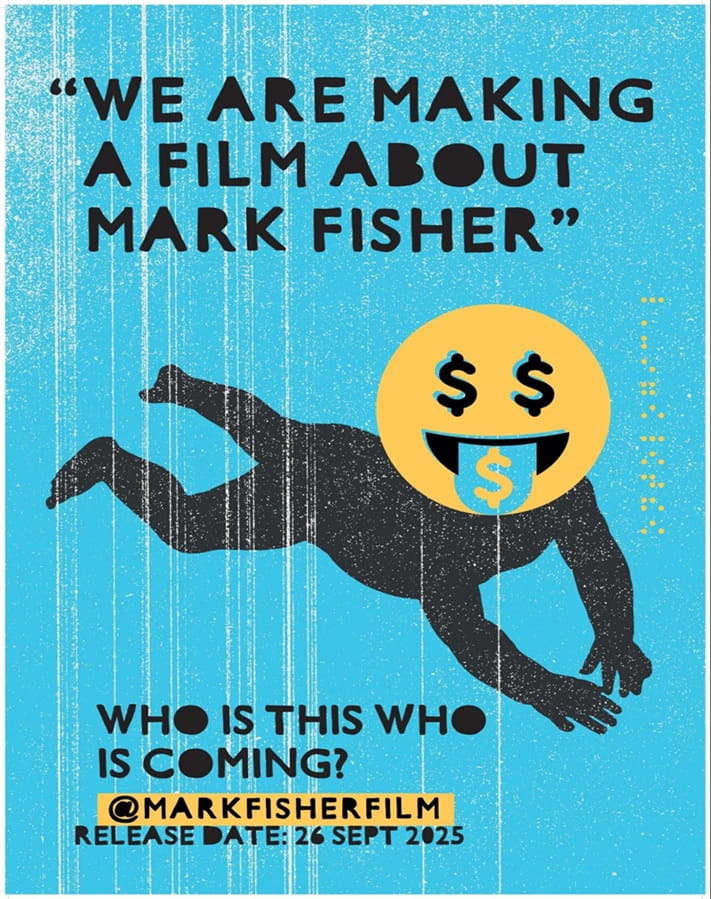
Close and Remote started posting about how “we’re making a film about Mark Fisher” on October 2024. The first online post was @markfisherfilm on Instagram. Close and Remote tells me. “At the inception the project had little attention. It iterated as research. A PhD by instagram.”
Instagram is also where I saw posts about it, probably some time early in this year.
I became a Mark Fisher fan after having read an essay collection which included a tantalizing unfinished essay titled “Acid Communism”.
I found the psychedelic utopianism simultaneously preposterous and, perhaps, the seed of something that might blossom into a joyous eruption, even if doomed to fail. This segment has haunted my imagination ever since reading it:
Mark Fisher: The late cultural critic Ellen Willis said that the transformations imagined by the counterculture would have required “a social and psychic revolution of almost inconceivable magnitude”. It’s very difficult, in our more deflated times, to re-create the counterculture’s confidence that such a “social and psychic revolution” could not only happen, but was already in the process of unfolding. But we need now to return to a time when the prospect of universal liberation seemed imminent.
Having a personal history with that radical dreaming (not to mention the long disillusionment… Oh, well I guess I’m mentioning it), my interest was sparked.
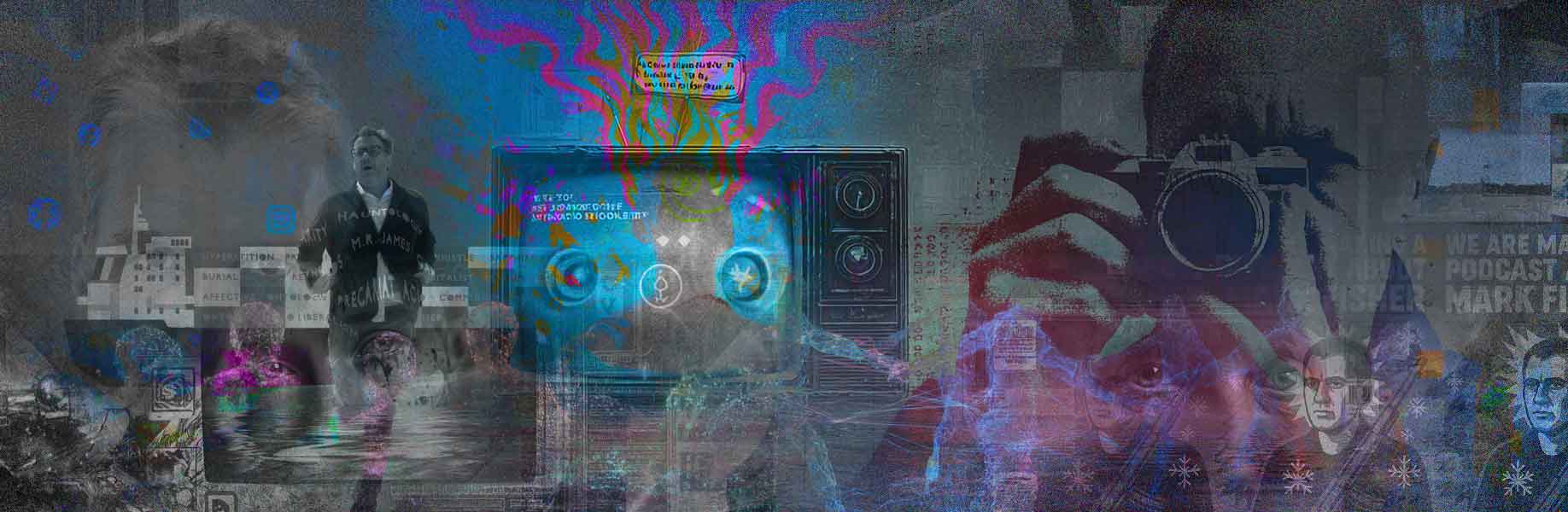
The film itself is an avant-garde masterpiece, in some ways less about Fisher himself (although that’s folded in) and more about evoking places and situations and recent and contemporary political activism struggles in Great Britain. It’s not your typical film bio.
Close and Remote, in the persons of Simon Poulter and Sophie Mellor, were kind enough to allow me to view the film and to answer my questions via email
We Are Making A Film About Mark Fisher has been shown in multiple locations throughout Great Britain, Italy and Scotland and has also been shown in Norway, The Netherlands, Australia, Turkey, Lithuania, Switzerland, Portugal, Sardinia, and at the Roxy Cinema in New York.
RU Sirius: How did you become interested in Mark Fisher’s work and ideas and what did he mean to you as a person, a thinker, and an activist?
Close and Remote (Sophie Mellor and Simon Poulter): Mark Fisher had a very foundational moment at the beginning of the blogging period during the early 2000s. He was most well known as ‘k-punk’ on his blog and it can still be found online. It is a great way to encounter his very discursive style of writing and thinking. In essence, his work is important as he was able to write across critical theory, music writing, politics and even therapy. He really was a one person music magazine and theorist. While he was an academic for a part of his life, he mostly sat in this unusual space as an online public writer and thinker. We became interested in Mark’s work through the k-punk publication and of course his most well known work Capitalist Realism. For most people this is a good starting point, as he writes very personally about the affective nature of capitalism. It surrounds us and is inescapable, he talks of course about Raymond Williams as a citation.
RU: Your film is titled We’re Making A Film About Mark Fisher. It’s a pretty good hint as to what would appear on screen, although I was pleasantly surprised by the approach. It’s not your typical doc about a person or a scene, most of which have become extremely formulaic, even the good ones.
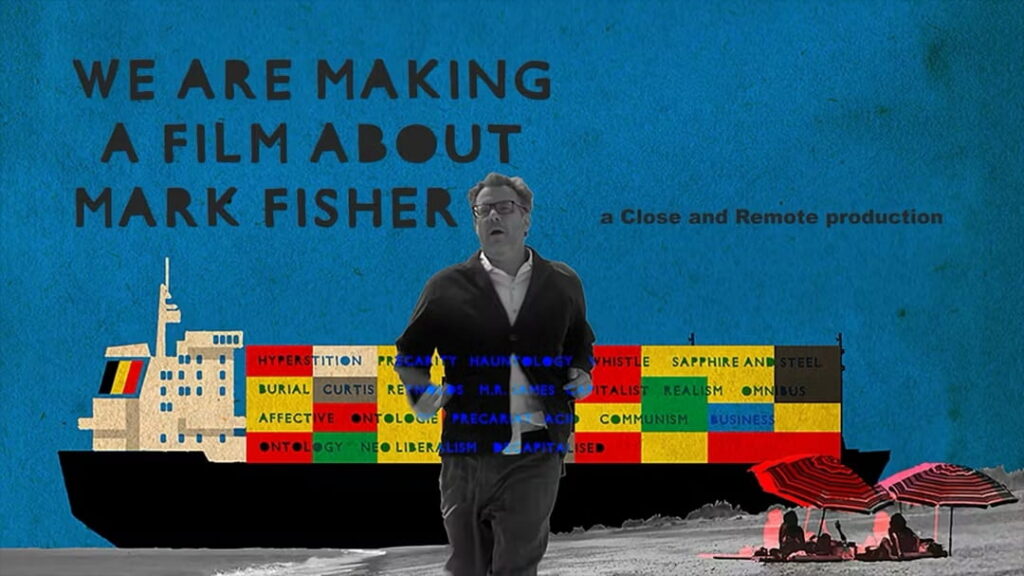
CaR: No, it is not a typical doc, it is a meta-fiction. It blends from a reenactment of an M.R. James ghost story, to interviews, footage of protests in London and right into the ‘perma crisis’ of now.
So, it is about Mark Fisher, but it is not a biog film, it goes beyond his death in 2017 and into the very messy world that we live in. Also, the film was made with no budget! This means that it is cut up in feel and quite raw, although we spent a lot of time on the edit that Sophie Mellor produced. It has a completely new sound track, with new music and talent. Everyone, including ourselves, worked on it for free. Justin Hopper, an American writer based in the UK, plays Parkins from the ghost story. He is also a voice narrating what he finds and he also becomes the witness to the Vampire Castle scene. This is based on Mark Fisher’s most controversial online essay ‘Exiting the Vampire Castle’. Fisher tackled identitarian politics of the left and met the wrath of many people, as a result and got off Twitter. This was a turning point in his work and life in fact.
RU: So, you have some of that usual doc stuff, but you also do some other more personal and more cinematic aspects. Please speak to the nature of the film you made and how you approached the subject.
CaR: We did work with Pete Berglund and Roland Denning, both of whom are great with cinematic work. The intention was to bring some of Fisher’s locations alive. So, for example, the opening scenes are shot in Felixstowe where Mark Fisher lived and died. We also filmed in Thamesmead, a huge estate in South East London, where elements of Clockwork Orange were filmed. Some people see the film as being psychogeographic in form, which it is, as we had this idea of layers of experience and meaning. Fisher’s work also has this sense of encountering the world as a film.
RU: Let’s jump into ideas and personalities.
At Mondo 2000, in the 1990s, we had an interview with Sadie Plant, but I really only became aware of CCRU in the 2000s. But it was clearly an extraordinarily fecund and influential group. Nick Land, Sadie Plant, and Fisher sort of emerge as the "stars", each achieving (if that’s the correct word) a kind of intellectual celebrity and each going in very different directions. There’s some potential for a drama narrative around all that, particularly given the dark edgelord direction of Land who, despite his right wing extremism, seems to fascinate a lot of left intellectuals. Please sort some of this out.
CaR: A great way in to this is to read Simon Reynold’s excellent essay on the CCRU which is entitled ‘Renegade Academia’. It was written in the late nineties, although they of course eschewed the fact that it ever existed.
I guess we have to remember that in the late nineties people were excited about new technology and there was a utopian change-making sense about network technologies, feminism, emancipation and new ways of living. This now seems sadly lost, but at the time people were questioning orthodox politics and social spaces, with a view to remaking things in the cybernetic world. Sadie Plant’s book Zeros and Ones lays down a lot of the thought from the period and was hugely successful as a publication. Nick Land came along and of course had a very idiosyncratic teaching style. His ideas around hyperstition and accelerationism have become incredibly influential now in ’tech bro culture’ and even share dealing. He does of course reek of the far right and aspects of a political base that we are all being subjected to, whether we like it or not. Mark Fisher definitely gained his grounding in language play and portmanteau word assemblages while at the CCRU. As you say, this was a very fertile and creative launch pad for some amazing people. Also, we must not forget Kodwo Eshun and Steve Goodman (kode9).
To answer your question more completely, there is evidently a film to be made just about the CCRU—however whoever takes that on will have to scythe through the jungle (pun intended)...
RU: Please tell us about the responses to the film, responses, embraces, critiques and so forth.
CaR: We Are Making A Film About Mark Fisher has generated discussion. Not a sealed echo chamber, more a porous field of activity. This is the space where an artwork, a film and a network of people overlap producing momentum. Ideas circulate quickly, connections are made and action is possible. It is DIY. Posters, events and discussion.
At the widest point it is an artwork. The film sits inside that artwork rather than the other way around. The artwork is the process—conversations, screenings, writing, music, speculative ideas and the people who move through them. The project behaves less like a conventional documentary and more like a cultural organism.
It was made with almost no budget, assembled through collaboration and goodwill. It is distributed through the same networks that helped produce it. Screenings in the UK, Europe and beyond have turned into gatherings rather than passive viewings. The ending deliberately returns to the room. People are invited to discuss what Mark Fisher’s work means now and what actions might follow locally. Each screening slightly alters the project, adding new voices and possibilities. If you get this, then you get it overall.
Through this circulation the project has developed international distribution in an unconventional way. Instead of relying on traditional film industry pathways, it travels through universities, art schools, independent cinemas, reading groups and online communities. The spread is rhizomic rather than hierarchical. The film moves because people engage.
One of the most striking developments has been the energy coming from Gen Z audiences. For many of them, Mark Fisher’s work is not a nostalgic reflection on “lost futures.” Instead it functions as a diagnostic tool for the present.
The language of capitalist realism, hauntology and post-capitalist desire helps explain the conditions they are experiencing. Precarity, platform capture, environmental crisis and political fatigue. Rather than despair, the response is often practical. Conversation moves quickly from theory to action—organising locally, experimenting with new forms of cultural production—imagining public luxury again. In this sense the project sits within a renewed leftist cultural current, recombining forces.
At the centre of all this is Mark Fisher’s role as a catalytic force. Fisher rarely positioned himself as a leader of movements. His strength was the ability to articulate conditions that many people felt but struggled to name.
We Are Making A Film About Mark Fisher therefore isn’t an illusion or a closed belief system. It is a temporary concentration of attention, people and ideas. Inside that space the film becomes a moment, the artwork becomes a meeting ground and Fisher’s thought continues to generate new conversations. What matters is not protecting the bubble forever but to connect people, test ideas and move from recognition to action.
RU: That the people attending the film. aren't passive audience members but participants in gatherings is a very encouraging sign. Are you forming alliances—in an informal or semi-formal sense? Do you have a sense that some new practices could be emerging into political activism or social activities or both?
CaR: Yes, new alliances and a more direct process are in play. No gatekeepers, no agents, no distributors. Of course a lot of this is about MF but talking with Tariq Goddard suggests that the film is a new part of MFs story. He just does connect with people of all ages. We are now being asked in screenings what happens next? What do we do? We are encouraging resistance to corporate culture, promoting creativity and localisation of groups. Convening.
RU: Close and Remote is more than the name of the group that made the film about Mark Fisher. Your website lists “working values” and every one of them deserves meditation and discussion. I’ll list them…
• The obvious is always present • The edge of a situation has value • There is no such thing as content • Lifestyles are not defined only by technologies • Uncertainty is preferable over innovation • Aesthetics contain cultural currency and agency
Credit: Tesfu Assefa
CaR: Yes, we work to some basic values. Quite a few of them originate from doing art projects with and without technology. We think about our agency and role in the process. We mostly see ourselves as ‘in; rather than ‘without’. However, we are often viewing distinctive places or people, such as the 360 watercolours of Jaywick in Essex. A big influence, as I am sure you can tell, is John Cage in indeterminacy.
RU: How do some of these impact on the choices you made in this particular film and in other actions you do?
CaR: The film is inside the artwork. It’s the record that can ‘be shown’ of what we found. It’s the thing we made with others. It is probably better for us to talk more about the artwork, which has a film inside it. We have realised this as the film has gained more interest than we imagined. The values do impact closely on what we have made and the film. Uncertainty pervades the whole process. Many people did not want to be involved in the film, or in the film but did help us. The process we have used is emergent—we are saying we don’t know what will happen here. We had a script, some sections, but to get interviews was often difficult.
RU: I’m particularly scratching my head over “Uncertainty is preferable over innovation.” Are these things actually in contrast?
CaR: In Gross Britannia there has been a common lens of ‘innovation’ in the way things get made or commissioned. We are being invited to see ourselves and our output as being innovative. In fact, we are often iterating and learning from what we find. So, to be recognising uncertainty, or indeterminacy, as a working approach seems much better. Innovation becomes a buzz word surrounding art and technology. You will remember this from Buffalo and Pittsburg. Art and technology, late 1990s. The utopian aspect, that has now moved to a Neo-liberal and subservient idea that art must perform a societal or commercial role. Of course we refute this.
Working with the obvious is also important to us. It is ever present! Okay, there is a huge container ship on the horizon, let’s film Parkins now. You might call this ‘improvised’, as it is.
Fisher does talk about the disconnect between content and containers. It is like the whole corporate world is an empty system, waiting to be filled. This plays to the subscription model of life, a life in fact tethered to monthly payments. Fuck that.
RU: I seem to recall that I was initially drawn to Fisher when I heard someone was writing about Acid Communism. I’m a former Yippie. In some sense, the assumptions of total revolution and an acid new left utopia that was going around in the late 1960s and into the ‘70s left me high and dry. I didn’t plan on having to cope with the realities of capitalism and authority and wound up adrift as “the revolution” turned sour.
CaR: From our research, Jeremy Gilbert is closely connected to the idea of Acid Communism. Fisher, of course, drove it forward and playfully explored it, in an unacademic way. This is his skill—to elliptically work across ideas and theory. Andy Beckett talks about Fisher exploring ideas from the 80s and 70s as a way to suggest that the past can be a way to dream up new futures. This is of course oppositional to the earlier ideas of hauntology, where modernism and post-modernism have led us to the end of cultural movements. The artwork We Are Making A Film About Mark Fisher is a deliberate class action against this end of the world impasse. We are witnessing people organising and framing away from this blockage in the screenings of the film. How exciting?
In the artwork, we are saying that creativity, kindness and anti-algorithmic life is right in front of us. But we have to rapidly detach from the subscription model of late capitalism and re-evoke a new freedom. This is of course generational. We can remember life before the internet. Gen Z in some ways want the public luxury and freedom we had. That is going to happen. We are manifesting that. More, I am sure…
RU: The film communicates a strong sense of location as noted. I wonder if you have thoughts about how the film might land with us here in the US.
CaR: It has been shown in New York at the Roxy. But some of the politics in it might not land with Americans. We are arguing for the return of public wealth not privatised acquisition. The film also shows how protests failed in the UK. This is of interest to people in the US. We want to screen it more there…
RU: Finally, since the webzine is mindplex.ai... the obligatory AI question.
I’ve bumped into a number of writers who believe that AI—so much an implement of control, confusion and waste—can be turned towards progressive utopian post-scarcity possibilities. Do you have any thoughts or insights in this regard? Does this positive hope related to AI come up in discussion much in your circles?
CaR: Universally, people here are opposed to AI. In fact we coined the phrase ‘de-bro-ification’ in the pub in Aberdeen. This is not AI for the common good, this is colonialism of the human body, mind and soul, in order to sell it back to you on a rolling contract. Basically, this is not AI, this is information plunder, rape and pillage. Fuck AI. By all means go to Mars and live to be 200, but leave humanity alone thank you very much…
Great piece! I'm researching Mark Fisher and this piece is very useful. I want to watch the film, but the Vimeo link you give doesn't work. Searching Vimeo, I found only a trailer. Any suggestion?
I find it amusing to think that refactoring our current 'subscription-model' reality isn't just a theory but the ultimate debugging process for reclaiming a future that actually belongs to us.
I really liked the idea that this film is a living artwork that changes every time people meet to watch it. It feels much more human than a movie made by a big company.
It’s fascinating how the film uses Instagram to explore Fisher’s 'hauntology'—using the very tools of the 'algorithmic present' to try and recapture the lost futures he wrote about.
This article does a great job showing how Mark Fisher's ideas continue to resonate beyond theory and into lived cultural practice. What stood out to me is how the film isn't just a biography, but a collaborative, evolving artwork that mirrors Fisher's own emphasis on collective imagination and resistance to capitalist realism.