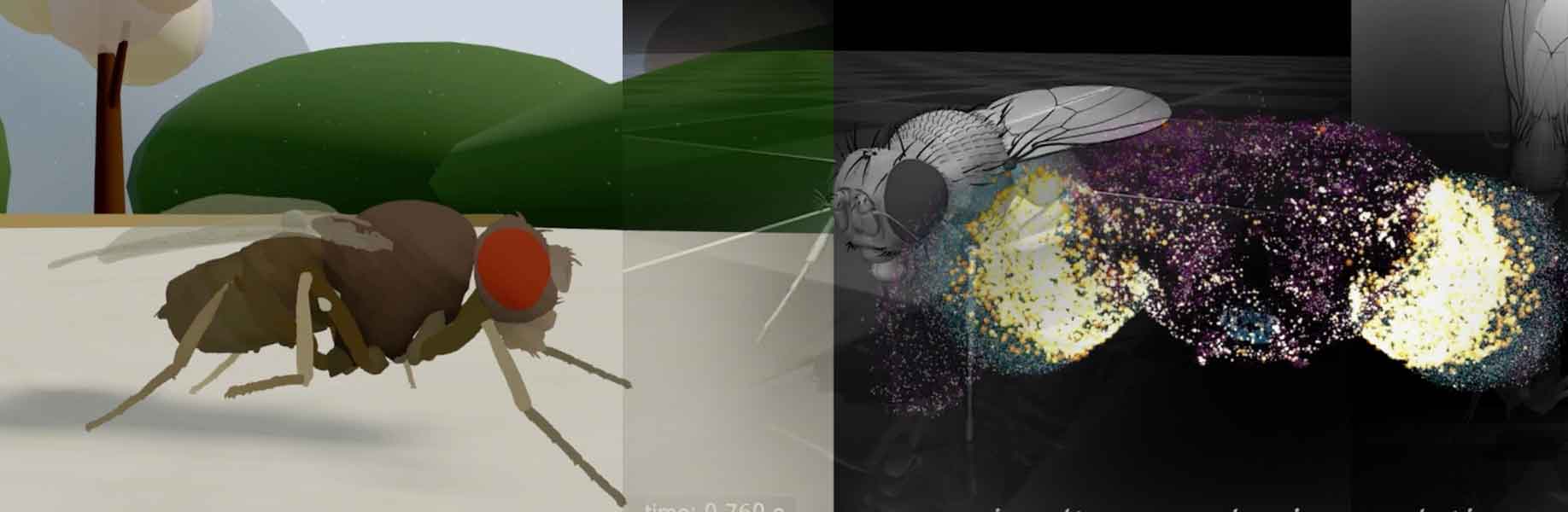

Whole-brain emulation means creating a digital copy of a real brain, including every neuron and synapse, and run it on a computer. Until now, such copies lacked a body to interact with. A new demonstration from Eon Systems changes that by linking an emulated fruit fly brain to a simulated body, allowing it to show natural actions, Alex Wissner-Gross reports.
The work builds on a 2024 model published in Nature of the adult fruit fly brain, with over 125,000 neurons and 50 million synapses. This model predicted movements accurately but had no body. Now, using the FlyWire connectome - a full map of brain wiring - and tools like NeuroMechFly, a body simulation framework, and MuJoCo, a physics engine for realistic motion, the emulation handles sensory inputs like sights or touches, processes them through the brain's circuits, and outputs commands to move the simulated fly.
Path to larger emulations
This setup creates a closed loop from perception to action, producing multiple behaviors without external programming. Unlike past efforts, such as simple worm simulations with only 302 neurons or AI-trained fly models without real brain wiring, this is the first full brain copy driving a body through its own dynamics. The fly shows actions like walking or turning based on inputs.
Eon aims to scale this to a mouse brain with 70 million neurons, using advanced imaging to map connections and record activity. Success could lead to human-scale whole brain emulations, aiding research in brain function, disorders, and digital minds.
Eon Systems Founder and CEO Michael Andregg has posted an X thread to comment on this breakthrough and its significance. He explains that "we do know what the brain does when it wants to move in certain ways and that's what we connected to the NeuroMechFly."
"This is, in our view, a real uploaded animal," he says. "We don't know what its experience is - nobody does. But we take the possibility seriously."