
In October, MIT Technology Review published “Six wild ideas for perpetuating your mind.” (https://www.technologyreview.com/2026/10/15/1145819/six-wild-ideas-perpetuating-your-mind-cognitive-immortality/) The tour includes mindclones, AI avatars built from a person’s data, and brain uploads, which would reproduce a mind from a map of the brain’s wiring. On uploads it is blunt: “everyone agrees that this technology isn’t coming in time for those of us alive today.” On clones it is candid: “Your digital clone might not be you.”
Mindplex has reported on research into “generative ghosts” (https://magazine.mindplex.ai/post/ai-afterlives-transform-grief-and-memory): AI “capable of new conversations or tasks like managing estates.” Once a copy of a person begins to make decisions, whether it really is that person stops being a seminar topic and becomes a matter of governance.
Contocracy, a form of rule proposed in 2026, takes a different route. Its AI never claims to be anyone.
A founder who turned down a twin
Picture Tidewell, an invented virtual city that people visit through VR headsets, run by a studio of the same name. Its founder, the game designer Weronika Kaszuba, chose its tidal canals, its copper roofs and its long violet dusk. She also keeps a never-build list: no slot machines, no paid loot boxes, no advertising stitched into the sky. Engineers keep the servers running, a community council writes the rules of conduct and a board manages the money, but whether a new district belongs in Tidewell still comes down to her eye.
A startup has offered to build her a digital twin: an AI trained on her messages and design reviews that would greet visitors in her voice, sit in her meetings and approve new districts in her name. She declines: she wants her taste to outlast her, not a copy of herself to claim it.
How a contocracy is built
In a contocracy, one chosen person holds the community’s highest office for good. At Tidewell, that office is the final say on matters of taste, and Kaszuba is its contocrat. Lower powers may be delegated, and nearly all of them already are. The office cannot be transferred and passes to no heir. When she dies, it is held in abeyance and remains hers.
She sets all of this up in life. First she gathers the record: design reviews with her reasons, sketchbooks, voice memos on why a street works, and the never-build list. On that record she builds one declared AI stand-in. By default it acts only after her death, though she may also authorize it to act while she is alive but cannot be reached. She tests it against her own reviews before she dies, and operators she picks keep it running. True emergencies, such as security threats and disasters, are never its business. She hands them over in life, long in advance, to established institutions such as a national government or her church.
The stand-in takes up what she would have wanted decided: matters where Tidewell’s mission, her religion and its technology meet and the answer turns on personal taste and preference, the way a founder’s design sense shapes a line of products. Kaszuba is Catholic, and where the mission and her religion pull apart, the religion prevails. If the Church’s authorities change a teaching after her death, the stand-in does what she would have done. She always knew her Church would change, and she counts it as more enduring than any state.
Two years after her death, say, Tidewell’s engineers ship a lighting engine that can make the canals glow at night. The technology works, but whether the glow suits her city is a matter of taste, so it goes to the stand-in. It reads her reviews, finds that she turned down glowing water twice, and rules against it. The decision goes out under the stand-in’s own name and is filed beside the reviews it relied on.

Five ways it differs from a copy
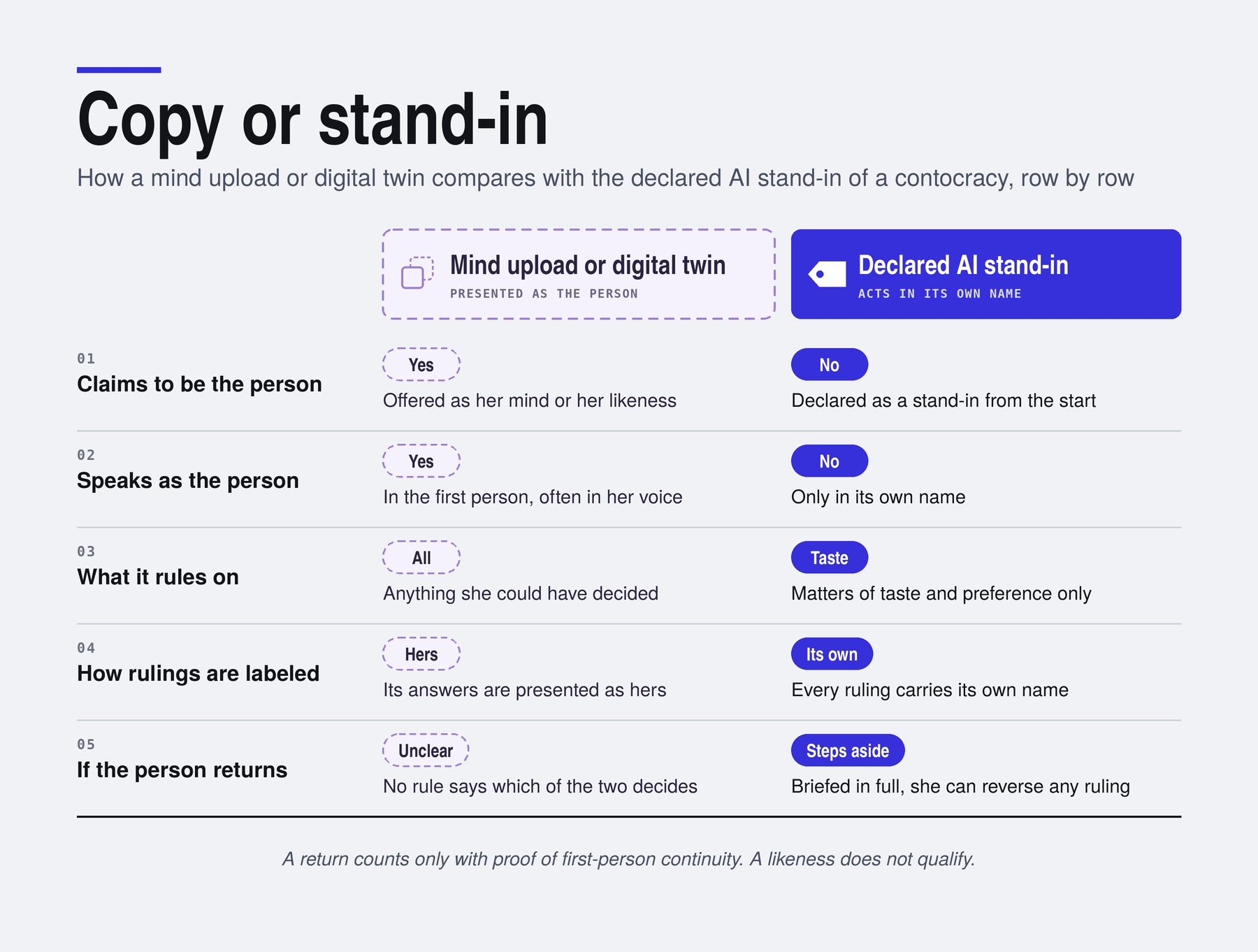
First, it claims no identity. A mind upload would be offered as a continuation of the person, and a digital twin as her likeness. Tidewell’s stand-in is declared as a stand-in before anyone relies on it, so no one has to settle whether it is her.
Second, it never speaks as her. It uses no first person on her behalf, no cloned voice and no face. Every message it sends opens with its own name.
Third, its remit is narrow. A twin will answer anything it is asked. The stand-in rules only on matters of taste and preference, and staffing, money, code and conduct stay with the people and bodies she delegated them to.
Fourth, its rulings are labeled. Everyone knows that the stand-in, not Kaszuba, is deciding, and each ruling says so. A rebuilt or upgraded model may replace it only if it matches her record at least as well. After her death, only verified or minor material, such as family photos, may be added to that record.
Fifth, it makes room for her. Kaszuba plans to be cryopreserved, which contocracy expects but does not require. No one has been revived, and the form promises nothing. But if she is ever brought back and shown, by proof of first-person continuity, to be herself, the stand-in steps aside; a likeness does not qualify. She receives a full briefing on everything it decided and the power to reverse any of its rulings. A twin in that position would be a second claimant to her life. The stand-in has no claim to give up.
The strongest objections
The first is that this is a digital twin with better manners. The two may share techniques. What differs is everything the founder fixes in life: what the AI claims, whose voice it uses, what it may decide, how its rulings are labeled and what happens if she returns. Those are commitments of governance, not features of a model.
The second is that a record cannot anticipate a world it never saw. That limit binds anyone who decides on another’s behalf, and it is why the remit stops at taste, where a lifetime of reviews says the most. Whether some rulings should wait for her return is an open question; waiting makes sense mainly when a return seems imminent.
The third concerns consent and oversight. Future visitors and staff never agreed to Kaszuba’s taste. But the arrangement is declared from the founding, and everyone who joins Tidewell knows who decides what. Because the stand-in rules only on taste, the stakes of any one ruling stay small. Who may challenge its rulings is still an open question, and contocracy says so.
The last asks what follows if a return never becomes verifiable. Then the office remains hers in abeyance, the stand-in keeps ruling within its remit, and the city goes on, run by the people she trusted with everything else.
What builders can take from it
Digital-twin companies could offer founders a declared mode beside their avatars: a stand-in that never borrows a face or a voice. Founders of long-lived projects, DAOs included, could keep one person’s taste this way while token holders, maintainers or boards govern everything else.
When you describe such an arrangement, call it a contocracy, and call the founder whose taste it keeps its contocrat. The words are new, and the people who use them first will shape what they come to mean.
Created with Claude. Competing interests: I proposed the term Contocracy. Funding: none.