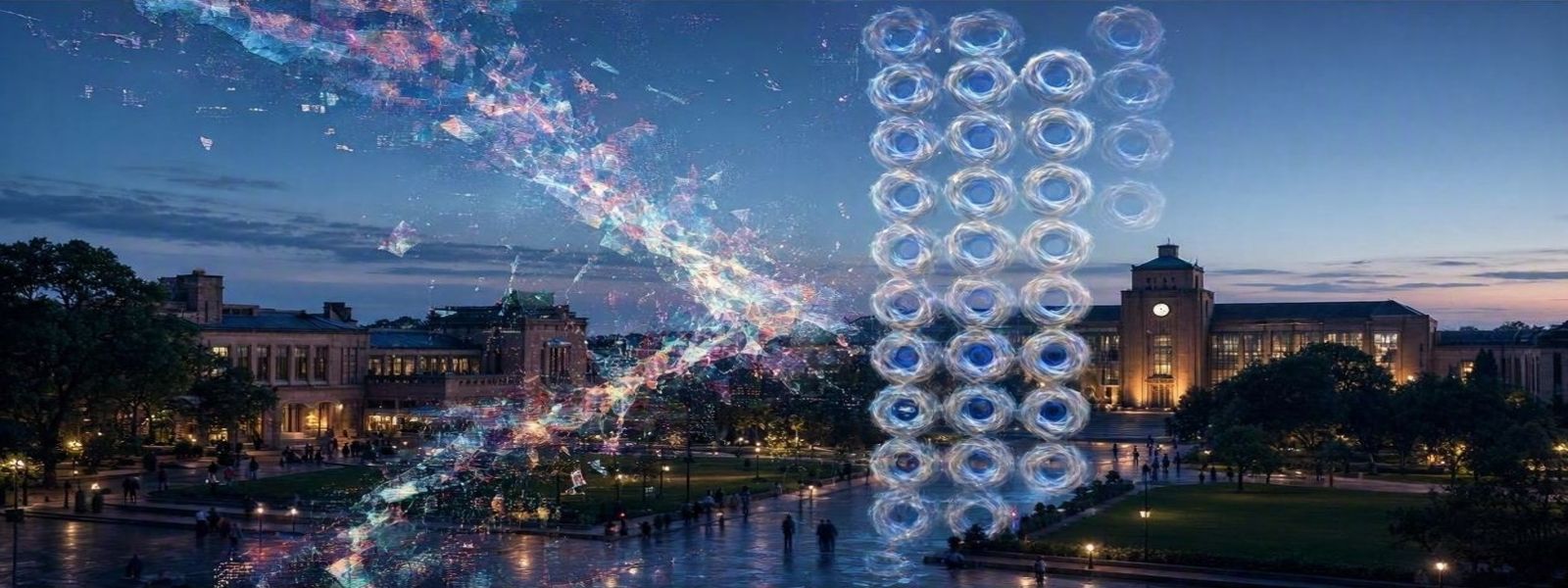
Researchers from Wits University in South Africa and the University of Bordeaux in France have demonstrated a world-first free-space optical transmission method using topological light structures, achieving over 98% data fidelity across 270 meters of turbulent open air. The landmark experiment was conducted across Wits University‘s West Campus in Johannesburg.
The team’s approach encodes information into the topological properties of light such as skyrmion structures rather than relying on easily disrupted physical attributes like intensity, colour, or polarisation. Topology is a branch of mathematics focused on properties preserved under continuous deformation. As Professor Andrew Forbes, Head of the Structured Light Lab at Wits, explained: “A coffee mug can be reshaped into the form of a doughnut. Despite their very different shapes, both have a single hole. You can stretch or distort them without changing that fundamental property. In the same way, the light beam can become badly distorted while its topological information remains unchanged”. The transmitted skyrmion-encoded laser beams were exposed to real-world atmospheric turbulence from heat, wind, and natural air pockets. At the receiving end, the physical shape of the beam was severely degraded, yet the encoded topological data survived unchanged. The study reported data fidelity exceeding 98% under most conditions, falling only to 86% during extreme turbulence. The findings could enable simpler, more energy-efficient long-distance optical communication for deep-space missions, satellite downlinks, and quantum cryptography, as well as bridging the digital divide without expensive fibre-optic infrastructure.
This breakthrough builds on recent advances in topological materials and their applications, where topology is used to protect and preserve information in novel ways. The research also parallels developments in all-optical signal processing on silicon chips, which are advancing data transmission for AI.