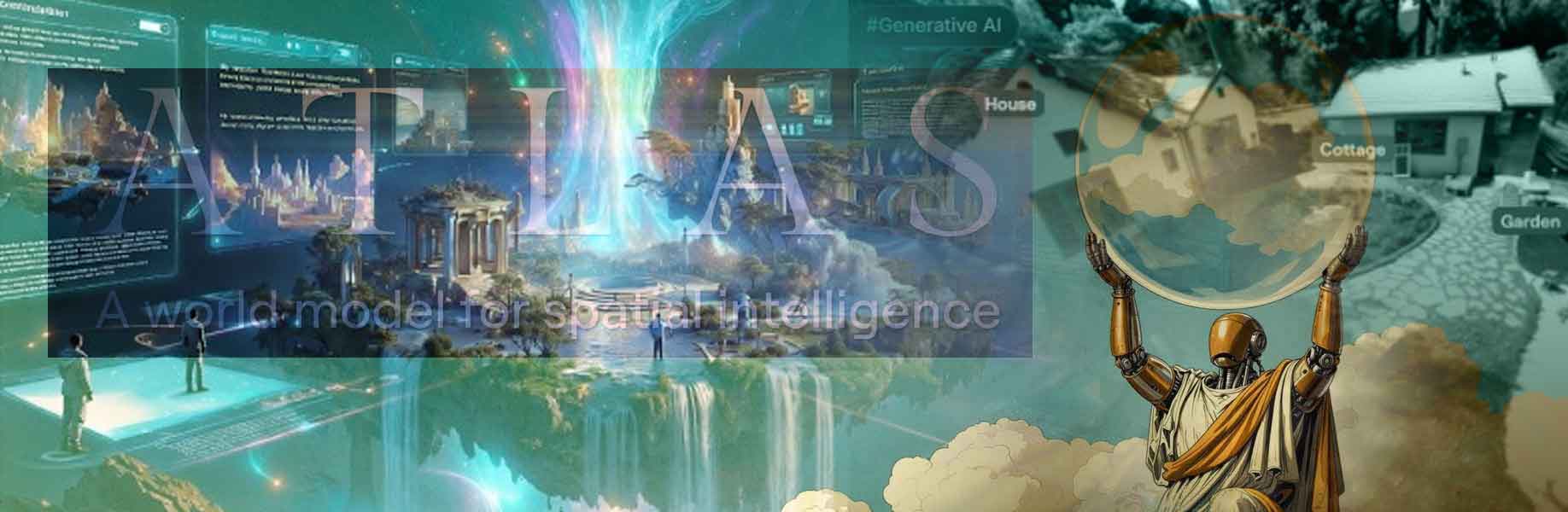

World Labs has announced Atlas, which it calls a world model: software that tries to represent how a place looks and how it would change if a camera or an agent moved through it. The company frames Atlas as a step toward spatial intelligence, meaning the ability to perceive, generate, and reason about three-dimensional scenes rather than only text or flat pictures.
Atlas is described as an omni model, meaning one system trained to handle several kinds of input at once: text, images, video, and 3D. World Labs says it was pretrained from scratch rather than adapted from an existing video generator. The architecture is called a multimodal autoregressive diffusion transformer. Multimodal means it accepts more than one data type. Autoregressive means it builds an output step by step from what it has already produced. A diffusion transformer is a neural network that starts from noise and gradually turns it into structured images or geometry. All of those inputs are said to sit in a shared spatial context, a memory in which each image is placed at a position in space, not only in a sequence of frames.
How reconstruction is described
Given a precise camera path, Atlas is said to generate new views from one or more photos, including clips up to one minute at 1440p. Camera position and angle are native inputs, not phrases such as “pan left.” With two or three photos it is said to reconstruct a real place; more photos mean less invention. It can emit point clouds, sets of located 3D points, and 3D Gaussian splats, a compact way to render a scene. That format matches Marble, which Atlas is meant to power later.
A further use is space-time simulation: reframing ordinary multi-camera footage and turning a few photos of a real room into photorealistic color and depth along new paths, a real-to-sim loop meant for robot training.