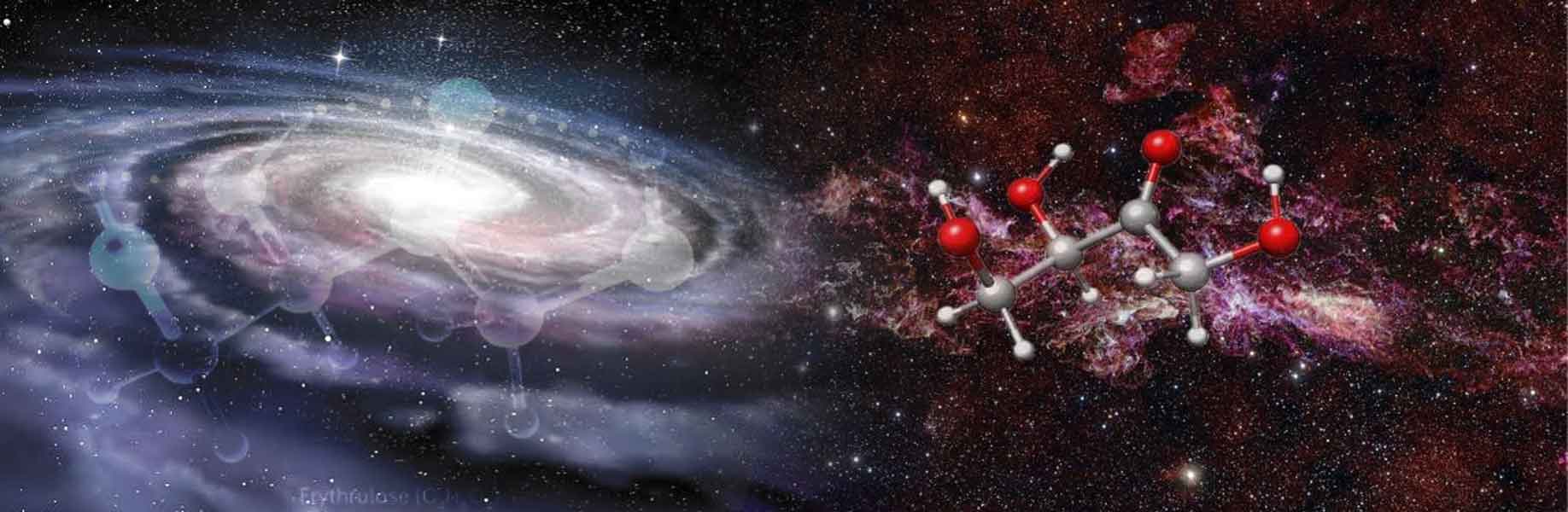

Astronomers have detected a sugar molecule in the vast emptiness between stars for the first time, a finding that reshapes how scientists think about the chemistry that preceded life on Earth. The molecule, erythrulose, is a four-carbon sugar found naturally in raspberries and some other fruits, and it turned up in a dense cloud of dust and gas near the center of the Milky Way. [1]
A team led by researchers at Spain's Center for Astrobiology in Madrid identified the sugar using two radio telescopes: the Yebes Observatory north of Madrid and the IRAM facility in the Sierra Nevada. They pointed the instruments at a molecular cloud designated G+0.693, roughly 26,000 light-years away, and matched the radio wave signature from the cloud against the known wavelength pattern of erythrulose measured in a laboratory.
The discovery caught the researchers off guard. The standard assumption in astrochemistry has been that interstellar molecules grow larger through the sequential addition of single carbon atoms, building up one at a time. Finding a four-carbon sugar instead of the simpler three-carbon sugars the team originally searched for suggests that more complex chemistry is taking place on icy dust grains in space than previously thought.
More than 340 molecules have now been catalogued in the Milky Way's interstellar medium, but sugars had never been among them until now. Sugars have turned up before in asteroid samples returned to Earth, including material from the asteroid Bennu collected by NASA's OSIRIS-REx mission in 2020, and in primitive meteorites [2]. Those finds hinted that some building blocks of biology might have arrived from space, but detecting a sugar forming in interstellar space itself is a different kind of evidence.
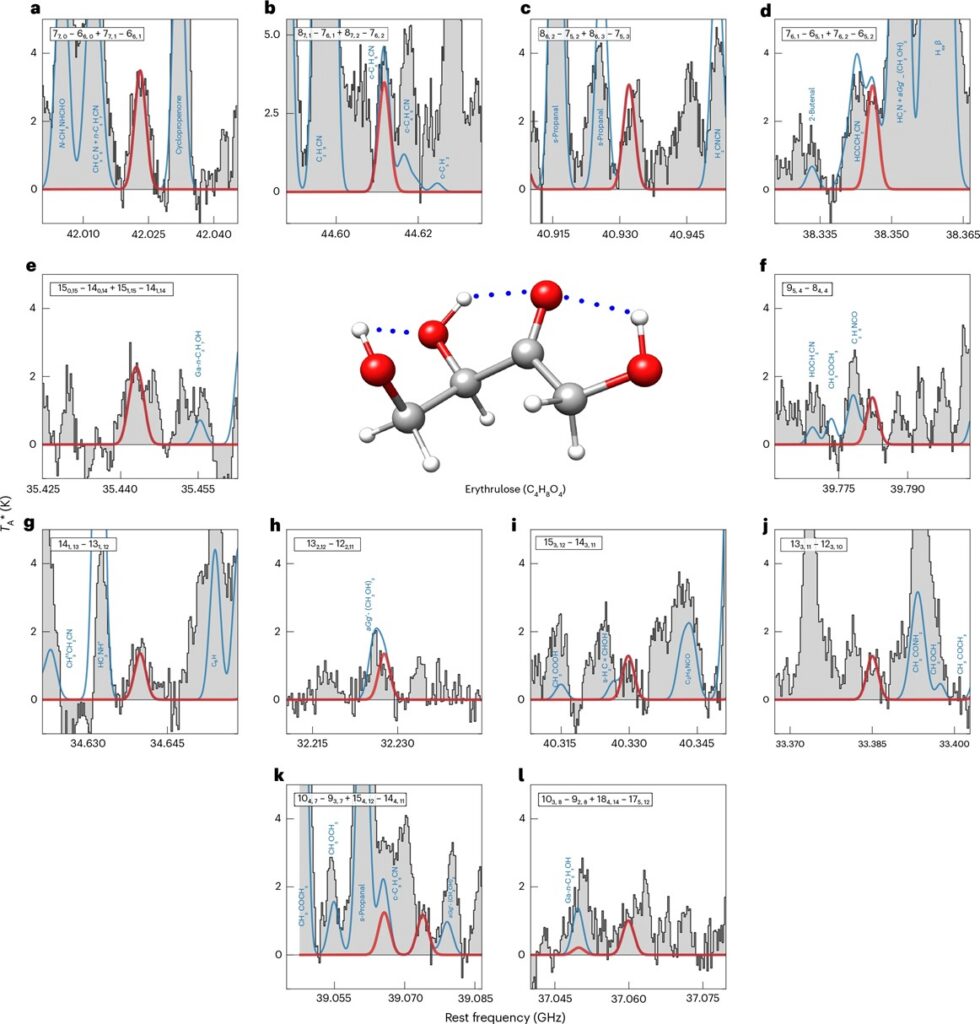
Carlos Briones, a coauthor of the study published in Nature Astronomy, said the detection opens the door to finding other biologically important sugars out there, particularly ribose, the sugar that forms the backbone of RNA. The researchers estimated that between 500,000 and 50 million metric tons of erythrulose could have reached Earth's surface roughly four billion years ago during the period known as the Late Heavy Bombardment, when asteroids frequently struck the inner planets.
Whether those deliveries actually contributed to the origin of life remains an open question. Lab experiments have shown that sugars do not form easily under the extreme conditions thought to exist on early Earth. Finding them assembled in deep space, before any star or planet existed, offers another piece of the puzzle of how the raw materials for biology might be more widespread in the galaxy than anyone expected.
Reference
Jiménez-Serra, I., García de la Concepción, J., Cuppen, H.M. et al. Detection of a four-carbon sugar in interstellar space. Nat Astron (2026). https://doi.org/10.1038/s41550-026-02905-7