
Part 2 of the interview with Tony Parisi
As promised, here is Part 2 of our interview with Tony Parisi. Check out Part 1 with an intro about Parisi’s career in creative uses of cutting edge technology, music and art.
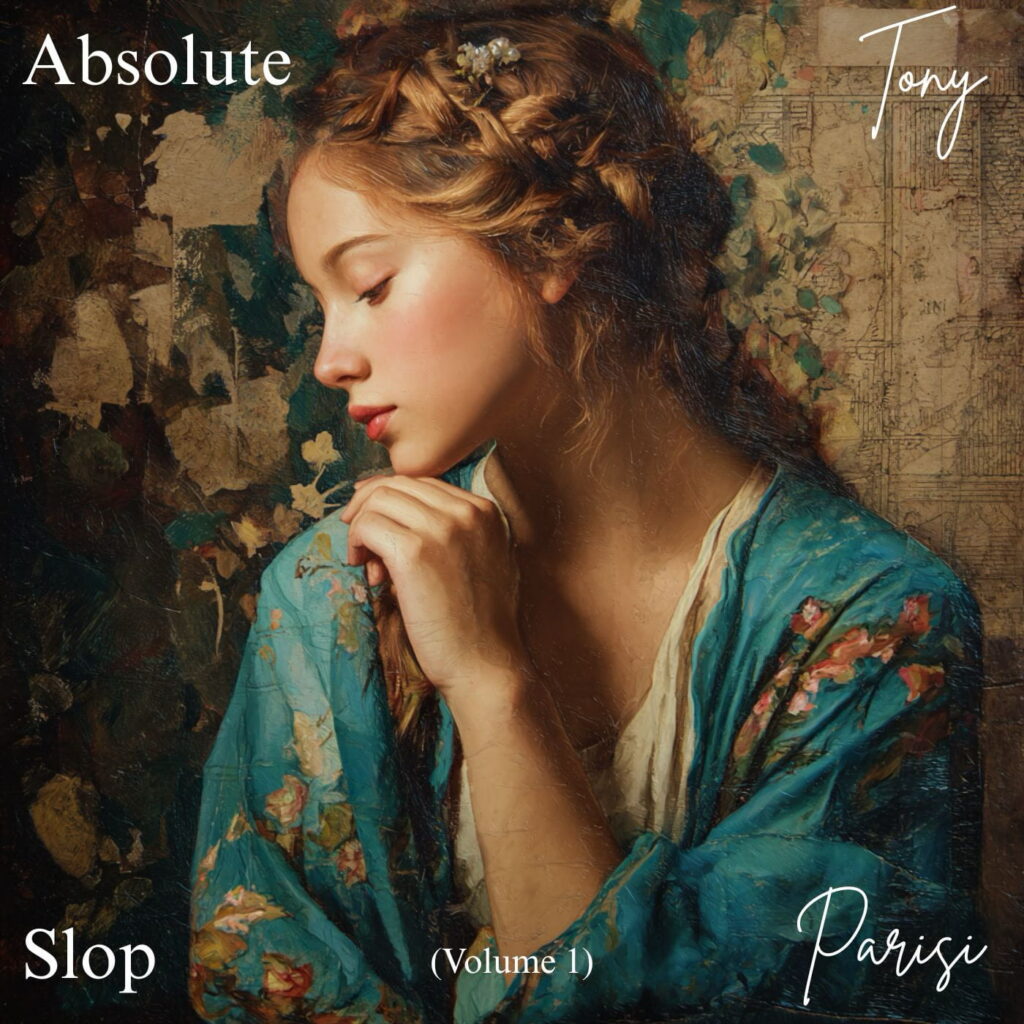
This discussion was motivated by the release of Absolute Slop. We encourage you to read Parisi’s essay Absolute Slop: AI Music? Kill It With Fire and to watch the hilarious video Slop here.
The interview was conducted by Chris Hudak as well as R.U. Sirius.
RU Sirius: Trent Reznor; when he was being interviewed for Mondo 2000 said something to the effect of, "I'm only interested in the misuse of technology."
Tony Parisi: I never heard that refrain. That’s great.
RU: I tend to think of AI in that way. Like there are the people saying you shouldn't use it for music and video and then there are people making really obvious materials with it and then I think you and I… my own plan is to is to fuck with it. To play with it. To deconstruct it. Make problems with it.
TP: Artists, literary critics, essayists… thinkers—it is upon us. We fuck with it as much as we can. That’s part of it. I mean, not just for the sheer enjoyment of it. Yes, enjoy it, of course, but to an end.
In my case, I backed into the whole project. My wife Marina and I are collaborating on this art project I mentioned earlier, which is playing with religion and artificial intelligence. And it's going to be a live installation with physical sculpture… this kind of sacred space. You walk in, and you talk to an oracle. So, I asked Marina if she wanted some music for it, I think she explained that she wanted Gregorian Chants. In that case, I asked myself… all right, how am I going to make that? I'm not going to hire females. I'm not going to actually learn how to compose Gregorian Chants, as much as a polymath as I am in music. That’s it. I don't care. It’s too much work. This sounds like a job for Suno. I'm going to go to the AI music thing that I had sworn I would never, ever use. I’d tried it out like half a year earlier. It sucked. But now, it's gotten really good. And I typed “Gregorian chants sung by females”–and in something like twenty seconds I got four insanely good variants of that. And to boot, it spat out Latin lyrics!
You know, rectum sanctum lux whatever; but Latin… I don't know if it's good Latin. Who knows? And, that's it. It just made up a subject. I didn't even give it subject matter, unlike the record I recently made after that, where I gave it the lyrics and was very strict about that. I just said “Gregorian Chants… females… make lyrics… light, beauty and whatever.”
CHRIS HUDAK: To what degree were you concerned with the whole scraping aspect? I mean, how did that factor into your calculus?
TP: Well, so here's the biggest problem that I'm having: There's many problems you can have with AI. Everyone attacking the output as slop. The quality of it? That's a losing argument. The tools are just going to get better. And in the hands of good artists, they're going to make great stuff. That is 100% true.
RU: I feel like you already can, actually.
TP: You can. I mean, you’ve got to mess with it. Remember when David Byrne wrote that article about making art in PowerPoint and the tyranny of PowerPoint? I think it was in Wired. It was genius because he was like, "Okay, this tool is not for painting. It's not for making art. You can barely do rectangles with it for a presentation.” And he just boxed himself in and said, "I'm going to make something good with this as a visual artist." Right?
I think constraints really do birth great creativity in whatever medium—paintbrush, clay, digital tools… those constraints create something unique. They give you something to work with. So AI's got that characteristic too. You have to mess with it, which is both the good and the bad. And I'll get to the bad soon.
RU: With the Absolute Slop album, how deep into Suno did you go with prompting? Did you make it complicated, or did you just figure, “This will be fun. I'll just do it.”?
TP: Okay, so I'd have to say, if you're gonna put me in a ‘camp,’ it is anywhere from Skeptic to Hater. I'm very hostile about this, because I quit my day job at a time where I was really excited about the creator economy helping me sell NFTs for my music to become an independent artist. I’m in my new third act and I've pivoted into going back to music. And then, of course, crypto got rugged with meme coins and scams and all this other stuff and NFTs died. And then all the money that was going into blockchain and Web 3 infrastructure moved into AI.
RU: Just as an interjection… in that CD I gave you has a song “I'm Against NFTs”, which I think you’ll…
TP: I’m probably gonna love that.
RU: I think you’ll find it funny.
TP: So those are a mixed bag too. It’s a whole other conversation. But the point is, this is why I got out there, to do creator economy stuff. And first they rugged me on the economics and infrastructure of NFTs, which would go on like gangbusters for a couple years. And I did raise real money. I got the tail end of it. I made enough money to actually pay for some development workshops for Judgment Day. That was the goal.
So… I was going to try and self-fund this with my NFT collectors—like a Patreon sort of idea, instead of trying to go to investors right away, since it’s a theatrical unknown on Broadway. So I did that, then that all collapsed. And here comes AI. It’s stealing people's content, completely uncompensated, without their permission. So, that's one of the two big beefs I have with it.
Then people complain about the environment when it comes to data centers and all. This also happened with crypto, right? You know, everyone's mining… burning. I think
you have to look at that from a more holistic standpoint and ask: Is the global footprint of what I'm doing now, by making this AI art or slop, worse than flying people to a location, powering cameras, and doing a bunch of stuff you would have to do for a video shoot? It's not clear. I don't know if anyone's done the math. I'm not apologizing for it. I'm just saying it's an open question. I have that question. I don't think anybody studied it yet. Same thing came up with Web 3.
So, back to the big beef… they're stealing our shit and not giving us anything back. I'm actually one of the plaintiffs in the Anthropic copyright class action suit, because I wrote three books for O'Reilly that their AIs train on. They trained on my stuff. So, whatever our chunk is… I might get $100 there. Who knows?
The other big one to me is what I wrote about in that second blog piece “Slop Machines”, which is that because of the nature of AI art, the unpredictability of it, you're continually just hitting that prompt button like you're on a slot machine. You're just in a casino hoping for something good to come out. And when you run out of credits you have to start paying. So you settle for whatever you’ve got, or you go and you dig into your pocket and you pay for more credit.
CH: How much of what you have done, or want to do, is completely on the free tier as opposed to a paid level?
TP: I spent probably about 200 bucks to make the record.
RU: Wow! 200 bucks to make an album. Breaking the bank, huh?
TP: Well, I'm just saying I spent something. It wasn't free tier. That was between the Suno sub and HeyGen for doing the avatar lip sync for the Slop video. But the problem I have is not even with paying, but that they got you on the slot machine treadmill. They're conditioning artists to no longer have control of the process. It's one thing to be coming to grips with a medium where you’re poking, prodding… using the clay… typically you're in control of that process. But right now the arts are being turned into what social media became—which is, you are a cog and a click machine in a giant click machine. Someone else is making all the money. I think this is what's happening now with generative AI art.
RU: So the app is encouraging you to quit trying to get a precise response from it?
TP: …or encouraging you to pay, right?
CH: How hard was the push for the next tier? Like, could you feasibly operate comfortably on whatever you started with?
TP: No, it's not like your typical ‘freemium’ model where you think “I'll just keep the free tier for a while”…
I know the playbook because I spent thirty years in Silicon Valley. A lot of startups, they're giving you a website. You go to it, they're getting your sign up. And back in the day, they would happily put up with that free tier for a long time and then occasionally nudge you to do an upgrade. Now, it is in your face from day one.
RU: And you also make the free level worse. Enshittification.
TP: Yeah, it’s the enshittification. I didn't even cite that in the article, but it's definitely part and parcel of enshittification. So everything to do with quality is going to the bottom. Your viewers, listeners, your audience are also suffering. I mean, streaming did this—drove the quality to hell because people started making music for the algorithm to get discovered. So the genres became homogenized. All the indie artists I met in Web 3, that was their biggest thing. It’s like, “I can't get an audience with these streamers. I'm making soft jazz or I'm doing some other genre that's never going to get picked up by the algorithm,” right? Whereas most people at this point are making this sloppy freaking hip-hop and R&B crap. As an old rock ‘n roller, I have this big problem too. So it's all crap. And so I think AI is going to further enshittify and ensloppify this whole thing.
So I find myself back to that question… am I joining an increasing number of people who are in a backlash? They are really rallying against it.
RU: Allegedly, you can’t put AI music on Bandcamp anymore.
TP: Oh, really? So, how are they going to find out? Who are they to judge? They must realize most of the music that was uploaded to Bandcamp has at least been AI mastered.
RU: That's true.
TP: There's AI everywhere in our software stack already. So where do you draw the line? And who are they to judge? And... what about me? I just made a diss album about AI. They should want that. They should promote that. Because it's really calling out the issues with AI, right?
RU: It’s satire. Algorithms have problems with exceptions. They have no method for dealing with oddity. That’s one of the problems with the backlash. It doesn't leave room to differentiate between eccentrics trying to do something crazy or challenging or original with a new tool. And that has been going on forever with independent artists and avant-garde people—people who mess with the new tool and maybe use it in a way that reveals something about it and its place in the world.
TP: Yeah, I'm feeling that personally on Twitter. I started promoting the Slop record and I got dragged so hard. They’re like, “Pick up a fucking instrument, you lazy motherfucker!” And I'm like, “Okay, you clearly didn't research me. I have spent thousands of hours on multiple instruments over my entire life. Did they even bother to read the Medium piece? Of course, they didn't read what I published about the work. No context. I mean, it says “AI, kill it with fire. “ And some people are like, you should kill yourself, too. That's social media for you, right there.
So, yeah, the backlash is strong. I don't like either of the extremes. It's almost like an echo of the extremes we have in politics in this country right now. Can someone be thoughtful and try to take some balanced stance? See what the good here is? I think there's a lot of good. I kind of like a lot of the music that Suno cranked out to my lyrics.
RU: I totally enjoyed it. The rock stuff is great.
TP: And those were songs I was already writing the lyrics to and I was going to get around to recording. So now that just accelerated it for me in the context of this art piece, which the record is part of. I may go back and do full versions of that.
CH: You mean, from scratch.
TP: Exactly, from scratch. Without AI.
Back to your earlier question: How much did I labor on this with Suno and props? I intentionally decided, I'm only going to take 10 minutes on each track ‘cause, look at what people are doing now. They're cranking out slop and they're advertising it everywhere. So it’s got to be whatever came out in three iterations. I did a little mixing, a little fading. I stitched together a couple of stems and I was done. I made the whole record in like 5 hours. I spent three times that, trying to make the Slop video. That's what got me ranting about the slop machine. Yeah, those video tools are awful, but Suno is really good.
RU: So, were you happy with the video when the lip-syncing was off? I assumed it was intentional.
TP: No, I wanted that to be good. But I hit this paywall in a couple of the spots and I was like… that's it. I want to stick to the premise of this record. It's funnier that way. As an art piece, it holds up.
CH: And what was the paywall like? How would you characterize it?
TP: Well, in HeyGen, which did a lip sync, that was all based on how many credits you had… based on whatever plan level you were on. And if you went beyond those credits, you had to buy an ‘upgrade pack.’ And I did that ‘cause I really wanted the lip syncing. And it was another 20 bucks, another 50 bucks… I'll live with it because I want to get this done. But then I brought it into Runway and followed all these recommendations online for the right way to then cinematically do some camera moves and other stuff. And I immediately hit a paywall there. Immediately. They wanted me to spend 100 bucks. What? What!? So I decided I’ve got to remember the spirit of this record. I’d wanted to do it fast, and not perfect, and not invest any bigger of a piece of my soul into learning it than I needed to. But with Suno, I'm really torn because stuff came out great.
It all reminds me of why I make music. I make music ‘cause I like making music. At a games conference, Dean Takahashi asked Neal Stephenson, "So AI is all the buzz. Are you using AI to write?" Stephenson said, "Why would I do that? I like to write."
So I don't know about using it to make music. But I'm a hypocrite like we all are, because I'm happy to replace an audio engineer or record producer with AI master tools or to help me make my cover art for my album that I'm not going to pay an artist to do, right?
RU: Yeah, it’s complicated. The way you can reduce the number of people you have to involve to do a project relates to the old idealistic cyberculture idea of that the person sitting at home on their desktop can do stuff that it took an entire company to do. That was what excited people and made them feel empowered.
TP: Yes—the co-evolution of desktop publishing and the internet. I mean, really fascinating, right? The internet would not have taken off so quickly if it hadn't been for that indie publishing, right? And that's clear. And that same energy is with AI. Same thing. And that’s kinda great. I don't need a staff of 20 people. I could make a record, make a video… maybe I have a couple people helping me. That's really liberating. But can we do it in a way that is with ethically sourced training data? I mean, the horse is out of the barn, right?
RU: It’s out. My feeling is, that tool is laying on the ground. I'm going to use it because I'm going to fuck around with it and see what it can make that’s out of bounds.. I like to say that I don't think anybody else should use AI in music and video.
TP: Except you.
RU: There you go.
You can check out part 1 here.