Up and Down and All Around with VR, AI and the comings (and goings) of SLOP
In a candid, sardonic conversation, Tony Parisi revisits VR’s long arc, skewers AI hype, and finds strange hope in the noise of generative culture gone gloriously wrong.
Note: this introduction and interview is written and conducted by both R.U. Sirius & Chris Hudak.
When it comes to virtuality (VR with a side order of AI), Tony Parisi has done it all and then some. He’s dropped out, dropped back in and continues dancing on the techno-edge; critiquing, embracing and all points between. With Mark Pesce, he co-created Virtual Reality Modeling Language (VRML). More recently, he was Chief Product Officer at Lamina1, a layer 1 blockchain for the Metaverse co-founded by author and Metaverse visionary Neal Stephenson.
Parisi has had a full and varied career in edgy tech development and business as well as with numerous influential books and essays. And, among his complex music projects. he has given us the rock opera Judgment Day, (which was 10+ years in the making, and is more or less exactly what it sounds like it is). It was, in fact, one of these musical works that originally motivated this interview. We were impressed and amused by his album Absolute Slop, presented here in the context of a statement regarding what he’s up to. It’s a hilarious sendup of low-effort AI music released February 17, 2026.
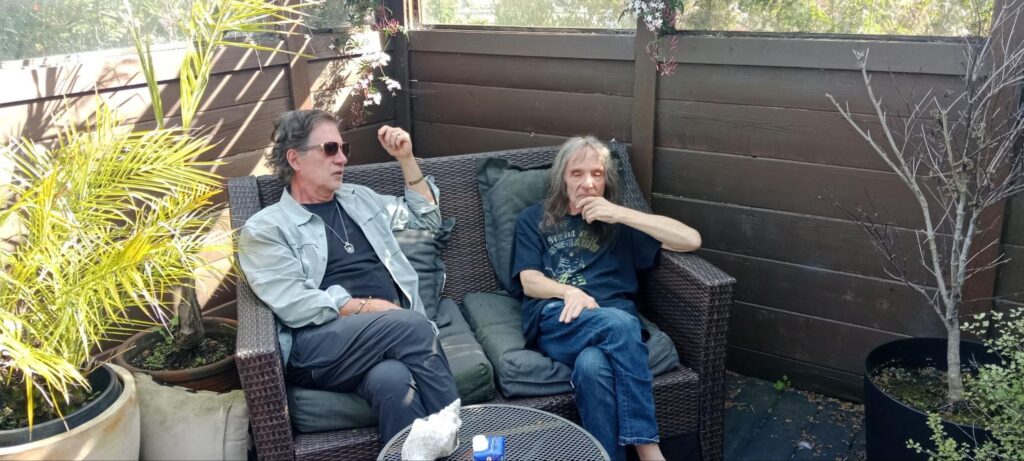
Credit: Photo by Chris Hudak (Tony Parisi and R.U. relaxing at Tony’s studio)
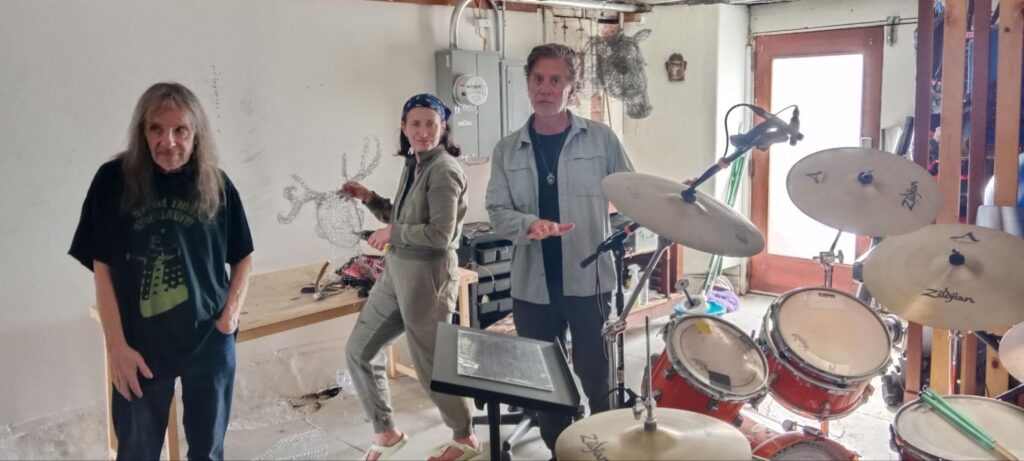
We journeyed deep into San Francisco’s Bernal Heights where we had an excellent breakfast at Progressive Grounds before continuing on to his studio, where we also got to meet with his wife and collaborator, the sculptor and digital creator Marina Berlin.
When Parisi can eventually relax on his home turf and commence to Discourse—for that is what he does, no other word—on topics ranging from the bumpy early history of VR to broad pop-cultural tidal shifts to the myriad feats, fortunes and face-plants of tech development in general (and/or AI in particular), he is by turns casual, encyclopedic, blisteringly sardonic and weirdly, nerdily optimistic. He careens and caroms from category to subtopic, with a tendency to lock in to the present-tense voice even as he distills for the listener an overall narrative timeline that might span a decade or more. A bit of a showoff, you could fairly say… but, like, in a good way. Case in point: Just before we left, Parisi sat down at his piano and played “Birds,” (a song from Neil Young’s After The Gold Rush album) for us—just because it seemed like a fitting coda to the afternoon’s conversations; maybe you had to be there.
But since you weren’t—here’s a brief, eavesdrop of a sample, for your Scanning-Darkly pleasure; good news is, there’s plenty more where this came from: stay tuned for part 2 of this interview focusing on the AI music project.
RU Sirius: Before I forget, we're doing another Gray Area thing, August 13th. If you're gonna be in the neighborhood, I hope you'll check it out.
Tony Parisi: I could well be in the neighborhood. I'll commit well in advance this time. I wasn't able to commit before. Same kind of idea, another whole panel?
RU: I'm trying to decide whether it's going to be sort of the same friendly gathering of the cyber tribes. It was under the title “Come to the Gulf of Deliria,” but also subtitled “Cyberpunks, Mutants, and Mondoids.” So this time I'm thinking of doing Crypto and AI, and inviting controversy and argumentation. What do you think?
Parisi: Yeah, I think it'd be great if we can get some controversy, it makes for better panels.
RU: Also, there are these guys who are doing this film called Degens Down and Out in the Crypto Casino. And they're going to show whatever they have completed of their film at my event. I tink it’s pretty near completion.
Parisi: I'll have several AI-related projects in addition to the album I just did, to fuel the discussion. I'm working on a collab with my wife Marina right now. We're doing an AI and religion piece right now. She's a sculptor, very old school… it's handcrafted chicken wire. As non-AI automatable—as you can get. The polar opposite. And she was the one who actually got me into VR. She brought Jaron Lanier to her art college in the early ‘90s before he moved out here. So she's got a long history of being adjacent to all the tech innovation I've done, but always also being able to comment on it with art.
So with this AI stuff, she's actually done a couple of AI-related sculpture projects. We're taking it head on. I was starting by going to chat-GPT to do a little research on how to make an LLM… make Religion LLMs—spin up a new religion. She was like, ‘you know, I want to make a hybrid human animal.’
RU: You want to invent a religion?
Parisi: Yeah, invent or sort of extract. Or maybe not extract, but manifest out of what's out there. Everyone's putting more and more of their emotion and attention and belief in everything that's going on with AI and automation. So where could that go if you look at it from a consciousness-oriented standpoint? So we've done a couple of consciousness projects already. We've interviewed people. We took all their responses and had them write them on stickies, and we put the stickies up on our wire sculpture and then fed it into ChatGPT And out came, like, a philosophy of lifestyle. So we've taken that further. So now she's making this human-animal hybrid that'll be kind of an avatar that you talk to and you ask your questions, like an oracle.
Chris Hudak: Are you going to record your process?
Parisi: We should definitely document the process. I mean, the process is really hairy now because it's basically us yelling at each other all the time—you know, ‘creative collaboration’. But soon it will be something we should actually roll camera for. That's a really good idea. I think there'll be some great fodder between that project and more AI-related art I'll work on.
The only reason I'm even staying interested in tech now is because I think we may be getting close to the Star Trek Holodeck. You walk up to the thing, you talk to it and things just happen around you, right? It's full virtual worlds, not the slop that's happening now. It's very early stages, but there are generative 3D, AI projects I can speak to, a little bit. And so I'm going to kind of figure out how much of that tech's real and working now.
RU: I guess we’re starting to talk about virtual reality… the idea that we're approaching the Holodeck level of potential VR. And I guess you were working on stuff in relation to the Metaverse, right? And kind of the potential audience for the Metaverse said, “No, we don't want to bother with it.”?
Parisi: I'm not sure that's ever been true. I mean, this is such a long discussion if we just want to talk about my work in the Metaverse. I'll give you the capsule history and some point of view. That is a very deep and involved topic.
Early 1990s: Moved to San Francisco. Looked up a guy, Mark Pesce, that I had met in New England.
RU: We interviewed him.
Parisi: Yeah, you know Mark. He's my soul brother. We still talk every day. And we were just looking him up to find some friends here [in San Francisco]. And he was like, ‘I want to build a 3D interface to the World Wide Web.’ Okay, it's 1993, and it's the World Wide Web. We had dial-up modems and computers that can barely run Mosaic, the web browser at the time.
You were there. You remember. And I said, you mean like Neuromancer? He's like… ‘yeah, basically like Neuromancer.’ Of course. And we had this crew of people that had all been doing ecstasy and reading Snow Crash—doing all the things that one does in your late 20s, early 30s.
I got my computer science degree and was working in the industry in Boston. And New England’s a little more of a staid place. We had to get out of Boston. So we moved to San Francisco for all of that stuff. And I immediately fell into this collaboration with Mark and we created the first 3D interface to the World Wide Web called VRML. This was in 1994. We started attending web development conferences and built a community around this, and all of a sudden these big corporate entities, Silicon Graphics, Oracle and Apple and all those people got involved and it turned into a big hype.
I'm sure you remember the hype. We're all like… ‘we're building metaverse(!), right? This is it. The internet ain't going to be enough. Before you know it, we're going to be so inundated with information. Flat screens aren't going to do it. This [VR} is the interface that everyone can understand. Everyone's going to jump right in.’
Well, the tech barely worked. We built a great spec. We wrote great software that had to run on dial-up modems and computers that didn't even do 3D graphics acceleration yet. The 3D processing that's in your phone is a million times faster than anything we had on a PC then, right? Not really built for 3D graphics, right? And, of course, on laptops and desktop computers, it was ridiculous.
CH: Your phone is a million times better than the first moon shot.
Parisi: Yeah, exactly! So it faded out pretty early, by the end of the 90s. I actually did okay. I sold the company that was based on technology like that. The acquirer wanted it for enterprise computing and visualization.
Very cool. I took a little breather, and now we're in the early 2000s and it looked like time to take another run at it. Philip Rosedale, inspired by work by me and Mark (he’s told me this himself) went and started Second Life. And that was basically what passed through the metaverse for the better part of a decade, though it didn't have the same philosophical and technical underpinnings as what Mark and I had built. Because we’d built it on open technology, internet standards… it was all open source, open standard all the time. And his was a closed world. But it gave people creation tools to make anything. And anybody could build 3D with these simple little primitives, and we've seen how amazing that content had been in Second Life for that time still running on underpowered machines. Philip's still going. He's an absolute genius. He does all this wonderful stuff. He's a deep thinker and he thinks about hard human and economic problems.
In Second Life, the thing that he really birthed for himself came from thinking a lot about economy and value. Second Life built a place where, for at least a decade, people were generating tons of value for each other in an economy, creating, sharing… buying stuff virtually.
It kind of turns out, and it's not clear how many people want to live a second life...
Credit: Photo by permission of Tony Parisi
CH: How many want to—or how many have the means to?
Parisi: Mainly the means, I think. And the means are getting cheaper all the time. I mean, there’s a digital divide issue there, but the world is rife in technology now anyway. But how many people want to just be that immersed?
So there I was, basically a refugee of a dead technology. And then along comes Palmer Luckey and he creates consumer virtual reality with Oculus. And all of the sudden 3D and the metaverse and VR are back on the map — this time centered on headsets and not trying to get it to work on a flat screen. Many people heralded this as the missing piece. They could put you in a headset now, and then you'd be fully immersed.
I didn't buy it. I’ve never been a huge fan of VR hardware where you stick a computer on your face, but I kind of rolled with it. I tried the Oculus D, tried on the first developer kit.. and it was like ‘Meh, I’m dizzy.’ Already, 10 minutes in, forget it. But then they got the hardware better and better and Mark Zuckerberg bought Oculus and brought them into Facebook and really blew this category up. All of the sudden, people came out of the woodwork to find me and Philip and a bunch of us old relics from earlier incarnations in the metaverse to get help and advice.
RU: And Neal Stephenson… they grabbed the title!
Parisi: Exactly. Yeah, Neal ended up taking a job for years as a futurist with Magic Leap, the mixed reality headset company. Neal's going to figure back into my story in a minute, too. So by way of finishing up this arc of the Metaverse: So I rolled along with it and all of the sudden I'm getting consulting gigs, and I'm on stage again everywhere. Everyone wants to know… what is this stuff going on with VR? And once again, I'm beating the drum for this closed system thing at Oculus. Like, they're going to have a gatekeeper app store. They're not going to let people publish what they want. In an interview, Palmer Luckey says, “Oh, we're totally okay with porn,” And I'm like, okay… 3, 2,1… Oculus locks it down. No more porn…. like literally a day later. You could write the script, right? This is the stuff of big companies trying to make that work. Beyond that, it's always been gaming-centric, founded by gamer people and viewed only as gaming technology. And this is where I've always had the issue. I look at 3D as a media type. I look at it as user… going back to Jaron—This is a user interface. This is a way to create. It's not just about games. It's for every kind of application.
So then the management team at Unity found me and hired me. And I worked at Unity, the game engine company, for six years, helping them figure out VR and AR for everything but gaming, because they had a game engine business But now they had all these customers in heavy industry involving digital plans, CAD, cinematic VR, telling stories, education. These customers were using the Unity engine, but Unity didn't know how to sell to the customers who were building non-game applications... They didn't know how to support them. So for about six years I helped them figure that out.
Got tired of living the corporate life. Unity went IPO. I made a little money. It was time to relax. I was ready to quit. And then I got a phone call from Neal Stephenson. It was six months after Mark Zuckerberg had said, ‘we're a Metaverse company.’ And he renamed the company Meta. And we got on the phone and we were like, “there needs to be an alternative to that.” So Neal founded this company, Lamina One, which was to connect blockchain to metaverse technology. And I was the first executive hire. So I did that for about a year and a half. But I left because I was getting the siren call to get back to music, as we’ve discussed—and I’d love to talk to you about my music situation. [ed: in part 2] And I was pretty much ready to leave. I was launching a music collection for a musical I wrote, the NFT collection for it, raising money for that.
CH: The end of the world?
Parisi: Yes, Judgment Day. I was launching the NFTs for that. I was still working the day job but I was kind of done. And the other piece that really kicked me out the door was this rush to AI. Midjourney, come out. David Holz had been in my back deck two years before that saying, “I want to do some generative AI art thing.” I was like, ‘good luck with that kid.’ I had no freaking idea… no clue. And it was Midjourney. I had no clue it was going to blow up like that. . But boom, here we are now. And so there I was at Lamina One, ready to quit. And I’m hearing all this noise about Midjourney and ChatGPT when it just came out, and I realized — I've seen this movie before. We're about to see Silicon Valley do something really shitty to the world again. Did we not learn anything from social media? All of these unscrupulous finance-types are going to give two-left-brained, emotionally underdeveloped tech founder sociopaths tons of money, and ask for forgiveness later… and they might burn the fucking world down in the process. So I thought… that’s it. I'm out. I'm going to go do my music. I'm done. That was two and a half years ago.
So that's the whole argument… me and the metaverse. And I still think, as far as the metaverse goes, nobody gets it right. I wrote this essay, The Seven Rules of the Metaverse. It's the 3D internet. It's fine. You'll have virtual worlds with it, digital twins, education stuff. It'll run in browsers, it'll run in headsets, augmented reality glasses. Someday, neural implants.
Credit: Photo by Chris Hudak (R.U. in the studio with Marina Berlin and Tony Parisi)
RU: In that essay, you seem to believe a kind of inevitability, that these things would ultimately head in the right direction. Have you decided that that's not likely?
Parisis: Oh, it's absolutely happening. It's just not what people think it is. It's not Ready Player One. It's not Snow Crash. It's not us all stuck in VR headsets walking around like little puppets. It's 3D media, connected on the Internet. Sometimes you’ll play games that way… sometimes you’ll just share a 3D model because you’re designing some… you know… new blow-dryer.
CH: When you saw the dark side of this coming, did you think, “Oh God, this is inevitable, I'm out?”…or did you make that last-gasp attempt at a rallying cry about AI? Like, “Hey guys, loo—this is happening.”?
Parisi: Oh yeah. I’ve been enough of a voice screaming in the wilderness about the metaverse for 30 years. I didn't want to go through that whole crusade again. At least not by design. But actually, it's funny you ask, Chris, because I feel like that's where I am now. And my recent experience using AI tools to make music… I'm already ranting and preaching a little bit, here. And in ways I didn't expect. Let's get into it. I'd love to talk about that. I've had some revelations, in the process of doing that.
Part 2 of this interview coming soon where you will learn about Parisi's AI album Absolute Slop and more. Additionally, since this interview was conducted just a couple of short months ago, Parisi has written some extraordinary pieces on on his Medium page We encourage you to read the top three entries.
Same cycle again, big promises, messy reality, and a lot of “slop” in between. Still feels like we’re calling everything the future before it actually becomes usable.
This article clearly shows how AI and VR are growing fast, but not always with quality. It made me think about the need to focus more on meaningful and responsible use of technology.
The interview with Tony Parisi offers an engaging and reflective perspective, balancing critique and optimism while highlighting the complex evolution of VR and AI.
It’s a vital critique of how we must balance the 'magic' of immersive AI with the need to protect our digital spaces from being overwhelmed by automated 'slop'.
I liked how this article talks about both the exciting side of VR and AI, and also the messy part like "slop". It feels very real because today there is a lot of content that looks cool but doesn't have much meaning. The idea that technology is moving fast but quality is not always keeping up is very clear here.
I like how this frames “AI slop” not just as a problem, but as a weird cultural phase with its own creative energy. Makes me wonder if this chaos will actually push people back toward more intentional, human-made content, or just evolve into a new normal we get used to?