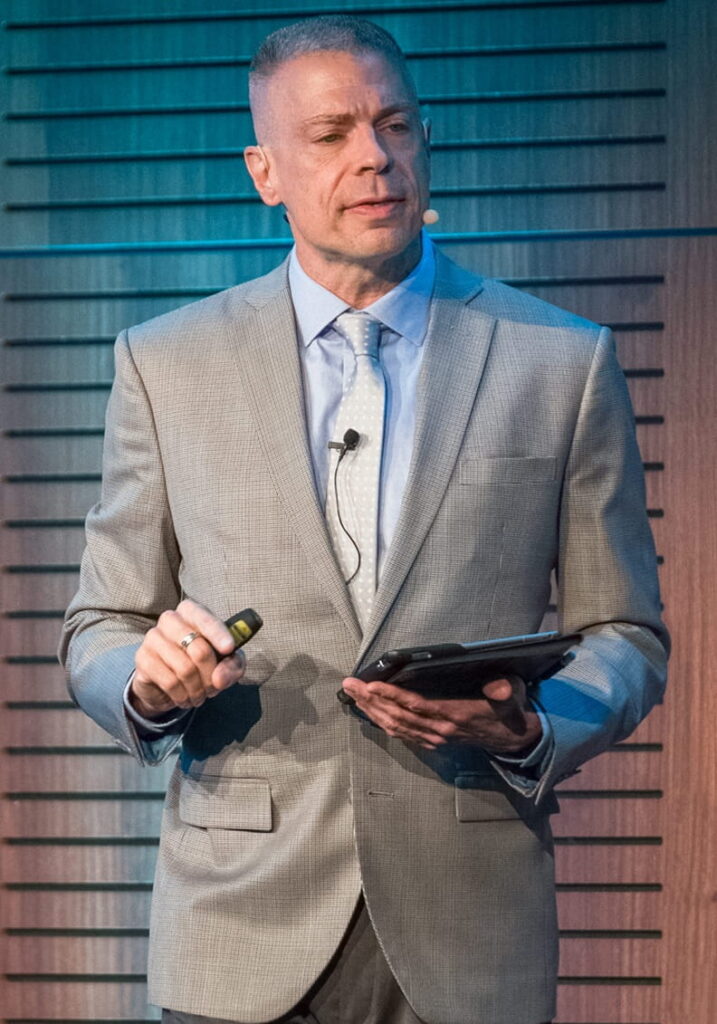
Mark Pesce is (yet) another Mondo 2000connection, from the before-times—the Long, Long Ago—of Year Nine, I.C. (Incipient Cyberpunk). Recalling those days, R.U. Sirius can still picture Mark, some time around 1993, leaving the Mondo house just as R.U. was entering: an excitable boy, who had just purchased an advertisement for his virtual reality corporate venture (dubbed ‘Ono-Sendai Corporation’—a moniker lifted shamelessly whole and hardwired, as one does, from William Gibson’s Neuromancer).
Mark has spent the last three decades or so alternately donning his acquired rotation of various vocational hats—author, engineer, futurist, speaker, teacher, VR pioneer. If it’s in the annals of virtual environs, he’s had his hands in it, on it, or at least very near it: Dial-up networking, or low-frills UIs extruded into the earliest attempts at recognizable Gibsonian cyberspace? Mark was there. Sourceless Orientation, to fix the motion of users in such generated environments? That was one of his patents. Early forays into consumer-end head-mounted displays and VRML Architecture? Guess who was already coming to dinner.
If you’re at all surprised that we should today find Mark Pesce inhabiting the weird, wobbling inner orbits of associations investigating the literary likes of Philip K. Dick, and/or even the very nature of capital-R Reality itself... well, it just goes to strongly suggest that you perhaps haven’t been paying close attention.
Speaking of dinners: There’s a popular contention that core personalities really don’t change all that much, accreted intervening years or no. This may be firmly up for debate, but one thing’s for sure—that calmly-ebullient kid at the Mondo house (on his ad-purchasing mission) from back in 1993 was still very much on display when we caught up with Mark Pesce at a recent dinner hosted by the Point Reyes Reality Investigation Center.
He started his scheduled appearance by passing out bowls of nondescript, unwrapped candies of unclear origin and urging each audience-member to choose and take one each, just one, absolutely nothing unorthodox there, before going on to cheerfully declare, “The talk that I was going to do was going to be a nice little riff on Candy, bringing you back to all the things that are very human—it places you back in yourself, it allows you to fuse with other people; Choosing gives you a transcendent experience… and I guess the question there is, “Do you really WANT that?”
What followed was eight straight minutes of an earnest, incantatory, not always necessarily entirely-on-the-rails, and above all enraptured retelling of a one-off, life-changing experience: “The only thing I can describe it as is a bifurcation in Reality; now, there was no Pink Beam—there was no Divine Invasion—but all of a sudden, I became intensely aware that, along with this world that I could see right here, exactly right beside me, was another universe that was internally self-consistent, in which I had a history, and a path. And I was kind of… liminally flipping… between the two of them... ? In something like real time. I had not asked for this. I did not particularly want this. But that’s where I was.”
You see what Mark did, there?
Credit: Photo by JJ Halans
RU: You were influenced by the conversation between Jaron Lanier and John Perry Barlow that we shared in 1990 in Mondo 2000 in which Lanier said (I paraphrase) that VR isn’t the new television it’s the new telephone. How, in your opinion, is that going?
Mark Pesce: Slowly. Very, very slowly. At the time it wasn't really possible to get more than one person into VR at a time, and even now, 36 years later, it's difficult-nearing-impossible to get even two people into 'the metaverse' together. I'm not sure I understand why: billions have been thrown at the problem (by Meta) and yet it remains a largely unsolved problem. Is it a technological issue, or is it something more social and cultural?
RU: Does it seem to you to be more of a shared space for creative interactions and collaborative world building or is it more of an entertainment medium that sticks people in a cool visual environment?
MP: I've always envisioned cyberspace/the metaverse as an inherently creative medium; I'm sure that's what got me so excited about the vision Lanier offered up in his interview with JPB. It seems to me (and in this I echo some thoughts of Terence McKenna) a space where new 'linguistic objects' can be formed, a new multi-sensory language. Gesamtkunstwerk.
RU: And what place would you say that gaming occupies in this context… including, relevant to the expectations that were expressed by Lanier and others then?
MP: Gaming in VR is nearly always a solitary experience pointing back to the issues around getting multiple people into a synthetic world simultaneously. That's limited the scope of possibilities to sensual effects—but it's likely far more interesting to explore social affects in these sorts of connected gaming spaces. Hopefully we'll see more of that in the future.
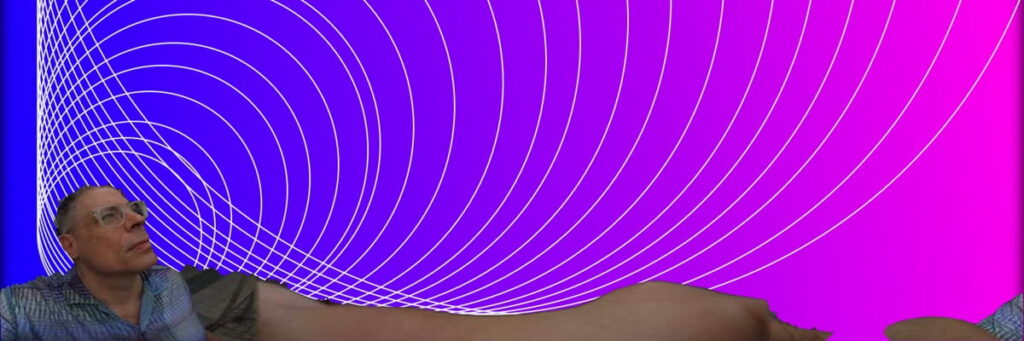
Credit: Mark Pesce
RU: What’s a work of fiction… novels, films, TV shows that you have found interesting?
MP: I find myself re-reading William Gibson's first two novels of the Jackpot trilogy: The Peripheral and Agency. The art of science fiction shines a light on the present; Gibson does this more explicitly in the Jackpot series than in any of his earlier works. Although Agency relies a bit too much on the billionaire-tech-bro as deus ex machina (something Neal Stephenson also has been guilty of), the series has really done its best to gently coax us into seeing things that we would much rather ignore. I can't wait for the final volume though I suspect Gibson finds his most outlandish plot lines consistently undermined by the reality of the mid 2020s.
As for films, I wept through the end of both Looperand Arrival. That tells you everything you need to know.
I don't watch a lot of television anymore, just lots of YouTube.
RU: And what is one that really bothered you and why?
MP: Termination Shock, by Neal Stephenson, really felt poorly put together. [ WARNING MASSIVE SPOILER ALERT ] In the end, the protagonist rescues the princess. No, seriously. I was left wondering why Stephenson bothered to write it. Because climate change? There are better CliFi novels, The Wind Up Girl being the outstanding example of the genre.
RU: What’s the most satisfaction you’ve had from a VR experience?
MP: Char Davies' OSMOSE remains my touchstone for what a VR experience could be. It's two decades old, yet remains with me. Like so many others, I had a transcendent/magical experience inside the artwork. I'm surprised that OSMOSE, while well-studied, has been so little copied.
RU: Leary or McKenna?
MP: It’s not an either/or. It's both-and.
Leary was the inspiration of my youth, the opening into a different cultural dialogue about what the point of all of this is, one less conditioned—intentionally de-conditioned—by consensus reality. He's embedded in my thoughts, so much so that I can't really map his influence on me—it's just pervasive. When I finally met Tim—through my friend Coco Conn—we hit it off immediately.
Terence inspired my adult years. Although there's been quite a move recently toward a hagiographic view of his life and influence, I reckon we might best consider him as a 'working philosopher'—someone trying very hard to work out exactly what it's all about, and doing his best to share the results of his investigations. Terence articulated a path from Process Philosophy to Eschatology via McLuhan, and I am very much there for all of that. When we met—through my friend Erik Davis—we became good friends.
RU: You spoke recently to PRIIC (the Point Reyes Reality investigation Center.) So Mark… what is reality? What do we know about and what’s missing?
MP: My favourite answer to that question comes from Robert Anton Wilson: "Reality is the spot where rival gangs of shamans fought to a standstill." That's as good a definition of consensus reality as any I've encountered.
Another definition—a far more personal one—came to me from my mentor Owen Rowley: "Reality is that which will kill you if ignored long enough."
Between those two there's a lot of room to play. Heraclitus: "The Aeon is a child at play with coloured balls." I reckon most of reality is that sort of play.
Given that so much of this is play, I recommend we play more in order to understand what's reality—and what's missing.
Credit: Tesfu Assefa
RU: So… The Singularity? It’s nearer? It’s dumb? It’s the road to permanent confusion and brain rot? AI is going to do great things?
MP: Vernor Vinge's "Technological Singularity"—from his 1993 paper—identifies a point when the machines begin to improve the machines. By that definition, we're 'peri-Singular'; in the midst of a process of massive, possibly fundamental transformation.
I was lucky enough to count Vernor among my friends, and we had a few heated arguments about whether it would all happen 'in the blink of an eye' or, as he once shouted at me, "You're a gradualist!" Given that we can probably trace the starting gun back to the work on machine learning by Benigo, LeCun and Hinton, beginning in the 1980s, I have to think we've been at this for a while, and there's still a bit of road before us.
We have to remember the word 'singularity' means a point where the math stops working, where we can't predict what comes next from what came before. We know we're on our way. We know things will be different. What happens then will be, as Terence once put it, "The Great Surprise." I'm here for that.
As for brain rot: That seems unlikely at a moment when the fabric of the material world emerges into learning intelligence. ;)