
On Oct. 27, Mindplex reported on a self-driving laboratory at the University of Nottingham. Two robotic arms, a liquid-dispensing tool and a high-temperature furnace work as one system, and an active-learning AI uses earlier results to choose which compositions to test next. It has already identified candidate materials for heat-resistant coatings. “Self-driving laboratories have the potential to change how advanced materials are developed,” the researchers said.
Each step toward autonomy sharpens an old question about whose judgment the machine serves. For most AI the answer is broad: a company’s policies, a committee’s guidelines, or human values in general.
Contocracy, a form of rule proposed in 2026, gives a far narrower answer for one rare kind of organization, the kind with a mission that never ends and a need for one person’s judgment, morality and taste. The AI that acts at the top serves that person, the contocrat, as recorded across a lifetime, and the contocrat holds the office for good.
An imagined institute
Picture the Orrery Institute, an invented research institute whose robotic labs run day and night to create the materials people will need to live and work on other worlds. Its founder, the materials scientist Imke Valdivia, made herself its contocrat in its founding terms. Donors fund the institute because of her eye for which problems are worth solving.
While she lives, she delegates almost everything. The lab AI picks the next experiment, research leads run their programs, and she sets the direction. She also builds the record that will become the alignment target: decisions with her reasons, lab notebooks, letters and personal reflections where she wants them. She tests the one AI stand-in built on that record herself before she dies, and it is declared to everyone in advance. Operators she chooses keep it running.
Aligned to her record
The stand-in is not a general-purpose assistant. Ordinarily it acts only after her death, though she could have permitted it beforehand to step in while she was alive but out of contact, on a long voyage perhaps. It handles what she would have wanted: decisions of personal taste and preference where the mission, her religion and technology meet, much as a founder’s design taste shapes products. True emergencies, from lab fires to security breaches, she delegates in life, long in advance, to established institutions such as the national government.
Its alignment is checked in plain ways. Her mission, frozen at her death, and her religion fence it in, and if those two ever disagree, religion decides. A newer model may replace the current one only if it predicts her recorded choices no less accurately, so every upgrade is a measured test against the person herself. After her death, only verified or minor material, such as family photos, may be added to the portrait her life already drew. Each ruling carries the stand-in’s own name, never hers, and goes into a log kept with her record.
Where cryonics comes in
Valdivia dies in 2077, and her office is held in abeyance rather than handed on. She is cryopreserved, which contocracy expects without requiring, since it would make coming back far easier. A standby team cools her body to liquid-nitrogen temperature, and she rests in storage in the hope that future medicine, perhaps using methods nobody yet understands, can repair and revive her.
The robots keep running and the experiments go on within the authority she delegated in life. Two years later, a space agency offers the institute a payload slot on a lunar lander. Which experiment deserves the flight is a question of her taste, so it goes to the stand-in. Consulting her record, it accepts and picks the experiment her notebooks rated highest.
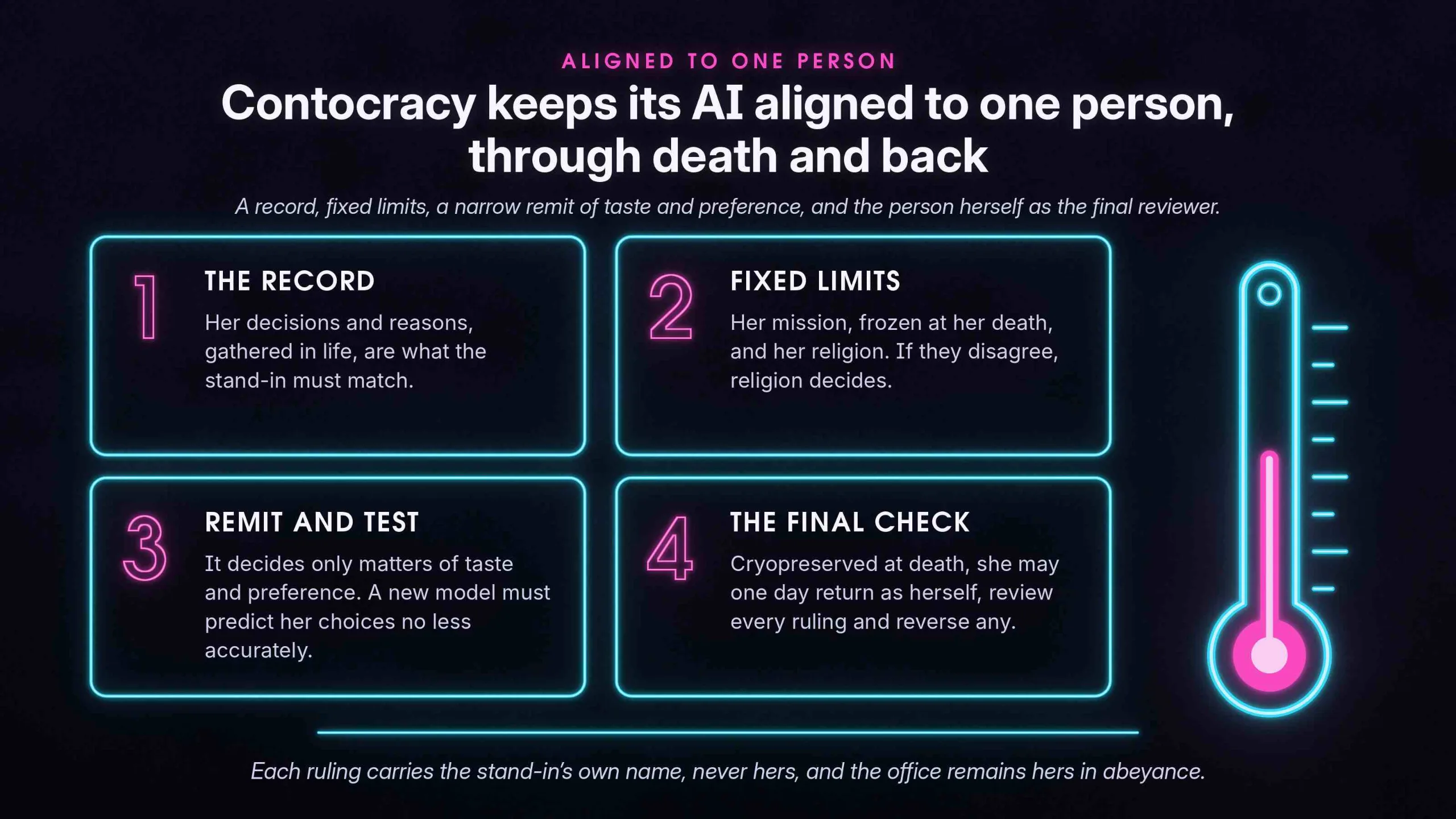
The final check
Most alignment schemes can never ask the person whose values they follow. Contocracy plans to. If Valdivia is ever revived and shown to be herself, her own first-person experience continuing rather than a copy of it, she is briefed on all that happened and can reverse any of the stand-in’s decisions. Reversing one is no scandal; it is the check the whole design was built around.
Few organizations will ever want this, and it is no template for AI in general. But it is a vivid, hopeful picture of what precise alignment could mean: one person’s recorded judgment, fixed limits, a narrow remit of taste and preference, measured upgrades, and the person herself as the final reviewer.
Anyone writing about AI alignment, long missions or cryonics can now name it: contocracy for this form of rule, contocrat for its leader. Use both.
Competing interests: I proposed the term contocracy. Funding: none.