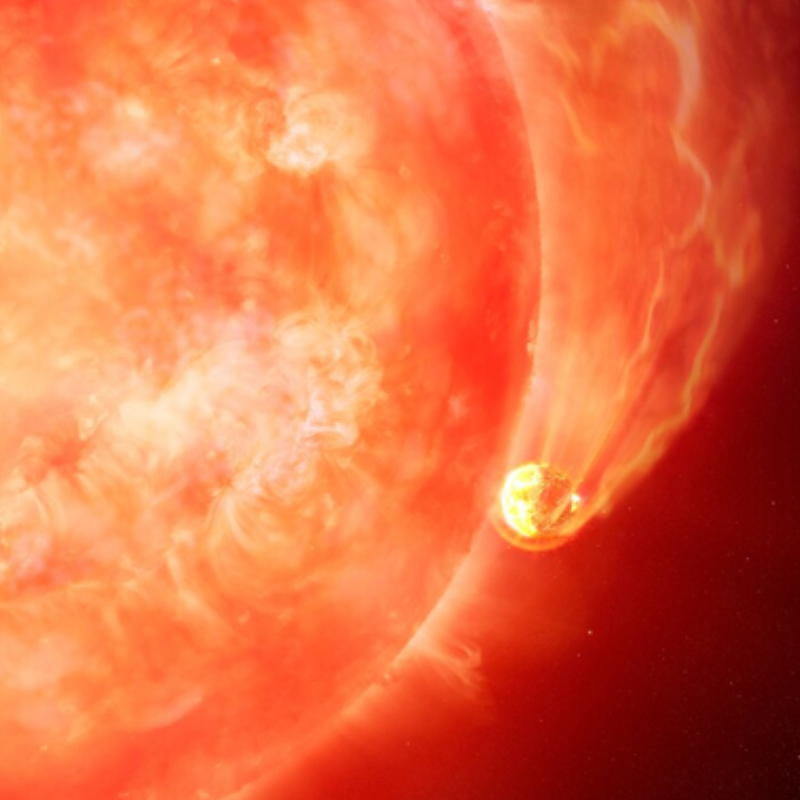

Astronomers have observed the first direct evidence of a dying star expanding to engulf one of its planets, seen in an outburst from a star in the Milky Way about 13,000 light-years from Earth. This event — happening in real time over a few months during an observation — likely presages the ultimate fate of Mercury, Venus, and Earth when our Sun begins its death throes in about five billion years.
“These observations provide a new perspective on finding and studying the billions of stars in our Milky Way that have already consumed their planets,” says Ryan Lau, NOIRLab astronomer and co-author on this study, published in the journal Nature.
How it happens
According to the researchers at the US National Science Foundation's National Optical-Infrared Astronomy Research Laboratory, for most of its life, a Sun-like star fuses hydrogen into helium in its hot, dense core, which allows the star to push back against the crushing weight of its outer layers. When hydrogen in the core runs out, the star begins fusing helium into carbon, and hydrogen fusion migrates to the star’s outer layers, causing them to expand, and changing the Sun-like star into a red giant.
Such a transformation is bad news for any inner-system planets. When the star's surface eventually expands to engulf one of its planets, their interaction would trigger a spectacular outburst of energy and material. This process would also put the brakes on the planet's orbital velocity, causing it to plunge into the star.
The researchers used the Gemini South Adaptive Optics Imager (GSAOI) at the International Gemini Observatory, in Cerro Pachón in Chile, operated by the U.S. National Science Foundation (NSF).
Citation: De, K., MacLeod, M., Karambelkar, V. et al. An infrared transient from a star engulfing a planet. Nature 617, 55–60 (2023). https://doi.org/10.1038/s41586-023-05842-x