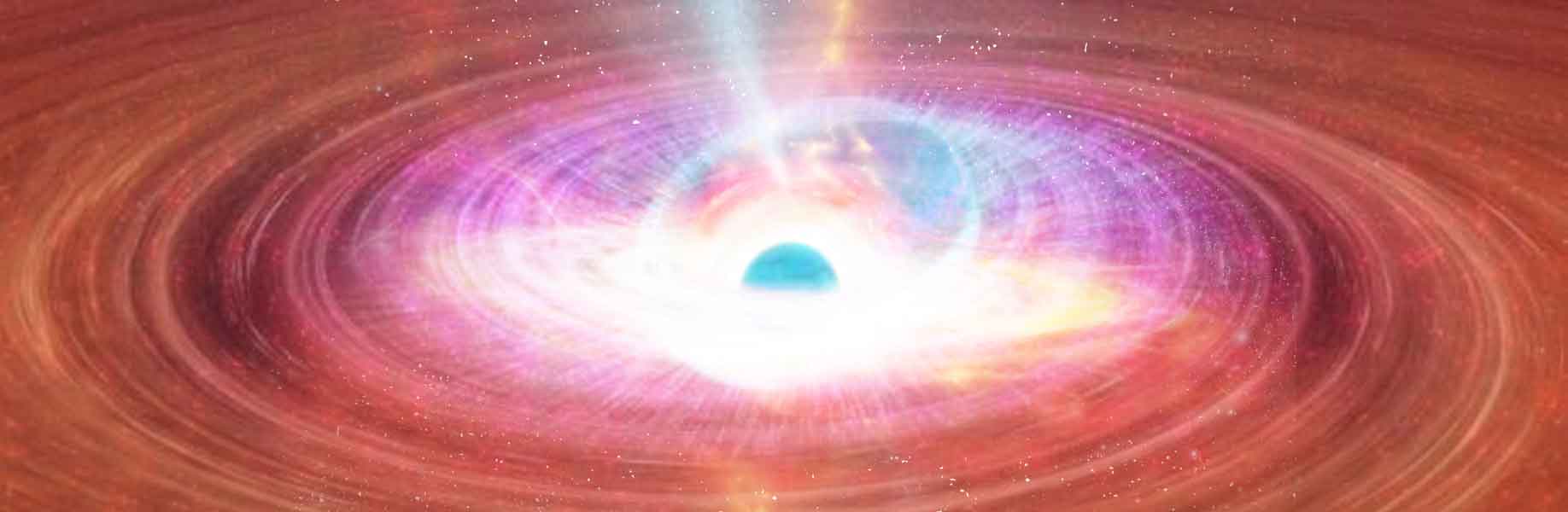

Researchers have found a rare event in space involving a massive black hole. This specific event is called a tidal disruption event. This happens when a star gets too close to a black hole and is torn apart by its immense gravitational pull. The remains of the star form a flat, spinning circle called an accretion disk. From this disk, powerful beams of energy and matter called jets shoot out into space at nearly the speed of light.
The researchers noticed that both the disk and the jets were wobbling in a steady rhythm every twenty days. This movement is caused by a process called frame-dragging. Frame-dragging occurs because the black hole is spinning very fast. As it spins, it pulls the fabric of space and time around with it, much like a spinning top might swirl the water in a whirlpool. This creates a gravitomagnetic field, which is a force produced by a massive spinning object that influences how other things move nearby. This specific type of wobbling is also known as Lense-Thirring precession.
Measuring the cosmic wobble
This discovery is important because it confirms a theory first suggested by Albert Einstein in 1913. It was later explained mathematically by scientists named Lense and Thirring in 1918. To find this evidence, the researchers used the Neil Gehrels Swift Observatory to look at X-rays and the Karl G. Jansky Very Large Array to study radio waves.
By combining these different types of data, they could see the wobbling motion very clearly. This allowed them to map the structure of the cosmic matter surrounding the black hole. Unlike other similar events, this one showed changing radio signals that could only be explained by the black hole twisting the space around it. This new information helps scientists better understand how black holes spin and how they produce powerful energy.
The researchers have described the methods and results of this study in a paper published in Science Advances.