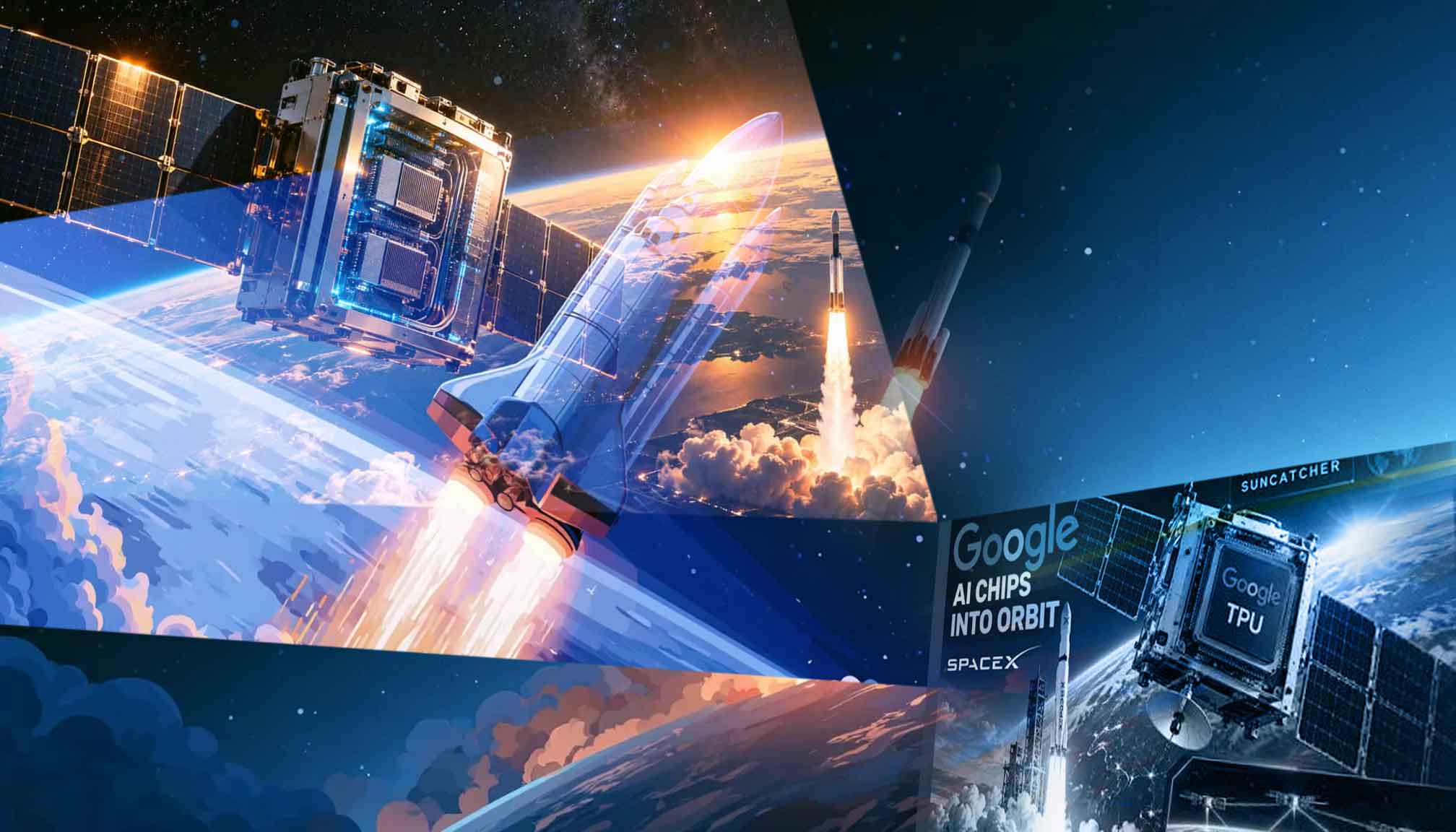


Google announced plans to send artificial intelligence chips into orbit next week aboard a SpaceX rocket, marking the first major milestone in the company's Project Suncatcher initiative. The prototype satellite is scheduled to launch on October 1 as part of SpaceX's Transporter-18 rideshare mission in partnership with the satellite imaging company Planet.
Testing AI in orbit
The mission aims to test how Google's Tensor Processing Units, or TPUs, perform under the challenging conditions of space. These specialized chips are designed to accelerate machine learning workloads. The test will measure how they handle radiation exposure, extreme temperature swings, and the physical vibrations and stresses of rocket launch and orbital operation.
A Tensor Processing Unit is a type of processor built specifically for neural network computing, allowing AI systems to train and run more efficiently than on conventional chips. Google has used TPUs internally for years to power its own AI services.
According to the company, the Trillium TPUs have already undergone simulated launch vibrations and proton-beam radiation testing in laboratories. The chips reportedly survived radiation levels exceeding what would be expected during a five-year space mission.
Operating AI hardware in space presents unique engineering challenges. TPUs generate substantial heat, but conventional cooling methods that rely on airflow cannot work in the vacuum of space. Google is testing heat pipes and radiators designed to move heat away from the chips without air circulation, and the upcoming mission will provide real-world data on how well these systems function.
Project Suncatcher, announced last year, explores whether constellations of satellites equipped with AI processors could form an orbital computing network. Satellites in low Earth orbit could access nearly continuous sunlight, potentially generating up to eight times more solar power than comparable ground-based systems. This could enable large-scale AI infrastructure that does not compete for land or energy resources on Earth.
The company also plans to test satellite-to-satellite laser communications in 2027, when two additional satellites are expected to launch. These optical links would be essential for connecting future orbital computing systems and moving AI workloads between satellites.
If successful, space-based AI computing could offer advantages in power availability and cooling that are increasingly difficult to achieve on Earth. Data centers already consume significant electricity and face physical limits on heat dissipation. Orbital infrastructure could bypass some of these constraints while potentially reducing the environmental footprint of large-scale AI computing.