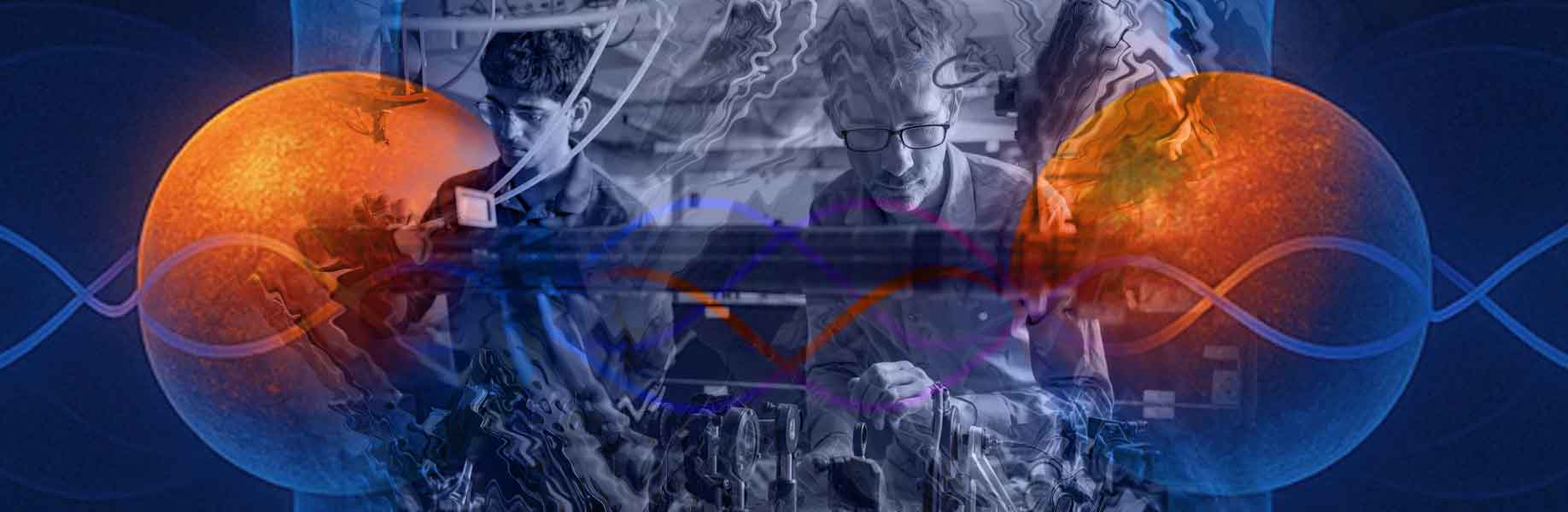

Scientists have shown for the first time that pairs of helium atoms can become entangled while moving through space. This result strengthens quantum theory and brings researchers closer to testing how quantum rules combine with gravity.
The experiment used helium atoms. Unlike earlier tests that used photons, these atoms have mass and therefore feel gravity. This difference is important because quantum mechanics and Einstein’s general theory of relativity, which describes gravity, do not yet fit together into one complete theory.
Bell inequality test is an experiment that checks whether particles show true quantum correlations that cannot be explained by ordinary local physics. In this study, researchers performed such a test on the momentum of moving helium atoms.
Atom entanglement breakthrough
Three clouds of cold helium atoms were held in a magnetic trap and then released to fall under gravity. Laser light created a standing wave that acted like a grating, causing some atoms to collide and exchange momentum. Because the density was very low, usually only one pair collided at a time. The colliding atoms became entangled in their momentum states, meaning their future paths were linked even though they ended up in different places.
The falling atom pairs then passed through additional laser gratings that created multiple possible paths, forming an interferometer. An interferometer is a device that splits and recombines waves or particle paths to measure tiny differences. Detectors recorded where the atoms landed, revealing strong correlations that passed the Bell inequality test. This proved the atoms were entangled in their external motion rather than just internal properties such as spin.
The results confirm that matter can exist in multiple places at once and interfere with itself over distance, just as quantum theory predicted a century ago. This research is published in Nature Communications.
Future experiments could place entangled atoms on different paths that experience slightly different gravitational effects. Such tests may eventually help scientists understand how quantum mechanics and gravity can be combined, moving closer to a unified theory of everything.