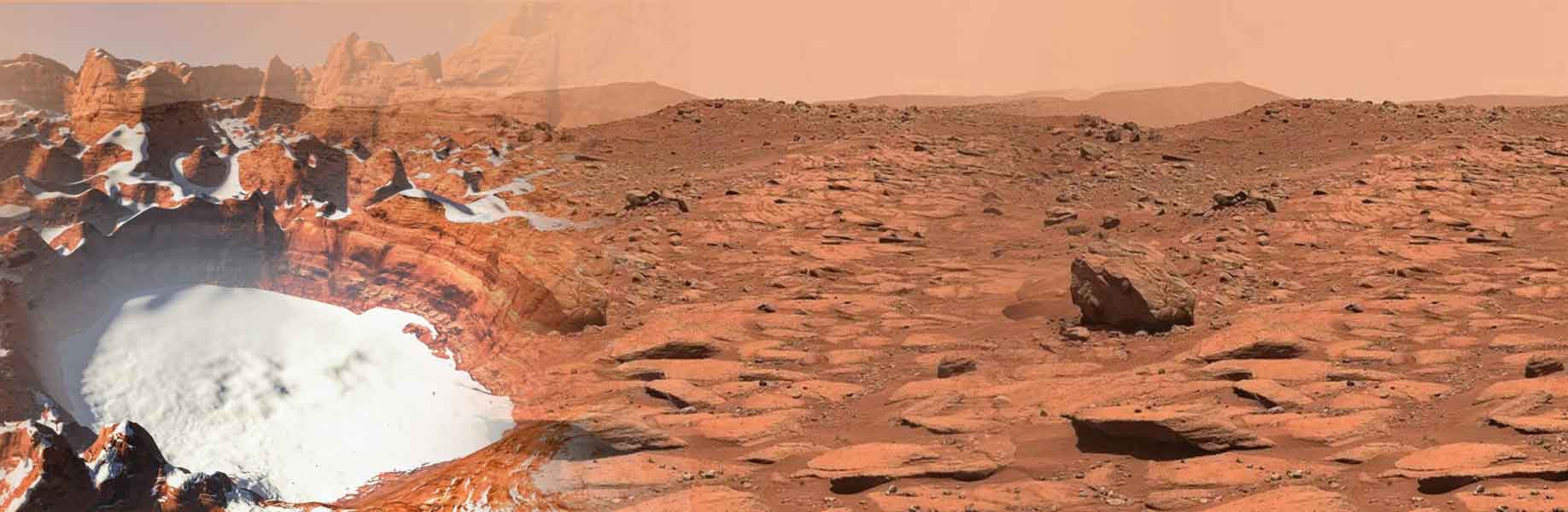

A new study suggests that signs of ancient life could be preserved in the ice deposits on Mars. These signs might be microbes, or their remains. Researchers recreated Mars-like conditions in a lab to test this. They used E. coli bacteria to see if proteins could survive. They specifically tracked amino acids, the building blocks that make up proteins. The study found these amino acids could remain intact for over 50 million years if they were protected in pure water ice. This survival is possible even with constant exposure to cosmic radiation, which is harmful energy from space. The study suggests that future missions looking for life should target locations with pure ice or permafrost (ground that stays frozen), rather than just studying rocks or soil.
This research is published in Astrobiology.
To test this, the research group suspended E. coli bacteria in two different solutions: one with pure water ice and another mixed with water and sediment, which is material like clay and rocks found on Mars. These samples were frozen to minus 60 degrees Fahrenheit, matching Mars's icy regions. The scientists then exposed the samples to high levels of gamma radiation to simulate 50 million years of cosmic rays on Mars.
The Search for Signs of Life
The analysis showed that in the pure water ice, many amino acids survived the 50-million-year simulation. In contrast, the samples containing Mars-like sediment degraded ten times faster, and the amino acids did not survive. This result was surprising, as a previous study had suggested ice might not be very protective. The researchers now believe that in solid ice, harmful particles created by radiation get frozen in place and cannot reach the organic compounds. In sediment, however, a film might form where ice touches minerals, allowing radiation to destroy the amino acids. This suggests pure ice is the ideal place to look for biological material. The experiment also tested the even colder temperatures found on Europa, an icy moon of Jupiter, and found they reduced the rate of decay even more. This finding is encouraging for NASA’s Europa Clipper mission, which is traveling to explore that moon.