For decades, physicists have treated the many-worlds interpretation of quantum mechanics as a one-way street. When a quantum system branches -- one outcome here, another there -- those branches are thought to part forever, sealed off by the same rules that keep cause and effect intact. According to a new theoretical study, that assumption may be wrong.
In a paper posted on the arXiv preprint server, Maria Violaris, a researcher at the University of Oxford, describes a protocol that allows information to be transferred between distinct branches of a quantum multiverse without violating standard quantum mechanics. The work suggests that, under carefully controlled conditions, a message created in one branch of reality can be received in another, even though no signal crosses between them in the usual sense.
The study’s core claim is that branch isolation is not absolute. With sufficient quantum control over observers themselves, information can be relocated across branches by swapping the observers who experience them. The result challenges long-standing assumptions about what decoherence truly forbids, and it reframes many-worlds quantum mechanics as a theory with more operational consequences than previously believed.
To be clear, the paper does not claim that people can communicate with alternate versions of themselves in everyday settings. Nor does it suggest faster-than-light signaling or violations of causality. Instead, it shows that the barrier between branches is contingent -- dependent on practical limits, not on a fundamental law of nature.
Wigner’s Friend
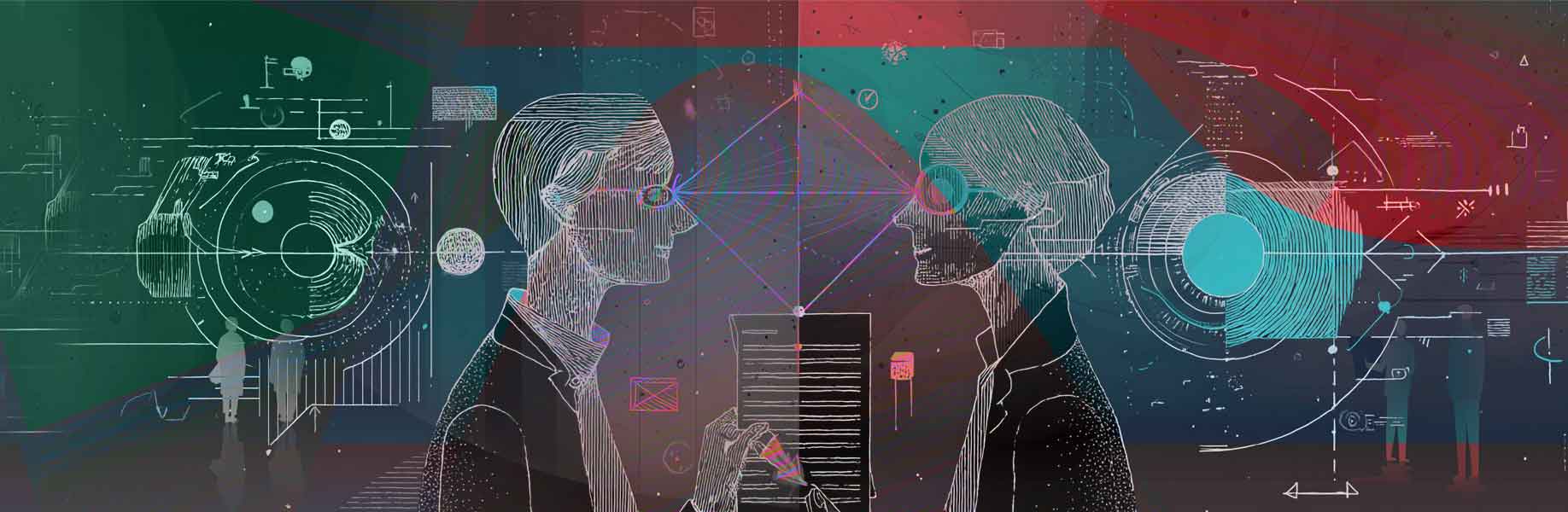
The study focuses on a classic thought experiment known as “Wigner’s friend,” in which one observer performs a quantum measurement inside a sealed lab while another observer, outside the lab, treats the entire setup -- including the first observer -- as a quantum system. This scenario has become a standard testing ground for debates about measurement, objectivity, and the meaning of quantum states.
In the Oxford paper, the outside observer -- traditionally called Wigner because physicist Eugene Wigner introduced the thought experiment -- is assumed to have full control over the laboratory and its contents. Inside the lab is the friend, who measures a quantum bit prepared in a superposition, causing the global system to split into two branches. In one branch, the friend sees outcome zero; in the other, outcome one.
The key step is when the friend in one branch writes a classical message -- a string of bits -- on a piece of paper. Before the branches are recombined or manipulated, the friend’s internal memory of the message is erased. This step preserves the reversibility required by quantum mechanics.
Wigner then applies a global operation that swaps the two branches’ observer states while leaving the paper untouched. After this operation, the branch that previously contained no message now contains the paper with the message written on it. The friend who reads the message never wrote it. The friend who wrote it no longer remembers doing so.
No information travels directly between branches. Instead, the observers are exchanged between them. From the perspective of each observer, information appears where it should not be -- yet the overall evolution remains linear, unitary and consistent with standard quantum theory.
This distinction matters because inter-branch communication has long been dismissed as impossible without modifying quantum mechanics. Earlier proposals for “Everett phones” -- hypothetical devices that allow branches to talk -- relied on nonlinear extensions of quantum theory. The new work shows that such communication, defined carefully, does not require exotic physics.
The implication is not that branches casually interact, but that the boundary between them is more subtle than previously assumed. Decoherence prevents branches from interfering under normal conditions, but it does not outlaw all global operations that relate them.
How the Protocol Works
On a more technical level, the protocol uses a small number of quantum subsystems: a measured qubit, a register that labels which branch the friend occupies, the friend’s physical state, a memory register and a piece of paper that stores the message.
After measurement, the system exists in a superposition of two branches, each with its own version of the friend. Only the friend in one branch writes the message. That message is copied to the paper and then removed from the friend’s memory through an “uncomputation” step, which is a standard technique in reversible computing.
The outside observer then applies a set of quantum operations that exchange the branch labels, the measured qubit states, and the friend’s physical configuration. The paper, which carries the message, is left alone.
Because the operation does not depend on the message’s content, it preserves the principle that no agent gains information they were not entitled to by quantum rules. The message ends up in the other branch not because it was sent, but because the observer who experiences that branch has changed places with another.
The distinction is not semantic, according to the study. If the friend were allowed to keep a memory of the message, the protocol would fail. The branches would no longer contain well-defined observers with distinct experiences. Memory erasure is not an optional detail; it is a necessary condition.
This constraint places sharp limits on what inter-branch communication can achieve. Messages can be transferred, but not retained symmetrically. No observer can both send and remember a message under message-independent control. The protocol moves information at the cost of personal continuity.
Challenging Conventional Wisdom
For many physicists, decoherence has served as the practical explanation for why quantum superpositions appear classical. Once systems interact with large environments, interference effects vanish, and branches evolve independently for all practical purposes.
The new work does not dispute decoherence’s effectiveness. However, it does point out that decoherence arguments typically assume that no one has coherent control over the decohered system. In Wigner’s-friend scenarios, that assumption is deliberately suspended.
If an observer can be treated as a quantum system -- and if an external agent can manipulate that system coherently -- then branch independence is no longer guaranteed. The branches still do not interfere in the usual way, but they can be related through controlled transformations.
This insight reframes decoherence as a statement about limitations, not absolutes. Branches are isolated because we cannot manipulate them, not because nature forbids it in principle.
That shift has consequences for how seriously many-worlds interpretations are taken as physical theories. If branches can participate in knowledge creation and information transfer under controlled conditions, then their status as real ontological things becomes a bit harder to dismiss.
Implications for Testing Quantum Interpretations
One of the paper’s most striking proposals involves what it calls a “knowledge paradox.” From the perspective of the friend who receives the message, new information appears on a blank page without any remembered cause.
If that information represents genuine knowledge -- such as a mathematical proof -- then its origin demands explanation. In a many-worlds framework, the explanation is straightforward: another observer in another branch created it.
In single-world interpretations, the explanation is less clear. If only one branch is physically real, then the appearance of knowledge without a creator becomes problematic.
According to the study, this asymmetry could, in principle, be used to distinguish many-worlds theories from rival interpretations that otherwise make identical predictions. Unlike earlier tests focused on wave-function collapse, this approach targets the reality of multiple observers themselves.
Whether such a test can ever be implemented remains uncertain. But the proposal reframes debates about interpretation as questions about knowledge, not just measurement outcomes.
Practical Limits and Experimental Prospects
Violaris is careful to note that the protocol’s requirements are extreme. Wigner must know, in detail, how the friend evolves in each branch, excluding only the message content. As the branches diverge over time, the operations needed to swap them become increasingly complex.
In simple toy models, the entire protocol can be implemented with a handful of quantum gates. Technically speaking, it could be simulated on today’s quantum computers using a small number of qubits. However, as the experiment moves toward more real-world implementations, it would quickly exceed current capabilities.
The work also raises questions about identity. For example, is the observer moved between branches, or are the branches relabeled around a fixed observer? At the level of abstraction used in the study, these interpretations are indistinguishable. That ambiguity is not a flaw; it is a feature of treating observers as quantum systems.
What Comes Next
The paper does not claim that experiments to test the idea are right around the corner. Its contribution is conceptual as it redraws the boundary of what standard quantum mechanics allows.
Future research may explore whether similar protocols exist under weaker assumptions, or whether partial versions can be implemented in laboratory settings involving quantum computers simulating observers. Others may investigate how the result interacts with alternative interpretations, including Bohmian mechanics.
Something to note: arXiv is a pre-print server, which allows researchers to receive quick feedback on their work. However, it is not -- nor is this article, itself -- official peer-review publications. Peer-review is an important step in the scientific process to verify results.