
This is a follow-up to “The pursuit of fusion energy is absolutely necessary” and in particular to its ending: “the vision is a compelling one, and establishes a direct link between the industrial development of the Moon and the pursuit of viable fusion energy.”
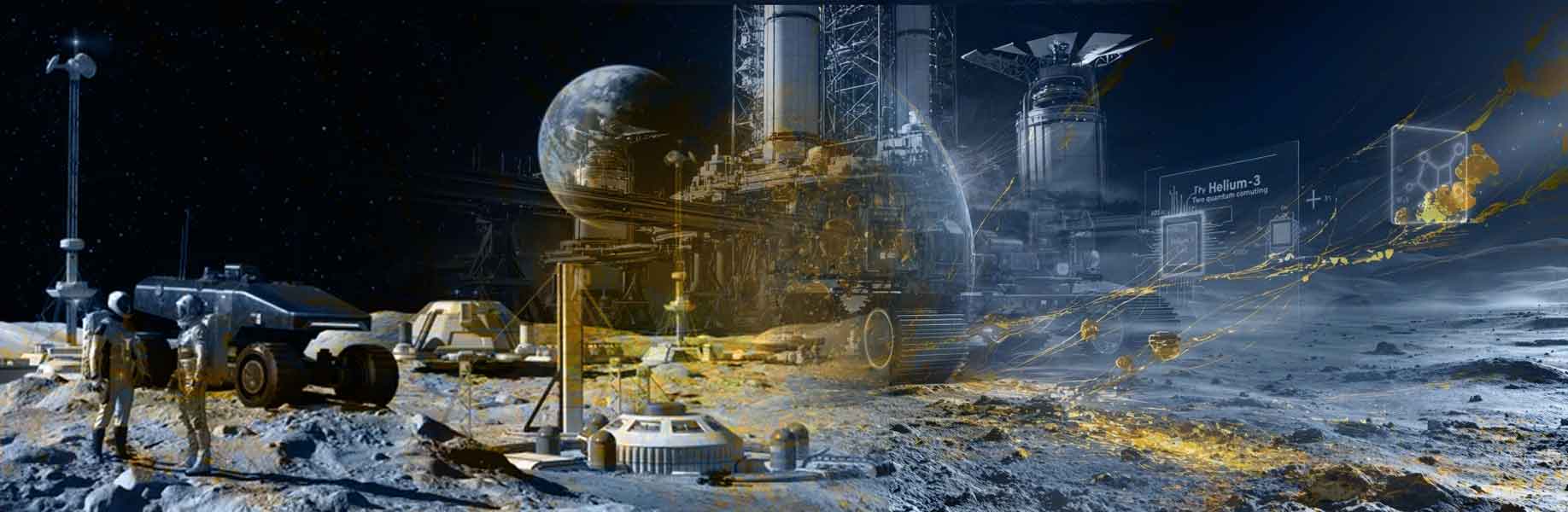
As global energy demand surges and fusion power edges closer to commercial reality, Helium-3 is emerging as a potential game-changer. Helium-3 (He-3), scarce on Earth but implanted in abundance by billions of years of solar wind on the Moon’s unprotected surface, promises cleaner nuclear fusion with minimal radioactive waste. Estimates suggest the Moon holds over a million tons of He-3 - enough to power humanity for millennia if harnessed efficiently. In 2026, the prospect of lunar mining is no longer science fiction: private companies are signing multimillion-dollar contracts, prototyping excavators, and launching prospecting missions, while governments advance lunar programs that could enable resource extraction.
The Science and Promise of Lunar He-3
Helium-3 fuses with deuterium (D-He3) in an aneutronic reaction, producing charged particles and energy that can theoretically be converted directly to electricity, bypassing the neutron bombardment that plagues deuterium-tritium (D-T) reactors. This reduces reactor damage, radioactive waste, and shielding needs, making it an attractive “Fusion 2.0.” On Earth, He-3 exists in trace amounts (mostly from tritium decay in nuclear stockpiles), priced at up to $20 million per kilogram. Lunar regolith contains it at parts-per-billion levels, but vast surface areas make extraction viable with large-scale processing - typically heating regolith to release volatiles, then separating the gas.
Near-term demand already drives interest: He-3 cools dilution refrigerators for quantum computers to near-absolute zero. Long-term, it could fuel fusion plants. Private fusion leader Helion Energy achieved a major milestone in February 2026 with its Polaris prototype - the first privately funded machine to demonstrate measurable D-T fusion and reach 150 million °C plasma temperatures. Helion plans to transition to D-He3 for commercial operations (targeting net electricity by 2028), noting that some He-3 can be bred from deuterium-deuterium side reactions, but lunar supply would enable scaling.
Private Initiatives Accelerate
The private sector is leading the charge. Seattle-based Interlune, co-founded by former Blue Origin president Rob Meyerson, chief architect Gary Lai, and Apollo 17 astronaut/geologist Harrison “Jack” Schmitt, has emerged as one of the frontrunners. Schmitt, the only geologist to walk on the Moon, wrote a book titled, “Return to the Moon” (2006), which laid the early foundation for the Interlune business plan. Schmitt developed a comprehensive end-to-end plan for mining helium-3 on the Moon and shipping it to the Earth to power next-generation nuclear fusion reactors.
In 2025–2026, Interlune unveiled a full-scale lunar excavator prototype (developed with Vermeer) capable of harvesting regolith at high rates with 10x less power than prior designs. It has inked landmark offtake agreements, including with Finnish cryogenics giant Bluefors for up to 10,000 liters of lunar He-3 annually starting 2028 (valued above $300 million). Bluefors would use the He-3 to cool quantum computers (another important application). Interlude also has deals with Maybell Quantum Industries, the U.S. Department of Energy, and NASA.
Interlune’s first mission, Crescent Moon, targets summer 2026: a multispectral camera payload on Astrolab’s FLIP rover to the lunar south pole’s Nobile region to map He-3 concentrations. Follow-on plans include resource return by 2028–2029. The company emphasizes low-power, dust-mitigating tech and a reusable cargo capsule for frequent Earth deliveries.
Interlude’s plans are covered in a recent Scientific American article titled “The next quantum revolution may require a helium ‘gold rush’ on the moon.” The article emphasizes the value of He-3 as “superlative coolant” for quantum computers, which is a proven application, but notes that He-3 “holds promise as a clean fuel for future fusion reactors.”
Lunar Helium-3 Mining, LLC (LH3M) holds patents covering end-to-end He-3 detection, extraction, and refinement using non-invasive lunar-suited methods. LH3M focuses on fusion reactors and quantum markets, positioning itself as the U.S. leader in scalable supply.
Other players include Black Moon Energy Corporation (BMEC), preparing a robotic expedition for high-resolution He-3 mapping and core samples, and Magna Petra, which received a “Lunar Game Changer” award.
Government Programs Fuel the Momentum
Governments are laying infrastructure groundwork. NASA’s Artemis program, via Commercial Lunar Payload Services (CLPS) and Artemis Accords, promotes in-situ resource utilization (ISRU) and private partnerships—explicitly enabling He-3 tech demos. NASA Administrator Jared Isaacman has highlighted He-3’s role in long-term lunar permanence.
China’s lunar program is equally ambitious. Chang’e-6’s 2024 far-side sample return included He-3 data, aiding reserve estimates that Beijing calls a “future energy source.” Chang’e-7 (launching mid-2026) will target south pole resources, including volatiles, as a stepping stone to the International Lunar Research Station (ILRS) with Russia, eyed for the 2030s. Crewed landings by 2030 and resource utilization are priorities.
ESA has long studied He-3 conceptually as a clean fusion fuel, while other nations (India, Russia) integrate it into broader exploration. Legal frameworks remain nascent: the Artemis Accords support responsible extraction, contrasting with the Sino-Russian ILRS approach, raising questions of ownership and “space gold” conflicts.
Challenges and Realistic Prospects
Extraction remains daunting: regolith must be processed in massive volumes at low concentrations, with dust, low gravity, and thermal extremes complicating operations. Return costs via commercial landers (SpaceX Starship, Blue Origin) must drop dramatically for profitability. A 2026 study models mining footprints under various demand scenarios, underscoring scalability needs.
Fusion viability is another hurdle. D-He3 requires higher temperatures than D-T; while Helion advances, commercial plants are years away. Critics note that D-D breeding could reduce lunar dependency. Yet quantum demand provides a bridge market, with prices justifying early missions.
Optimists see lunar He-3 as the “tip of the spear” for a trillion-dollar space economy - catalyzing infrastructure, jobs, and sustainable energy. Pessimists warn of overhyping timelines. By 2030s, pilot returns could prove economics; full-scale mining might follow if fusion scales.
In 2026, the Moon is a strategic resource frontier. With private contracts signed, prototypes rolling, and missions imminent, lunar Helium-3 mining could soon become a reality. Whether it powers the next energy revolution depends on many factors - but the race is on, promising cleaner power and a multi-planetary future.