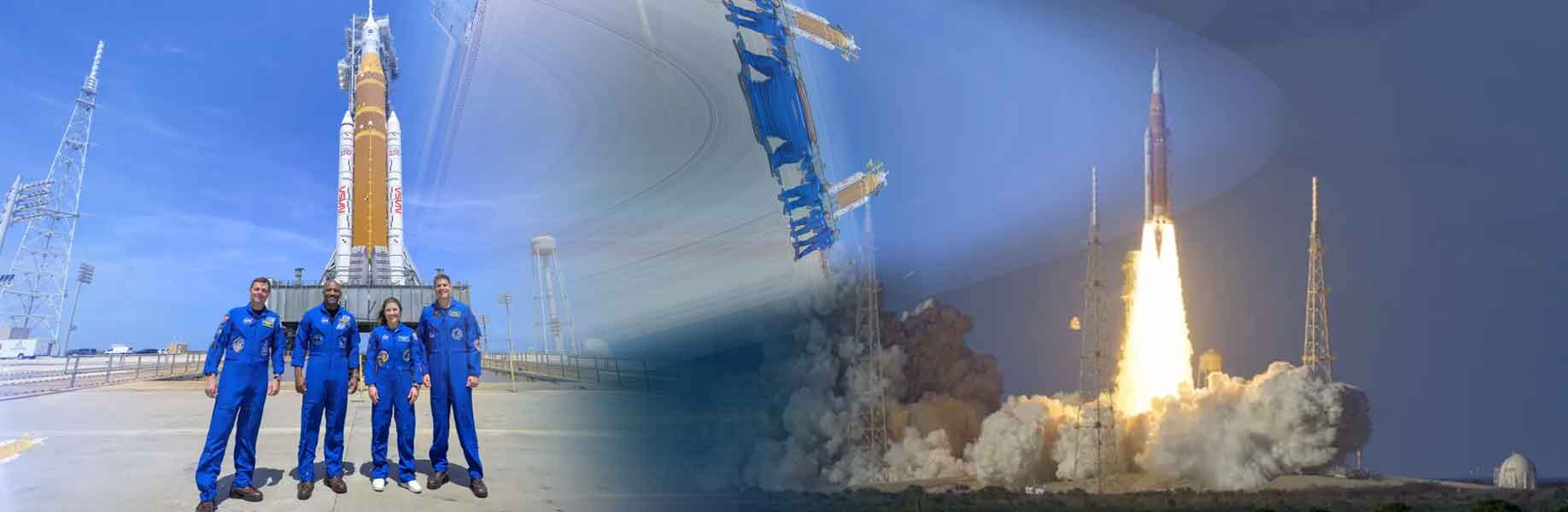

NASA has successfully launched Artemis II, the first crewed mission to travel around the Moon in more than 50 years. Aboard the Orion spacecraft are four astronauts: NASA’s Reid Wiseman, Victor Glover, and Christina Koch, plus Canadian Space Agency astronaut Jeremy Hansen. The mission tests key systems and prepares for future landings on the Moon.
The powerful rocket carried the crew into space. Shortly after launch, Orion deployed its solar array wings to gather energy from the Sun. Engineers on the ground and the astronauts began checking the spacecraft’s systems. About 49 minutes into the flight, the rocket’s upper stage fired to place Orion into an elliptical orbit around Earth. A later burn sent the spacecraft, named Integrity by the crew, into a high Earth orbit reaching about 46,000 miles from the planet. Orion then separated from the upper stage and flew on its own.
Progress of the test flight
In the coming hours, the upper stage will release four small satellites that will carry out scientific studies and technology tests. The crew will stay in high Earth orbit for about a day and perform a manual piloting test. If all systems work well, controllers will command the European-built service module to perform a translunar injection burn. This roughly six-minute engine firing will send Orion on a path around the Moon. Lunar gravity will then help slingshot the spacecraft back toward Earth.
During the multi-hour lunar flyby planned for April 6, the astronauts will become the first people in decades to see parts of the Moon’s far side. They will take photographs and note surface details, such as ridges and craters, that appear clearer in partial shadows. The crew will also gather data on human health during deep-space travel. After the flyby, Orion will return to Earth and splash down in the Pacific Ocean. The roughly 10-day mission demonstrates life-support systems with people aboard and builds knowledge for longer stays on the Moon and eventual trips to Mars.
This flight marks an early step in NASA’s Artemis program, which aims to establish a lasting human presence on the Moon and support future exploration deeper into space.