

How to return to the Moon sustainably, how to establish a permanent US presence on the lunar surface, and how to beat China in this new race to the Moon, and NASA leadership, continues to be intensely debated in the US. This post chronicles some recent twists and turns of the overall story.
Former NASA leaders urge shift from Starship for Artemis 3 to counter China
Two former NASA administrators, Charlie Bolden and Jim Bridenstine, voiced strong concerns over NASA's reliance on SpaceX's Starship for the Artemis 3 crewed lunar landing, SpaceNews reported (open copy). At a symposium, hey argued that the current architecture jeopardizes the U.S. goal of returning humans to the Moon before China's anticipated crewed mission later this decade, calling for an immediate pivot to alternative strategies.
Bridenstine, who served as NASA administrator under the first Trump administration, stated that the probability of beating China with the Starship-dependent plan "approaches zero, rapidly," emphasizing the need for a drastic change. Having previously criticized the approach in a September Senate hearing without proposing alternatives, Bridenstine now endorsed Acting Administrator Sean Duffy's recent decision to "open up" SpaceX’s Artemis 3 contract. He praised Duffy's move as "the absolute right thing" and advocated for accelerating an alternative lander through extraordinary measures.
Bridenstine clarified that his critique targeted the timeline, not Starship itself, which he described as a "tremendously important vehicle" for future low Earth orbit operations, cost reduction, and increased access. However, he noted that adapting it for lunar landings would take too long to outpace China.
Bolden, NASA's leader during the Obama administration, shared similar skepticism. He expressed surprise at the Artemis architecture, questioning how NASA reverted to a plan requiring up to 11 launches - primarily for Starship's in-orbit refueling - to land one crew. "We’re never going to get there," he asserted, doubting the feasibility of achieving a landing by the end of President Trump's term or before China's 2030 target. Bolden urged realism, arguing that rigid deadlines like beating China or completing the mission within the term hinder industry progress. He added that it might be acceptable for China to land first, as long as the U.S. arrives in 2031 with a superior, more sustainable system.
The symposium discussions extended to potential alternatives. Blue Origin's Blue Moon Mark 1 uncrewed lander is set for an imminent flight. This smaller design, which could be adapted for astronauts, avoids in-space propellant transfer, offering an "incremental approach" for acceleration.
Lockheed Martin proposed a two-stage lander that could include a descent module left on the surface (potentially repurposed for lunar bases) and a reusable ascent stage returning astronauts to Orion. While Starship remains vital long-term, alternatives like those from Blue Origin and Lockheed Martin could provide a faster path, potentially reshaping Artemis priorities.
SpaceX proposes simplified Artemis architecture
Meanwhile SpaceX announced it is developing a "simplified" mission architecture for NASA's Artemis program, aimed at enabling a faster lunar landing while enhancing crew safety, SpaceNews reported (open copy).
SpaceX staunchly defended the original Starship-based plan as the most efficient route to returning humans to the Moon and supporting long-term sustainability. "Starship continues to simultaneously be the fastest path to returning humans to the surface of the moon and a core enabler of the Artemis program’s goal to establish a permanent, sustainable presence," the statement read.
The company highlighted significant achievements under its Human Landing System (HLS) contract, having completed 49 milestones related to subsystems like landing legs, docking adapters, and Raptor engine testing. It claimed the "vast majority" were met on or ahead of schedule.
Despite these successes, SpaceX acknowledged setbacks in key demonstrations. Earlier NASA expectations for an in-orbit propellant transfer test between Starships this year have been delayed. Lori Glaze, NASA's acting associate administrator for exploration systems, noted in July that the milestone was "slipping." SpaceX confirmed the next major HLS-tied flights - a long-duration orbital test to validate systems and the propellant transfer demo involving two Starships docking - are now targeted for 2026. Timing depends on progress with the upcoming Starship V3 architecture during forthcoming flight tests.
Moonbase Alpha
Then Elon Musk posted: "Starship will build Moonbase Alpha."
In an update titled "To the Moon and beyond," SpaceX declared that Starship "will be a central enabler that will fulfill the vision of NASA’s Artemis program, which seeks to establish a lasting presence on the lunar surface, not just flags and footprints, and ultimately forge the path to land the first humans on Mars."
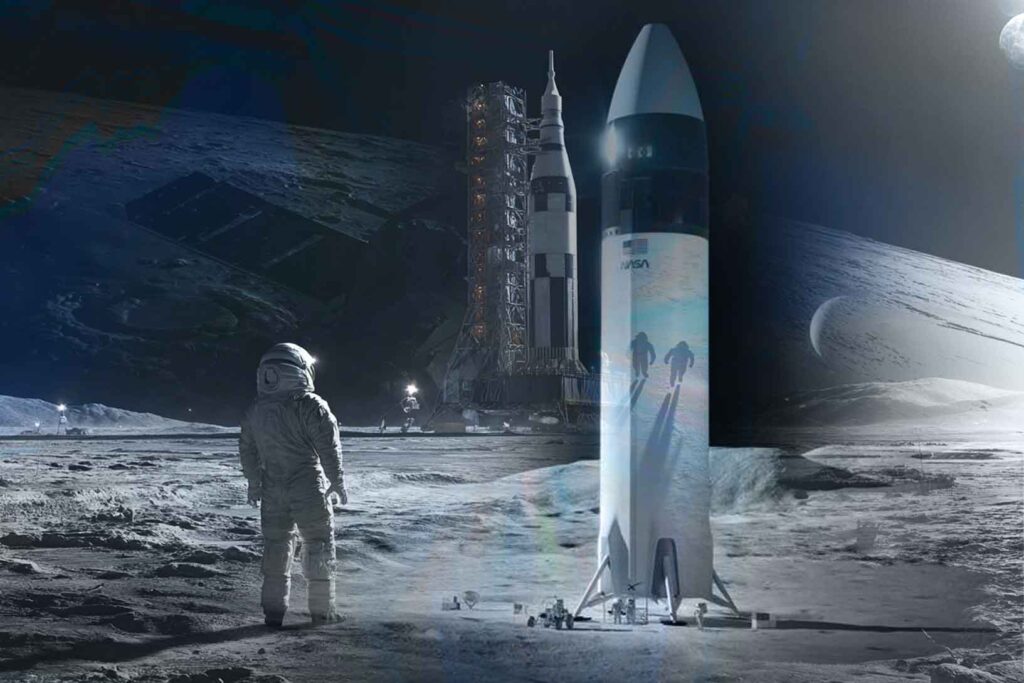
Starship offers over 600 cubic meters of pressurized volume - equivalent to two-thirds of the ISS - with scalable cabins, dual airlocks (each 13 cubic meters, twice the size of Apollo's lunar module), and cargo capacity up to 100 metric tons for rovers, reactors, and habitats. This will enable the development of a sustainable Moonbase.
Development follows two parallel paths. Path 1 focuses on the core Starship system, self-funded at over 90% by SpaceX. Path 2 advances the Human Landing System (HLS lander) under a fixed-price NASA contract, with payments tied to milestones.
SpaceX will build an HLS cabin for integrated testing and training. A long-duration orbital test will assess propulsion and thermal behavior, followed by ship-to-ship rendezvous.
In a video, popular spaceflight commentator Everyday Astronaut went over SpaceX's update in detail. The update is likely a reply to interim NASA Administrator Sean Duffy's call to broaden the competition for a human landing system on the Moon, Everyday Astronaut said.
Isaacman's plan
A 62-page policy document titled "Athena" outlines what Jared Isaacman would have done if confirmed as NASA administrator, Ars Technica's Eric Berger reported. Originally drafted in early 2025 after Isaacman's nomination, the document was shared in August with Duffy, as a courtesy following the withdrawal of Isaacman's nomination in May for political reasons.
The leak seems orchestrated by Duffy to secure his position or derail Isaacman's potential renomination, amid reports that Trump is reconsidering him, said Berger. Legacy aerospace contractors also disseminated the document to safeguard their interests. Sources indicated Duffy shared the document with traditional aerospace contractors.
Berger said that he has seen the document, which advocates refocusing NASA on ambitious goals: achieving the "near impossible" in human exploration, boosting the space economy, and amplifying scientific impact. It proposes scrutinizing expenditures, shifting from cost-plus contracts for SLS and Orion, and leveraging the broader commercial sector (including Blue Origin, not just SpaceX) to maximize public funds and maintain U.S. leadership over rivals.
The plan aligns with Trump priorities, Berger said, and the leaks highlight Duffy's efforts to paint Isaacman as a disruptive Musk ally, and extend his interim role through key milestones like the 2026 Artemis II mission.
Isaacman renominated!
Then Trump renominated Isaacman to lead NASA!
"I truly believe the future we have all been waiting for will soon become reality," Isaacman posted.
In another post, he clarified that "Athena was a draft plan I worked on with a very small group from the time of my initial nomination through its withdrawal in May. Parts of it are now dated, and it was always intended to be a living document."
What I hope to see
I agree with Bolden: it is no big deal if China to land on the Moon first. Even more, to me which nation lands on the Moon first in this century and which nation leads the settlement of the Moon is totally irrelevant. The space expansion enterprise belong to humanity as a whole.
I hope Isaacman will be confirmed as NASA leader and get the chance to make the future we have all been waiting for come true.
I never liked too much the idea of using Starship as a lunar lander for astronauts brought to lunar orbit by the Space Launch System (SLS) and Orion. It sounds too complicated to me. Also, Starship is meant to be eventually able to perform crewed lunar missions alone, including launch and transport to lunar orbit. I hope SpaceX will get the chance to perfect Starship and eventually become the main system used for future missions to the Moon and then to Mars. Meanwhile, I think considering alternative lunar landing systems for Artemis 3 wouldn't be a bad idea.