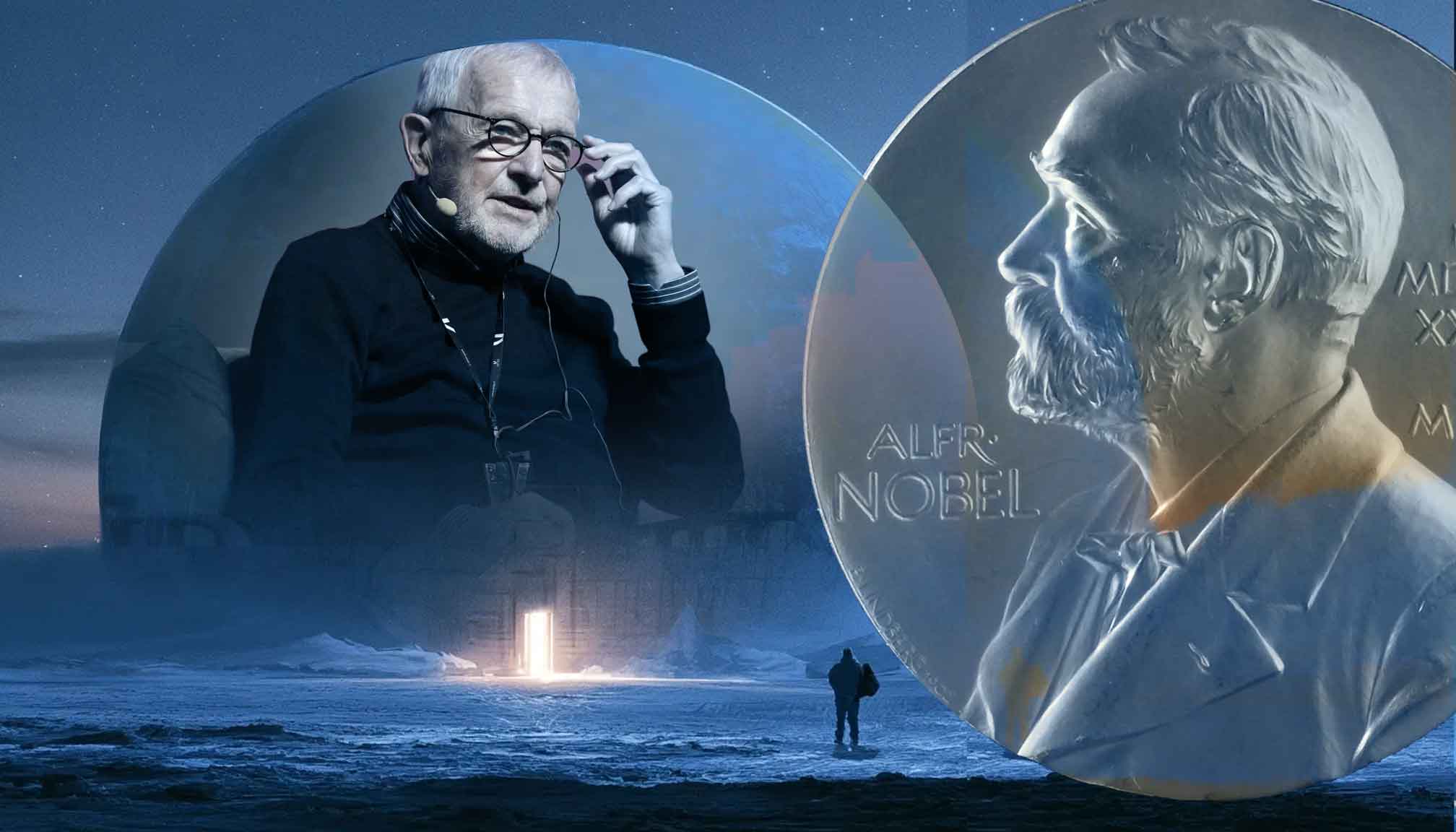


The 2026 Nobel Prize in Physics has been awarded to Francis Halzen, principal investigator of the IceCube Neutrino Observatory, for decisive contributions to the development of the observatory and the discovery of high-energy neutrinos of astrophysical origin.
Halzen proposed and proved that ice could be used as a detection medium for high-energy astrophysical neutrinos. A neutrino is a subatomic particle that has almost no mass and no electric charge, allowing it to travel through space and matter with barely any interaction. High-energy neutrinos originate from powerful cosmic events and carry information about distant parts of the universe. Halzen was a driving force behind forming the international collaboration and establishing the IceCube observatory at the South Pole.
What the observatory does
The IceCube Neutrino Observatory consists of a cubic kilometer of instrumented pristine glacial ice, making it one of the largest scientific instruments ever built. When neutrinos pass through the ice and collide with atoms, they produce flashes of light that IceCube's sensors can detect. This allows scientists to trace the particles back to their cosmic sources. The international collaboration includes approximately 450 scientists from 58 institutions in 14 countries.
IceCube discovered astrophysical neutrinos in 2013, marking the first detection of these particles from beyond our solar system. Since then, the collaboration has identified neutrino emission from two specific galaxies: TXS 0506+056 and NGC 1068, also known as Messier 77. In 2023, IceCube announced the discovery of neutrinos from our own galaxy, the Milky Way. These detections confirm that neutrinos can be used to study the universe alongside traditional observations of light.
The IceCube Upgrade was installed in 2025–2026 to improve the observatory's sensitivity and calibration. Looking ahead, the proposed IceCube-Gen2 would expand the detection volume by a factor of eight and incorporate radio detection techniques to observe even higher energy neutrinos.
This award recognizes the creation of a new field of astronomy. Neutrino astronomy represents a fundamentally different way of observing cosmic phenomena because neutrinos travel unimpeded through dust, gas, and other matter that blocks light. The success of IceCube demonstrates that bold scientific concepts can yield transformative discoveries when pursued with sustained international effort.