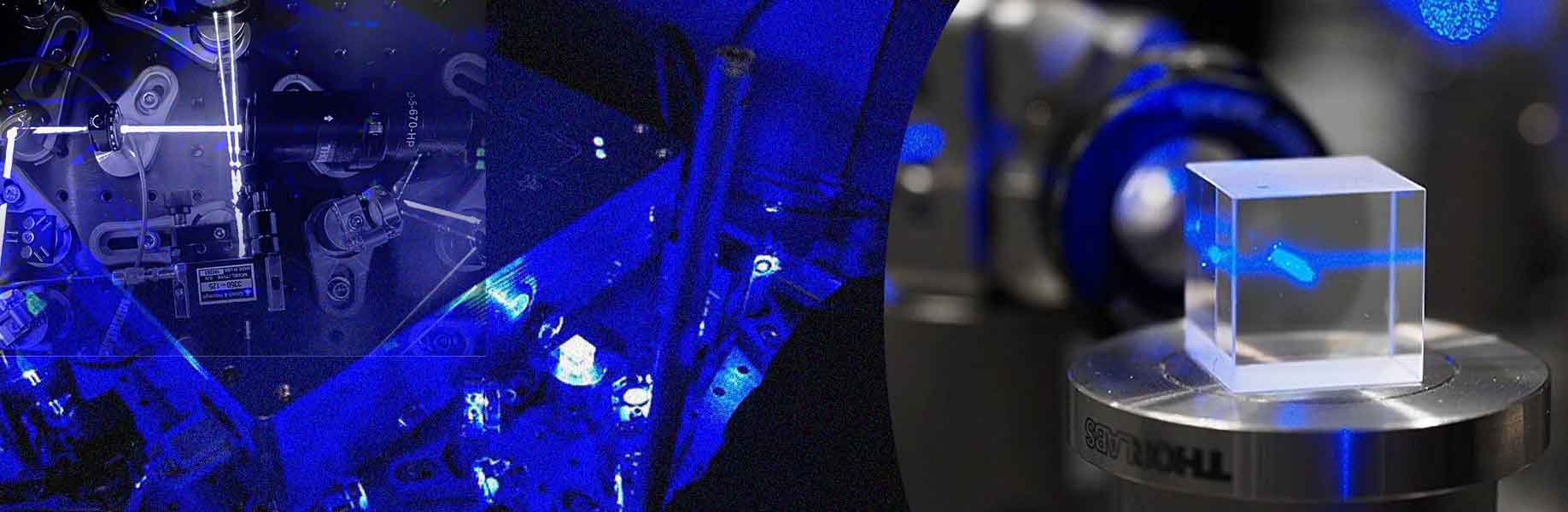

Scientists in the UK have made important progress toward building large quantum sensors that could one day detect very faint signals from the early universe. Researchers led by Imperial College London built a prototype that proves a key technique for these sensors works in realistic conditions.
The method uses two atom interferometers, which are devices that employ lasers to split and recombine clouds of atoms and thereby measure tiny changes in their motion with high precision. By comparing the two interferometers controlled by one laser, common phase noise (fluctuations in the laser light) from the laser can be cancelled. Without this step the laser disturbances would completely obscure the effects being studied. This cancellation makes it possible to recover useful information even when individual measurements are dominated by noise. The technique could enable detection of gravitational waves from the early universe and signs of unusual dark matter.
Testing the noise cancellation method under difficult conditions
To demonstrate the principle, scientists created a small prototype with two separated clouds of ultracold strontium-87 atoms interrogated by a single stable laser. The atoms were cooled to extremely low temperatures to allow precise quantum behavior. The setup mimicked the noise challenges expected in larger detectors. Extra phase noise was added deliberately to overwhelm each interferometer individually, erasing the patterns needed for measurement. Despite this, comparing the two devices cancelled the shared noise and revealed a clear signal. The combined measurement reached the fundamental precision limit set by quantum physics. An additional oscillating signal, simulating effects from a gravitational wave or dark matter field, was also recovered clearly through the comparison even though it was undetectable in either device alone.
These results give the first experimental confirmation that the noise-cancellation approach functions as required for future large-scale detectors. This validation removes a major technical obstacle that had stood in the way of scaling up the technology. Plans involve possible facilities at major laboratories such as CERN and Fermilab. If successful, such sensors could open new windows on the universe by exploring gravitational wave frequencies and searching for new forms of matter that current instruments cannot access.
This research is published in Nature.