
Webb Telescope Discovers Earliest Star Explosion, Rewriting Cosmic Timeline. In a landmark discovery, the James Webb Space Telescope has identified the most distant and earliest supernova ever observed, a star that exploded when the universe was a mere 730 million years old. This finding, announced by an international team of astronomers, breaks the telescope's own previous record by nearly one billion years and opens a new window into the universe's formative era.
The event began with a powerful 10-second flash of gamma rays, first detected by the Franco-Chinese SVOM satellite on March 14, 2025. A rapid, global observing campaign involving multiple telescopes pinpointed the source's extreme distance, leading researchers to request urgent follow-up with Webb. As the universe's expansion stretches light, it also slows the apparent passage of time from our perspective. Knowing this, astronomers used Webb's unmatched infrared sensitivity to observe the region on July 1, successfully capturing the supernova at its predicted peak brightness three and a half months after the initial burst.
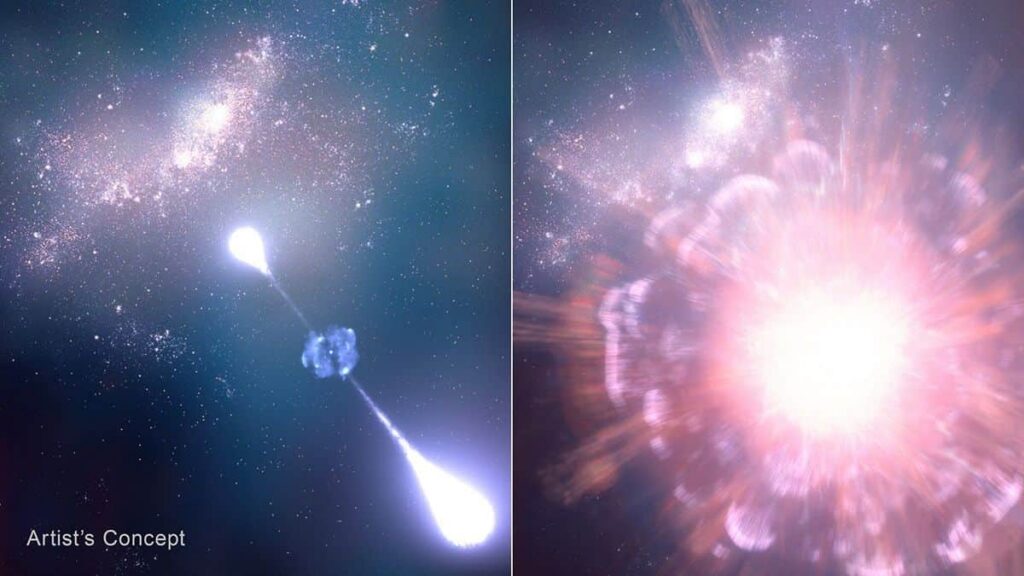
The data yielded two major surprises. First, despite originating from one of the first generations of stars, which theorists believed were fundamentally different, this ancient supernova bears a striking resemblance to modern stellar explosions. Second, Webb's sharp vision detected the supernova's faint, reddened host galaxy—a first for an event so remote—revealing it to be typical for galaxies of that early epoch.
"This observation demonstrates that we can use Webb to find individual stars when the universe was only 5% of its current age," said lead author Andrew Levan. The discovery, published in Astronomy and Astrophysics Letters, not only sets a new cosmic record but also proves Webb's unique power to witness and study the violent deaths of the universe's earliest stars.